



 For all latest news, follow the Daily Sun's Google News channel.


Setting up an independent asset management company to take over distressed loans, distinguishing genuine struggling businesses from wilful defaulters, and ensuring strict legal action against those involved in loan fraud are among the major reforms experts have proposed to tackle Bangladesh's deepening banking crisis.
They say repeated loan rescheduling, restructuring, interest waivers and special repayment facilities have failed to bring down non-performing loans (NPLs). Instead, such concessions have weakened repayment discipline, allowing influential borrowers to evade their obligations while the burden of unpaid loans continues to grow.
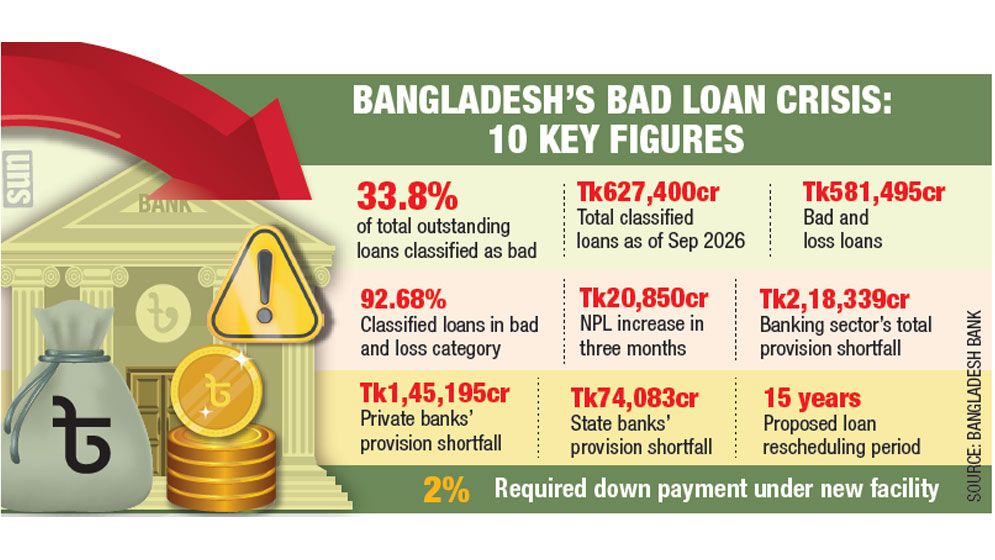
According to Bangladesh Bank data, classified loans reached approximately Tk627,400 crore at the end of September, accounting for 33.8% of total outstanding loans. Of these, Tk581,495 crore, or 92.68%, were categorised as bad and loss loans, indicating limited prospects of recovery.
Classified loans increased by around Tk20,850 crore in just three months, while total outstanding loans grew by only Tk5,600 crore during the same period.
The banking sector is also facing a massive provision shortfall. Against a requirement of Tk4,82,520 crore, banks had set aside Tk2,64,182 crore, leaving a deficit of Tk2,18,339 crore.
State-owned commercial banks accounted for Tk74,083 crore of the shortfall, while private commercial banks faced a deficit of Tk1,45,195 crore. Foreign banks, in contrast, maintained a provision surplus of Tk967 crore.
Dr Zahid Hussain, former lead economist of World Bank’s Dhaka office, said Bangladesh Bank's accommodative policies had failed to contain bad loans. Rather, repeated concessions over the years had further deepened the problem.
He stressed the need for stronger corporate governance, effective regulatory oversight and accountability to restore discipline in the banking sector.
Toufic Ahmad Choudhury, former director general of the Bangladesh Institute of Bank Management (BIBM), said the current government was also following the old approach to tackling defaulted loans.
Under a Bangladesh Bank initiative to restructure large defaulted loans, borrowers have been offered the opportunity to reschedule their loans over 15 years with a down payment of just 2%. Previously, borrowers had to pay 10% for their first rescheduling, while loans could not be rescheduled more than twice.
Independent asset management company proposed
Experts say Bangladesh needs to move beyond repeated concessions and adopt a more comprehensive approach to managing distressed assets. One major proposal is to establish an independent asset management company to purchase bad loans from banks and pursue their recovery, restructuring or sale.
International experience, particularly that of South Korea and Malaysia, offers useful lessons in this regard.
Following the Asian financial crisis of 1997, South Korea established the Korea Asset Management Corporation (KAMCO) to address a sharp rise in non-performing loans.
The institution purchased distressed loans from banks at discounted prices and assessed borrowers' assets, collateral and business prospects before pursuing recovery, restructuring or asset sales.
The government also restructured and merged weak banks and injected capital into viable institutions. This helped banks reduce the burden of legacy bad loans and concentrate on fresh lending.
Malaysia adopted a similar institutional approach following its 1998 financial crisis, establishing three specialised bodies to address the problem.
Danaharta took responsibility for managing non-performing loans and collateral, while Danamodal provided capital support and helped restructure weak banks. The Corporate Debt Restructuring Committee (CDRC) facilitated negotiations between lenders and borrowers to revive struggling businesses.
Businesses with viable prospects were given opportunities to resume operations, while stricter measures were pursued against wilful defaulters.
Thailand also introduced out-of-court settlements, specialised debt restructuring mechanisms and asset disposal arrangements. Japan and Sweden, meanwhile, relied on insolvency and liquidation proceedings for businesses deemed financially unviable after assessing their repayment capacity.
The common lesson from these experiences is that viable businesses should be given opportunities to recover, while unviable borrowers and wilful defaulters should face appropriate recovery and legal measures instead of receiving repeated concessions.
Mustafa K Mujeri, former chief economist of Bangladesh Bank, said the country could establish an independent asset management company modelled on South Korea's KAMCO and Malaysia's Danaharta.
The proposed institution could purchase bad loans from banks through a transparent valuation mechanism and subsequently recover, restructure or sell the distressed assets to realise outstanding debts.
However, he cautioned that transparency and accountability would be essential to prevent the proposed institution from becoming another avenue for financial irregularities.
Banks must not be allowed to exploit political influence to sell bad loans to the institution at inflated prices. Independent audits should be mandatory to establish the actual value of loans and collateral, he told the Daily Sun.
Genuine borrowers need support, defaulters face action
Experts also stress the need to distinguish between genuine borrowers struggling with business difficulties and wilful defaulters who deliberately evade repayment.
Zahid Hussain said the first category included business owners who had failed to repay loans because of circumstances beyond their control, including the global economic slowdown, dollar shortages and rising energy and raw material costs.
The second category comprised wilful defaulters who allegedly secured loans through political influence or collusion with bank officials and subsequently diverted the funds elsewhere.
For genuine businesses, he recommended loan restructuring, bringing in new investors, converting debt into equity and facilitating out-of-court settlements based on commercial viability.
Such support, however, should be conditional on a thorough assessment of borrowers' financial positions, business prospects and realistic repayment plans.
Wilful defaulters, by contrast, should not receive special concessions. Their assets must be identified, allegedly siphoned-off funds traced, collateral seized and legal proceedings expedited.
Bank officials and directors involved in facilitating loan fraud must also be held accountable, he said.
Faster legal action crucial for loan recovery
Prolonged legal proceedings remain another major obstacle to recovering defaulted loans. Cases filed with Artha Rin Adalats (money loan courts) often remain unresolved for years, preventing banks from selling collateral and recovering outstanding debts.
During this period, the value of collateral may decline, while borrowers may transfer assets to other individuals, further complicating recovery efforts.
Experts have called for special benches in Artha Rin Adalats, digital case management systems and specific deadlines for disposing of cases.
They also stressed the need to strengthen legal provisions to facilitate the swift seizure of assets and prevent defaulting borrowers from transferring properties to evade repayment.
They further emphasised stronger supervision of banks, effective monitoring of large loans and accountability of bank management and directors to prevent fresh irregularities.
Without a combination of institutional reform, effective loan recovery, legal enforcement and accountability, experts warn, repeated concessions will continue to undermine repayment discipline without resolving the banking sector's bad loan crisis.