



 For all latest news, follow the Daily Sun's Google News channel.


BPC to import Tk8,010cr fuel in H1 2027
Daily Sun Report, Dhaka
Published: 27 Nov 2026, 12:00 AM
The government has approved the import of 625,000 tonnes of petroleum products worth Tk8,010.14 crore to meet domestic fuel demand during the first half of 2027.
The imports will be made through international open tenders by the Bangladesh Petroleum Corporation (BPC) under four packages.
The decision was taken at a meeting of the Cabinet Committee on Government Purchase, chaired by Finance Minister Amir Khosru Mahmud Chowdhury on Wednesday. The Ministry of Finance disclosed the decision on Thursday.
The approved imports comprise 150,000 tonnes of diesel, 350,000 tonnes of furnace oil and 125,000 tonnes of octane.
Singapore-based Trafigura Pte Ltd has been selected to supply petroleum products under three packages, while Unipec Singapore Pte Ltd will supply octane.
Under package PG-03, Trafigura will supply 60,000 tonnes of diesel at Tk960.41 crore, with a premium of $16.93 per barrel. It emerged as the lowest bidder among three technically qualified companies.
Under package PG-04, the company will supply another 90,000 tonnes of diesel at Tk1,444.97 crore, with a premium of $17.45 per barrel. Trafigura was selected as the lowest bidder among four technically qualified companies out of five bidders.
Under package PG-05, Trafigura will supply 350,000 tonnes of high-sulphur furnace oil at Tk3,493.61 crore, with a premium of $69.82 per barrel.
Meanwhile, Unipec Singapore will supply 125,000 tonnes of gasoline 95 unleaded, commonly known as octane, under package PG-06 at Tk2,111.14 crore, with a premium of $17.36 per barrel.
According to the BPC, half of the country’s petroleum imports are procured through government-to-government (G2G) arrangements, with the remainder sourced through international open tenders.
The corporation plans to import 6.67 million tonnes of petroleum products in 2027, equally divided between the two procurement methods.
The expenditure will be met from the BPC’s own budget and revenue from petroleum sales, alongside loans from other sources. Applicable customs duties, VAT and advance income tax will be paid separately.
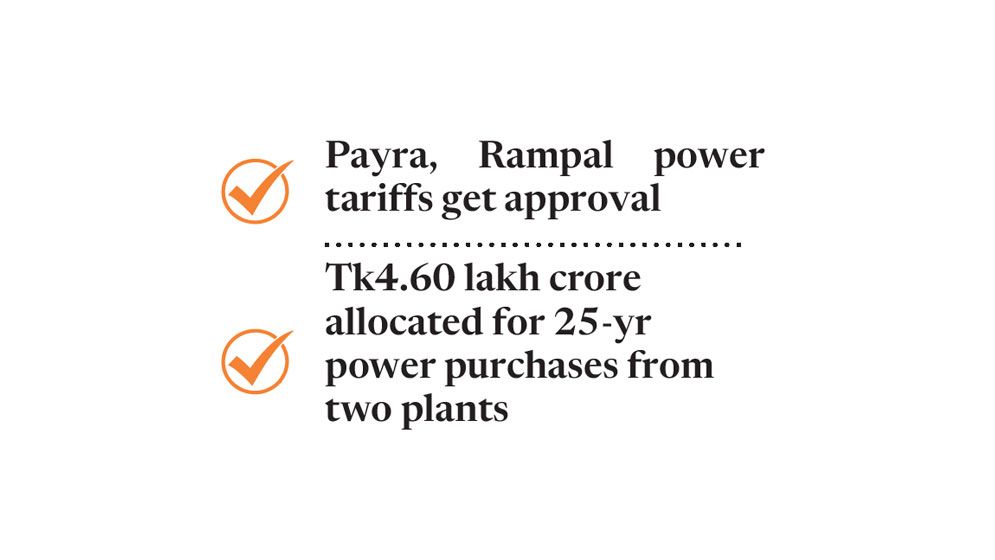
Tk4.60 lakh crore for Payra, Rampal electricity purchases
In a separate decision, the government approved tariff structures for electricity purchases from the Payra and Rampal coal-fired power plants over 25 years, involving an estimated expenditure of Tk4,60,610 crore by the Bangladesh Power Development Board (BPDB).
Of the total amount, Tk2,28,663 crore will be spent on purchasing electricity from the 1,320MW Payra power plant, while Tk2,31,947 crore will go towards electricity purchases from the 1,320MW Maitree Super Thermal Power Project in Rampal.
According to the Power Division, the tariff for electricity from the Payra ultra-supercritical coal-fired plant has been fixed at Tk6.78 per kilowatt-hour. The BPDB will pay around Tk9,147 crore annually.
For the Rampal plant, the tariff has been set at Tk9.11 per kilowatt-hour from the Initial Operation Date (IOD) until the Commercial Operation Date (COD). After commercial operation begins, the rate will fall to Tk8.98 per unit. The BPDB will pay additional Tk5,104 crore for electricity during the period between IOD and COD, followed by around Tk9,227 crore annually after commercial operation begins.
The Payra plant, built by Bangladesh-China Power Company Private Limited (BCPCL) at a cost of $2.40 billion, began generating electricity in 2020. The approved tariff will take retrospective effect from 8 December 2020.
The Rampal project, developed by Bangladesh-India Friendship Power Company Private Limited (BIFPCL) at a cost of around $2 billion, began generation in 2024. Its approved tariff will take retrospective effect from 12 March 2024.
The Finance Division had earlier raised objections to providing the required subsidies for the two plants, as their tariff structures had not received formal approval from the government purchase committee.
The latest approval is expected to clear the way for subsidy payments and ensure continued electricity purchases under the respective 25-year power purchase agreements.