



 For all latest news, follow the Daily Sun's Google News channel.


Idle funds pile up in state-owned banks
Unutilised lending capacity widens 41% to Tk1.45 lakh crore amid sluggish loan disbursement
Daily Sun Report, Dhaka
Published: 26 Nov 2026, 08:58 AM
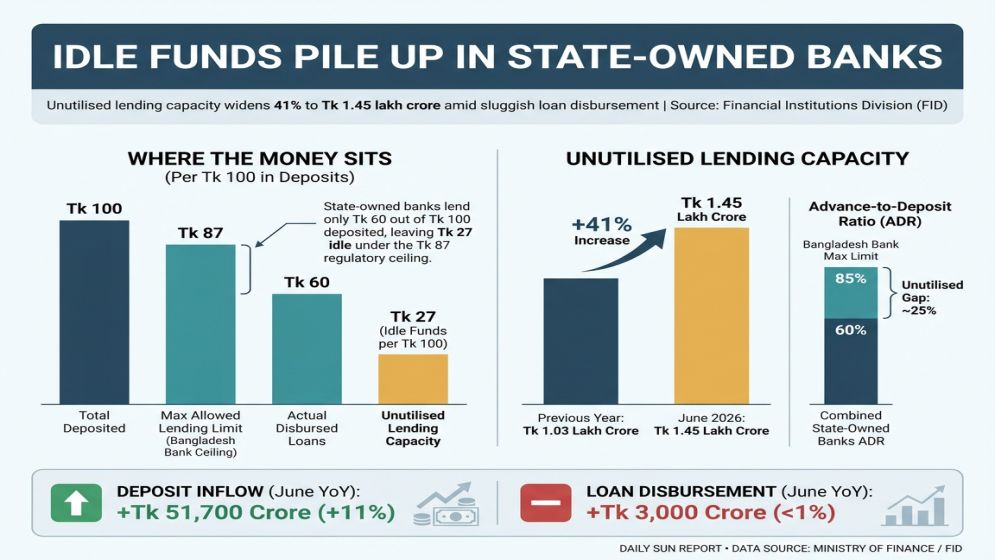
State-owned commercial banks are sitting on an expanding mountain of idle funds against surging deposits, even as entrepreneurs struggle with a severe liquidity crunch.
According to Bangladesh Bank
regulations, conventional banks can lend up to Tk87 against every Tk100 in
deposits, yet state-owned banks have disbursed only Tk60, leaving Tk27
per Tk100 in lending capacity unutilised. With deposits rising while loan
disbursement stagnates, this gap between lending capacity and actual credit has
widened by roughly 41% over the past year.
By the end of June, the
unutilised lending capacity stood at approximately Tk1.45 lakh crore, meaning
the banks are failing to channel substantial available funds into productive
credit within existing regulatory limits.
Over the past year, deposits
at the six state-owned banks grew by about Tk51,700 crore, whereas loan
disbursement increased by only Tk3,000 crore. As a result, massive inflows of
public deposits are failing to reach the private sector or entrepreneurs.
The findings were revealed in
a report by the Financial Institutions Division (FID) under the Ministry of
Finance. According to the report, combined deposits at the six banks rose by
nearly 11% year-on-year at the end of June, while credit growth remained below
1%.
The six banks are Sonali,
Janata, Agrani, Rupali, BASIC, and Bangladesh Development Bank (BDBL). FID
Secretary Nazma Mobarek recently held separate meetings with top executives of
the banks, and the report was compiled based on data presented during those
sessions.
An analysis of the report
shows that total loans disbursed by the six banks stood at Tk3,28,806 crore at
the end of December 2025, but declined by about 1.85% to roughly Tk3,22,700
crore by the end of June 2026. Excluding accrued interest added to loan
accounts, real credit growth would appear even weaker, the report noted.
A bank’s lending relative to
deposits is measured by its advance-to-deposit ratio (ADR). While Bangladesh
Bank allows conventional banks a maximum ADR of 85%, the combined ADR of the
six state-owned banks currently stands at around 60%.
Between December last year
and June this year, the ADR declined across all six banks. Sonali Bank recorded
the lowest ADR at 48%, down from 58% in December, while Janata Bank posted the
highest at 81%.
Even in March this year, state-owned banks recorded the banking sector’s highest deposit growth at nearly 12%, but the lowest credit growth at 2.4%, compared to an industry-wide credit growth rate of 4.1%. At that time, state-owned banks held an ADR of about 67%, against 80% for private banks and an overall sector average of around 76%. Although state-owned banks hold roughly 24% of total banking sector deposits, they account for only 19% of total loans. By contrast, Islamic banks hold 17% of deposits but have disbursed 27% of total loans.
Why loan disbursement is
slowing
Agrani Bank Chairman Syed Abu
Naser Bukhtear Ahmed said the bank has shifted its focus from large corporate
loans toward smaller, agricultural, new, and women-led enterprises. "That
makes overall credit flow appear lower, though these loans carry lower
risk," he said, adding that heavy loan write-offs alongside weak new
disbursement have widened the apparent gap with deposit growth. Economic
uncertainty, high lending rates, and cautious banking practices are also
weighing on credit expansion.
He noted that bank officials
have grown wary of sanctioning new loans out of fear of facing future
accountability. Weak business conditions have further dampened credit demand,
as imports of capital machinery and raw materials have fallen and uncertainties
over gas and electricity supply and pricing continue to deter fresh investment.
Centre for Policy Dialogue
(CPD) Executive Director Nazneen Ahmed said state-owned banks attract strong
deposit inflows due to public trust and extensive branch networks reaching
remote areas. However, large borrowers increasingly prefer private banks for
faster service, greater flexibility, and diversified retail products such as
auto and home loans.
"State-owned banks will
continue to play an important role, but they must improve efficiency, broaden
their credit services, and overhaul their business strategies," she said,
adding that weak private credit demand despite ample bank liquidity indicates either
waning investor appetite or an unfavourable investment climate.
Directive to boost productive
and job-creating loans
The Financial Institutions
Division has instructed state-owned banks to play a more active role in
boosting production, investment, and employment. According to minutes of a
recent meeting, FID Secretary Nazma Mobarek directed bank officials to step up
lending to cottage, micro, small, and medium enterprises (CMSMEs), farmers,
women entrepreneurs, new businesses, and employment-generating sectors.
"Compared to the
Bangladesh Bank ceiling, the ADR of most state-owned banks is significantly
lower, leaving room to convert a portion of existing deposits into sound,
income-generating loans," she said, cautioning that lending standards must
not be relaxed merely to raise the ADR.
Despite the push for priority
sectors, CMSME lending among the six banks fell 2% between December and June to
about Tk56,000 crore. However, the banks exceeded their agricultural credit
target for the 2025–26 fiscal year, collectively disbursing nearly Tk4,000
crore, around 10% of the national target, with only BDBL falling short of its
individual goal.