



 For all latest news, follow the Daily Sun's Google News channel.


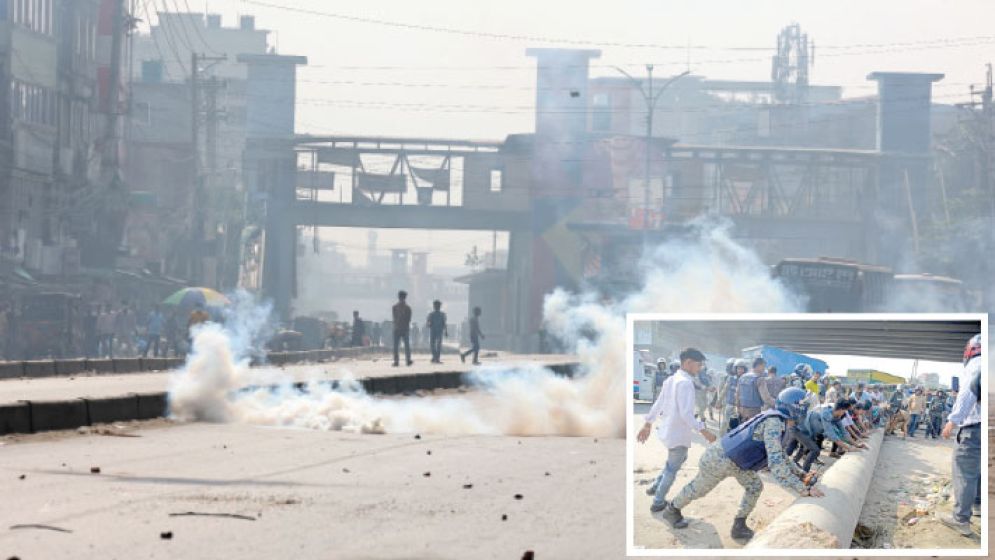
Thick white smoke billows across a brick-strewn deserted highway on Wednesday as garment workers protest the Tk17,000 minimum wage, staging blockades along key routes, including the Dhaka-Mymensingh highway near Bhogra Bypass. (Inset) Police and locals push aside a concrete utility pole used to block the Dhaka-Tangail highway during the demonstration. -DAILY SUN Photo
A wage agreement reached between garment factory owners and workers’ representatives has failed to ease unrest in the country’s major industrial belts, with workers continuing to stage demonstrations, block highways and attack factories over a pay structure they say falls far short of their expectations and rising living costs.
The disconnect between the decision of the Minimum Wage Board and the response on factory floors has raised questions about whether the agreement adequately reflects workers’ demands, even though their representative on the board accepted the final proposal.
The board on Wednesday announced a proposed monthly minimum wage of Tk17,000 for Grade-IV readymade garment (RMG) workers, a 36% increase from the existing Tk12,500. The proposed rates are Tk19,000 for Grade-III, Tk20,000 for Grade-II and Tk21,500 for Grade-I workers.
The decision followed a marathon meeting that continued until late Tuesday night and was finalised through a vote, with four of the  board’s six members supporting the proposal.
Earlier, representatives of garment factory owners and workers had agreed to implement the revised wage structure from December 1, with workers due to receive the increased salaries in January alongside their December pay.
Yet protests continued in Gazipur, Savar, Ashulia and Narayanganj on Wednesday, disrupting production and traffic. At least 12 police and Ansar members were injured in clashes with workers in different parts of Gazipur, where law enforcers fired tear gas and sound grenades to disperse demonstrators blocking major highways.
A widening gap between expectations and reality
One of the main reasons behind the continued discontent is the wide gap between workers’ original demand and the amount eventually proposed by the board.
Workers initially demanded a minimum monthly wage of Tk32,000 for Grade-IV employees. They subsequently lowered the demand to Tk25,000 and then Tk22,000 in successive rounds of negotiations.
Employers, meanwhile, initially offered Tk15,000, raising it to Tk15,500 before proposing Tk15,700 in their latest offer. The final Tk17,000 proposal is Tk4,500 above the existing minimum but still Tk5,000 below workers’ latest demand.
The Amsterdam-based Clean Clothes Campaign (CCC), a global labour rights watchdog, rejected the proposed wage, describing the Tk17,000 floor as “exploitative” and arguing that it falls substantially short of the Tk32,000 living wage sought by workers.
The IndustriALL Bangladesh Council (IBC) also criticised the proposal, saying it failed to meet workers’ expectations and questioning the bargaining strategy adopted by the workers’ representative on the board.
In a joint statement, IBC President Mir Abul Kalam Azad and General Secretary Salauddin Shapon said they would submit formal objections within the stipulated 14-day period after publication of the draft gazette. They urged workers to return to work until a final settlement was reached.
The Bangladesh Garment and Sweaters Workers Trade Union Kendra also rejected the proposal as unacceptable.
The objections highlight a key distinction in the wage negotiations: acceptance by the workers’ representative on the board does not necessarily mean that the wider workforce and labour organisations consider the settlement adequate.
Board member and workers’ representative Babul Akter acknowledged that he was dissatisfied with the proposed wage. He said he had sought Tk18,000 for the lowest grade but had to accept the collective decision.
Nevertheless, he described the Tk4,500 increase as significant, noting that a similar increase had taken five years to achieve under the previous wage revision, compared with three years this time. He urged workers to return to their workplaces and called for swift implementation of the revised structure.
The Bangladesh Garment Workers Unity Council (BGWUC) also welcomed the revision, which was finalised within 24 days of the board’s formation, and urged workers to resume production and refrain from violence.
Rising living costs fuel dissatisfaction
Beyond the gap between demands and the final proposal, the rising cost of living remains a major source of workers’ dissatisfaction.
Centre for Policy Dialogue (CPD) Executive Director Nazneen Ahmed said the wage-setting process was not ideal, partly because there was no reliable data on workers’ living standards and actual living costs.
The CPD had earlier proposed a monthly minimum wage ranging from Tk18,578 to Tk24,204.
Nazneen called for a permanent system of annual wage adjustments in line with inflation, rather than leaving workers to wait three or five years for a revision. Regular adjustments, she said, would help wages keep pace with changes in the cost of living.
She also argued that additional business costs arising from bureaucratic inefficiency, corruption and extortion should not be passed on to workers, urging the state to take responsibility for addressing such problems.
Owners warn of pressure on factories
Factory owners, meanwhile, have raised concerns about their ability to implement the revised wage structure, particularly at financially struggling units.
BGMEA Vice-President Shihab Udduza Chowdhury said most factories would be unable to pay the new minimum wage of Tk17,000. He called on the government to formulate an exit policy to allow loss-making factories to wind up their operations lawfully.
Factory owners have also expressed concern that the higher wage floor could affect Bangladesh’s competitiveness in attracting investment, particularly from foreign manufacturers seeking lower production costs.
The concerns underline another challenge in implementing the wage agreement: ensuring that factories can meet their increased labour costs without undermining employment and investment.
Rumours and outside interference alleged
Amid the continuing unrest, Home Minister Salahuddin Ahmed alleged that rumours were being spread to provoke disorder in Gazipur despite the agreement reached between workers and employers.
Speaking to journalists at the Secretariat on Wednesday, he described the unrest as part of a political conspiracy and claimed that genuine garment workers were not involved in the protests.
He said the wage board had held several meetings within a short period, inspected factories and consulted relevant stakeholders before reaching its decision.
“After discussions that continued until late last night, all sides agreed to the decision this morning,” he said, adding that board members had signed the decision.
However, protests and clashes continued at several locations.
In Gazipur, workers blocked the Dhaka-Tangail and Dhaka-Mymensingh highways at different points, including Naojor, Bhogra, Bhabanipur and Salna. Clashes were also reported in Sreepur, Tongi and other industrial areas.
Police said groups of people attacked five factories in Sreepur, including Hams Garments, Victoria Garments, Luxma Innerwear, Fakhruddin Textile and Noman Home Textile. Assistant Police Superintendent Shafiqul Alam said the attackers were outsiders rather than factory workers.
In Savar and Ashulia, workers gathered at Padma Mor in Hemayetpur and other locations, demanding higher wages in line with market prices and payment of outstanding allowances. Police used tear gas and sound grenades to disperse demonstrators.
Authorities declared general holidays at around 60 factories in Savar and Ashulia to protect industrial establishments and prevent further trouble. About 50 factories in Gazipur also announced holidays, while around 35 were reported closed indefinitely, according to industrial police.
Narayanganj remained largely calm, although workers staged demonstrations and blocked roads in Fatullah’s BSCIC, Masdair and Panchabati areas. Three factories announced general holidays.
Workers there also raised concerns over the grading of senior and skilled employees and full payment of leave benefits. Bangladesh Garments and Sweater Workers Trade Union Centre district President MA Shaheen said the proposed wage failed to meet workers’ expectations but stressed that the union did not support violence or disorder.
Implementation and trust remain key challenges
Labour and Employment Minister Ariful Haque Choudhury urged workers to return to their workplaces and resume production, while calling on factory owners to maintain cordial relations with employees.
He said the proposed minimum wage for the lowest grade had increased from Tk12,500 in 2023 to Tk17,000 in 2026, with the annual increment also rising from 11.25% to 12%.
The government has also reduced the interval for wage reviews from five years to three years through amendments to the Labour Act, he said.
Inspector General of Police Mohammad Ali Hossain Fakir said police were making every effort to maintain law and order in industrial areas to ensure uninterrupted economic activities.
The latest unrest, however, suggests that announcing a wage agreement and securing signatures from representatives may not be enough to restore confidence on factory floors. The adequacy of the proposed wage, the credibility of the negotiations and the timely implementation of the revised structure remain central to resolving the workers’ discontent.