


 For all latest news, follow the Daily Sun's Google News channel.


BIDS-BCI survey
Energy crisis hits production in medium and large industries
Daily Sun Report, Dhaka
Published: 25 Nov 2026, 09:42 AM
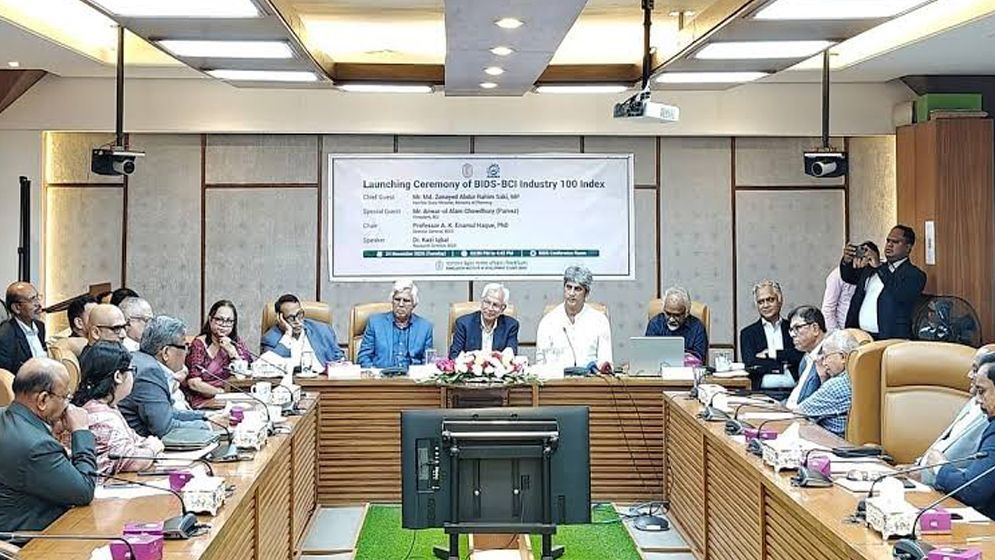
Photo: Collected
Bangladesh’s medium and large-scale manufacturing industries are facing mounting pressure from irregular electricity and gas supplies, high borrowing costs and rising raw material prices, leaving more than one-third of their production capacity unused, according to a new survey.
Industrial output fell by 0.4% year-on-year in the April-June quarter of 2026, while overall capacity utilisation dropped to 66%, highlighting the growing strain on the country's manufacturing sector.
The findings emerged from the first round of the ‘BIDS-BCI Evaluate 100 Index’, jointly conducted by the Bangladesh Institute of Development Studies (BIDS) and the Bangladesh Chamber of Industries (BCI).
The survey analysed data from 130 factories across 14 major industrial sectors, including readymade garments, textiles, pharmaceuticals, steel, leather and food processing. The findings were presented at a conference at the BIDS headquarters in the capital’s Agargaon yesterday.
The surveyed factories account for nearly 90% of medium and large-scale industrial production in the country, according to the study.
Sector-wise data revealed significant disparities in production. Automobile manufacturing recorded 22% growth, followed by jute at 13% and readymade garments at 2%. In contrast, output declined by 20% in textiles, 12% in electrical and electronics, and 9% in food processing.
The textile sector experienced a particularly sharp decline in capacity utilisation, falling from 73% in 2025 to 55% in the second quarter of 2026. The number of factories operating at less than half their production capacity increased from 19 to 28.
Energy shortages emerged as the most significant obstacle to industrial operations. Around 93% of surveyed factories identified the energy crisis as one of their three main business constraints, while 79% described it as their biggest challenge.
Average daily interruptions in grid electricity supply increased from two hours in 2025 to 4.1 hours in the April-June quarter. Among 66 factories using piped gas, daily supply disruptions rose from 0.9 hours to 3.2 hours.
Satisfaction with the quality of grid electricity plunged from 38% to just 7%, while satisfaction with gas supply dropped from 70% to 17%.
To cope with shortages, factories have increasingly relied on alternative energy sources. Expenditure on liquefied petroleum gas (LPG) rose by 25%, generator fuel by 15% and grid electricity by 8%. Average quarterly energy costs per factory increased by 5% to Tk 3.32 crore, from Tk 3.16 crore a year earlier.
Rising raw material and transportation costs have added to the pressure. Imported materials account for 77% of total raw material expenditure in the surveyed industries. The average cost of raw materials per factory increased to Tk 87.60 crore in the second quarter from Tk 85.70 crore in the same period last year.
Around 94% of factories reported an average 12% increase in raw material prices. Securing raw materials alone takes an average of 35.4 days, while fulfilling an order from receipt to delivery takes around 65 days.
Transportation expenditure per factory increased by 10% to Tk 1.12 crore during the quarter. Total operating costs rose to Tk 1.49 crore. However, the average time required to clear imported raw materials from seaports improved from 12.4 days to 10.9 days.
The uncertainty has also hit fresh investment. Average quarterly spending on capital machinery per factory plunged from Tk 1.76 crore in 2025 to just Tk 11 lakh in the second quarter of 2026. Machinery purchases declined sharply across almost all sectors, except pharmaceuticals and chemicals.
Employment also contracted, with the workforce across the 130 surveyed factories falling by 1% to 135,700 from 137,100. Both new recruitment and employee departures declined by 19%.
The average monthly wage of workers, excluding bonuses and other allowances, stood at Tk 21,263. Male workers earned an average of Tk 23,861, compared with Tk 18,820 for female workers.
The survey's business sentiment indicators also painted a gloomy picture. On a scale of zero to 100, where 50 indicates an unchanged situation, all five indicators — production, profitability, demand, growth and overall business conditions — remained below 50, ranging from 36 to 43.
The profitability index recorded the lowest score at 36, with around 61% of factories reporting a decline in profits. The growth index stood at 37, production at 39, demand at 43 and overall business conditions at 39.
Besides energy shortages, 37% of factories identified high interest rates and financing costs as major constraints, while an equal proportion cited difficulties in procuring raw materials.
Despite the prevailing difficulties, entrepreneurs expect some improvement in production during the July-September quarter, with the production index projected to rise to 54.
The new index was introduced to provide policymakers and businesses with more timely information on industrial performance, as the publication of quarterly GDP data by the Bangladesh Bureau of Statistics (BBS) is typically delayed by three to four months.
Speaking the chief guest at the report launch, State Minister for Planning Md Zonayed Abdur Rahim Saki, said the present government had inherited both a devastated economy and weakened institutions.
"The government has to operate with these institutions inherited from the past. The Middle East crisis has added to the challenges. Despite this, the government is trying to build an investment-driven economic system that will generate employment and boost production growth," he said.
The study was conducted by a BIDS research team comprising Kazi Iqbal, Muntasir Murshed, Mitali Parveen and Kazi Zubayer Hossain of its Industry and Physical Infrastructure Division (IPID).
BIDS Director General Dr AK Enamul Haque chaired the event. National Professor Mahbub Ullah, BCI President Anwar-ul Alam Chowdhury (Parvez), former FBCCI president Mir Nasir Hossain and Apex Footwear Managing Director Syed Nasim Manzur, among others, also spoke.