


 For all latest news, follow the Daily Sun's Google News channel.


The country’s garment industry has suffered an estimated $428 million in production losses over 18 days of labour unrest, while overseas buyers have shifted another $254 million worth of confirmed orders to competing countries, adding to manufacturers' mounting pressure ahead of a fresh round of minimum wage negotiations.
The Bangladesh Garment Manufacturers and Exporters Association (BGMEA) disclosed the figures on Sunday, based on an emergency survey of 317 member factories. The survey covered disruptions between 1 and 18 November, with the association estimating that more than 600 factories had been affected.
The production losses amount to around Tk5,136 crore, while the shifted orders represent another Tk3,048 crore in lost business. Buyers have moved approximately 59 million pieces of confirmed garment orders abroad, according to the BGMEA.
The affected factories suspended production for between one and 16 days. The association warned that shipment delays had put many other export orders at risk, forcing manufacturers to consider expensive air freight, offer substantial discounts or face cancellations.
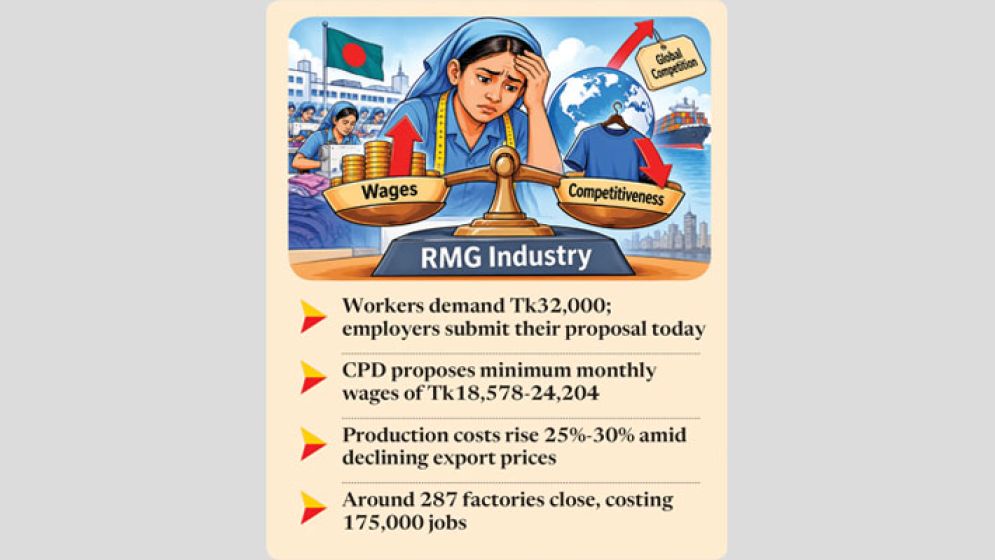
The losses come as the industry grapples with rising production costs, declining export prices, international competition and demands for higher wages. The minimum wage review has brought workers' livelihoods and the industry's competitiveness into sharp focus.
The unrest, triggered by workers' demand for a monthly minimum wage of Tk30,000, began on 31 October and spread across Gazipur, Ashulia and Savar in early November.
The government formed a six-member Minimum Wage Board on November 1 to review the existing monthly minimum wage of Tk12,500.
At the board's second meeting, workers' representatives proposed raising the minimum wage to Tk32,000. The employers were scheduled to present their proposal at the third meeting, but it was postponed.
Speaking to the Daily Sun, BGMEA Vice-President Md Rezwan Selim said employers would submit their proposal as scheduled today. Meanwhile, the Centre for Policy Dialogue (CPD) has proposed a monthly minimum wage ranging from Tk18,578 to Tk24,204, seeking to balance workers' living costs with the industry's capacity to pay.
Wage comparisons expose competitiveness gap
Bangladesh's garment minimum wage of Tk12,500 is higher than rates in several domestic industrial sectors but remains below those in a number of competing apparel-producing countries.
The rate exceeds the minimum wages in hosiery (Tk12,080), leather and footwear (Tk11,900), re-rolling (Tk10,650), cotton textiles (Tk10,001), plastics (Tk8,000) and tailoring (Tk7,275). However, pharmaceutical workers receive Tk13,750, while the proposed rate for dyes and chemicals is Tk14,000.
International comparisons reveal a different picture. Bangladesh's garment minimum wage is estimated at $101 a month, compared with $113 in India, $130 in Pakistan, $139 in Indonesia and $141 in Vietnam. The corresponding figures are $210 in Cambodia, $277 in China and $97 in Myanmar.
Although Bangladesh remains among the lower-wage apparel-producing countries, its minimum wage has risen faster than those of several competitors. Between 2016 and 2026, it increased by 136%, compared with 59% in India, 54% in Vietnam and 50% in Cambodia, according to industry figures.
Manufacturers argue that wages alone do not determine competitiveness, pointing to Bangladesh's relatively high energy, financing, logistics and infrastructure costs.
Inflation erodes workers' purchasing power
The current minimum wage took effect in December 2023. Since then, rising living costs have significantly eroded workers' purchasing power.
According to Bangladesh Bureau of Statistics data cited in the industry assessment, general inflation reached 29.5% between December 2023 and October 2026. Food inflation stood at 32.82%, while non-food inflation was 26.83%.
The assessment estimates that a Grade 4 garment worker receiving a gross monthly wage of Tk12,500 takes home around Tk19,520 after overtime, festival allowances, attendance bonuses and other benefits.
Average take-home earnings across all grades are estimated at Tk22,051. However, this includes an average of 78 hours of overtime a month, which is not part of the guaranteed minimum wage.
Introduced at Tk560 in 1984, the garment minimum wage has been revised several times, reaching Tk12,500 in 2023. The Labour (Amendment) Act, 2026, reduced the wage review interval from five years to three.
Rising costs squeeze manufacturers
While workers demand higher wages to cope with inflation, manufacturers say their ability to absorb additional labour costs has weakened.
The industry's average production costs rose by an estimated 25% to 30% between 2023 and 2026, according to the assessment. Electricity prices increased by 43%, diesel prices by 23.85% and transportation costs by around 15%. Port tariffs rose by 41% in October 2025, while bank lending rates climbed from 9% to between 12% and 16%.
Manufacturers also face energy shortages, delayed payments from international buyers and additional US tariffs imposed since August 2025.
Meanwhile, the average free-on-board (FOB) price of exported apparel declined by 2.56% over the past three years, according to National Board of Revenue data cited in the assessment.
RMG exports fell from $42.6 billion in FY22 to $39.3 billion in FY25 and $38.7 billion in FY26, according to Export Promotion Bureau figures.
Imports of textile capital machinery and garment machinery declined by 25.70% and 19.48%, respectively, in FY26, Bangladesh Bank data showed.
Smaller factories face employment risks
The wage negotiations are particularly sensitive for small and medium-sized manufacturers.
According to the BGMEA assessment, 1,078 factories, or around 57% of its members, exported less than $10 million each in FY26. Another 21% recorded exports between $10 million and $25 million.
The association estimates that raising the minimum wage to Tk15,000 could push some smaller factories into losses averaging 0.3% to 0.5%, threatening their operations and employment.
It also reported that around 287 factories had closed since January 2023, resulting in the loss of approximately 175,000 jobs.
Manufacturers warn that further cost increases could force more factories to shut down, restructure or accelerate automation, potentially reducing employment opportunities.
Balancing workers' welfare and industry survival
The RMG sector employs around 40 lakh workers, approximately 60% of whom are women. Its importance to employment, exports and the wider economy makes the wage review particularly significant.
The challenge is to improve workers' earnings without undermining factory viability, export competitiveness and employment.
The BGMEA has urged all concerned parties to act responsibly to restore stability and prevent further damage to the industry.
Its Secretary General Maj Gen (retd) Dr Md Shahedul Islam said the emergency survey captured only part of the actual damage, as more than 600 factories had reportedly been affected.
The association warned that shifting confirmed orders could have lasting consequences for Bangladesh's reputation as a reliable supplier in the global apparel market.