



 For all latest news, follow the Daily Sun's Google News channel.


BGBA warns of mounting losses as RMG labour unrest disrupts production
Buying house association urges swift resolution of wage dispute to protect industry, exports and national economy
Daily Sun Report, Dhaka
Published: 19 Nov 2026, 06:15 PM
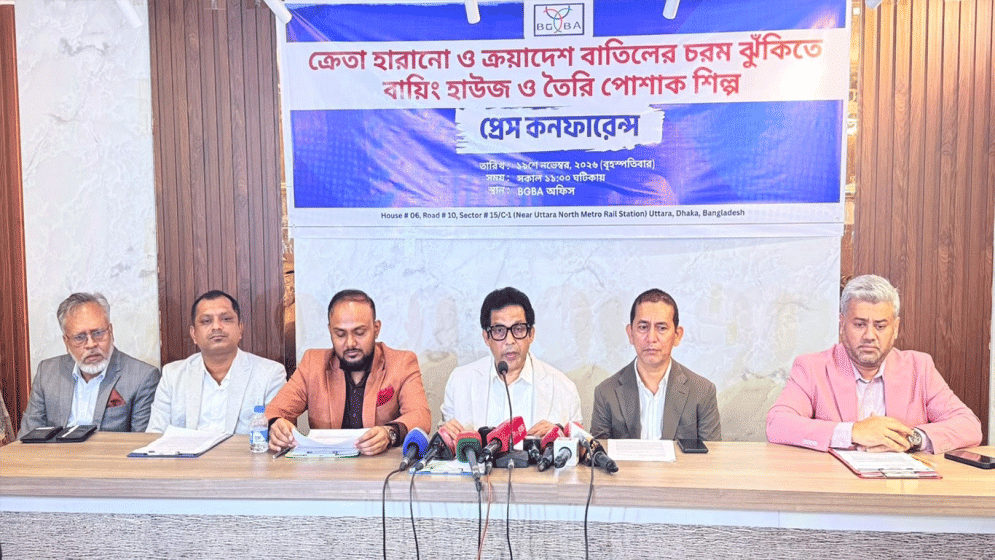
Photo: Daily Sun
The Bangladesh Garment Buying House Association (BGBA) has expressed deep concern over ongoing labour unrest, factory closures and road blockades in the country's readymade garment (RMG) sector, warning that prolonged disruptions could undermine export competitiveness and damage Bangladesh's image among international buyers.
The leaders of the association made the remarks at a
press conference held at its Uttara office in the capital on Thursday.
They added that said industrial unrest in Savar,
Ashulia, Mirpur and Gazipur over the past few weeks had severely disrupted
production and supply chains, pushing the country's key export-earning sector
into uncertainty.
The association acknowledged that workers' demands
for higher wages were justified in view of rising living costs and inflation.
It said discussions were underway among the
government, workers' representatives, the Bangladesh Garment Manufacturers and
Exporters Association (BGMEA), the Bangladesh Knitwear Manufacturers and
Exporters Association (BKMEA) and other stakeholders to resolve the dispute.
BGBA President Md Abdul Hamid expressed hope that
the parties would reach an agreement on a timely and reasonable wage structure
that ensures workers' dignity and fair compensation while remaining affordable
for garment manufacturers.
However, he stressed that an immediate resolution
was essential, estimating that the country loses around Tk2,000–Tk2,200 crore
in economic output for every day of halted RMG production.
The association fears that the ongoing unrest has
already caused losses amounting to Tk3,000–Tk4,000 crore. It warned that the
financial damage would continue to mount unless normal operations were restored
quickly.
The impact, it said, would extend beyond garment
manufacturers to transportation, banking, logistics, exports and other interconnected
sectors of the economy.
As a key intermediary between international buyers
and garment manufacturers, buying houses have already started discussions with
foreign buyers over possible production delays, shipment disruptions and
related cost implications, the statement said.
The unrest is affecting not only the production of
new orders but also the timely shipment of finished goods. Delays in delivering
products scheduled for upcoming seasons could force exporters to bear
additional freight costs and face pressure from buyers for price discounts.
More importantly, the association warned that
continued disruptions could erode international buyers' confidence in
Bangladesh's reliability as a sourcing destination.
BGBA said buying houses were already experiencing
the direct consequences of the situation, with many international buyers
becoming cautious about placing new orders with Bangladeshi suppliers. In some
cases, order volumes had also declined.
If the trend continues, garment factories may fail to
operate at full capacity, while some could be forced to suspend production, it
said.
Such developments would not only affect industrial
capacity and export earnings but also threaten the livelihoods and financial
security of thousands of workers and their families.
The association also expressed concern that the
economic fallout from the unrest could become more visible in the country's
export earnings and industrial performance over the next three months.
Bangladesh, the world's second-largest garment
exporter, faces intense competition from countries such as India and Pakistan
in the global apparel market.
Against this backdrop, prolonged domestic
instability could create a negative impression among international buyers about
the country's ability to ensure timely deliveries and maintain supply-chain
reliability, the statement added.
Calling for a responsible approach from all
stakeholders, BGBA urged the government, workers' representatives and industry
leaders to adopt realistic, reasonable and flexible positions to reach an
acceptable solution without further delay.
It emphasised that ensuring workers' legitimate
rights and dignity was as important as protecting the industry's production
capacity, the survival of factories and the country's broader economic
interests.
The association called on all parties to engage in
meaningful dialogue based on mutual trust and sincerity so that no stakeholder
is deprived of legitimate rights while safeguarding the RMG industry and the
national economy.
BGBA also called on the government to take prompt
and practical decisions to resolve the crisis and ensure stability and
continuity in the sector.
At the same time, it urged workers to return to their workplaces and cooperate in restoring normal production activities, expressing confidence that dialogue, mutual cooperation and tolerance could protect both workers' rights and the industry's future.
Senior Vice President Mohammed Zakir Hossain, Chief
Adviser and former president Mohammad Mofazzal Hosen Pabel, Vice President
(admin) Md Roman Mia, Vice President (finance) Md Emdadul Haque Miazi, Vice
President AKM Saifur Rahman and other members of the board of directors were
also present at the event.