


 For all latest news, follow the Daily Sun's Google News channel.


55 banks breach 4% spread cap, keeping loans costly
Daily Sun Report, Dhaka
Published: 19 Nov 2026, 12:00 AM
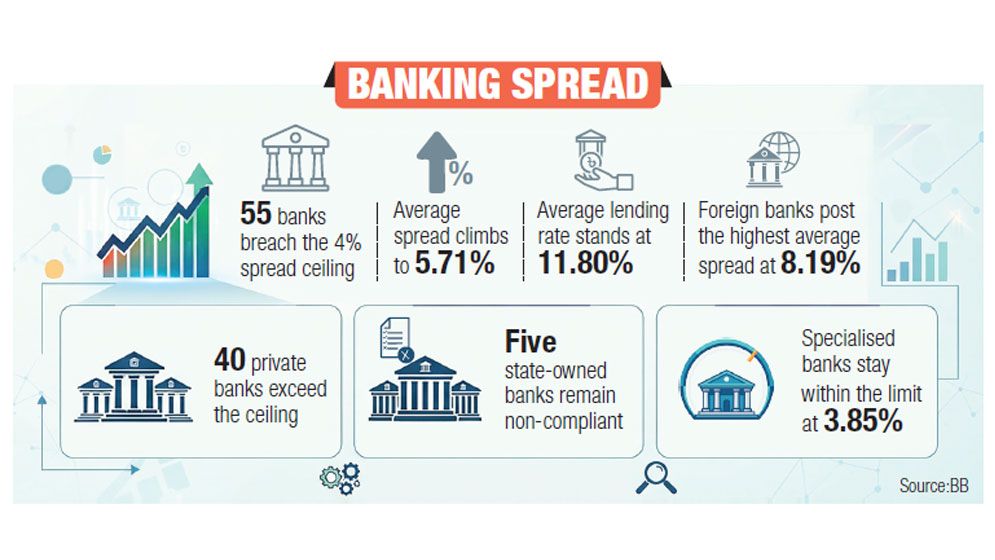
Borrowing remains costly for businesses as 55 of the country’s 61 banks continue to maintain interest rate spreads above Bangladesh Bank’s prescribed ceiling, undermining efforts to reduce financing costs and stimulate investment.
Nearly three months after the central bank capped the difference between lending and deposit rates at 4%, only six banks complied with the directive in September, excluding credit card and consumer financing loans.
The banking sector’s average spread stood at 5.71 percentage points, reflecting a persistent gap between borrowing costs and returns offered to depositors.
The high spread increases financing costs for businesses, industries and entrepreneurs already struggling with expensive credit, potentially discouraging investment, expansion and production.
Bangladesh Bank data show that the weighted average deposit rate stood at 6.09% in September against a lending rate of 11.80%, leaving a spread of 5.71 percentage points, or 1.71 percentage points above the ceiling.
The average spread was 5.67 percentage points in August, 5.60 in July and 5.70 in June, when the central bank issued the directive. Although it narrowed slightly in July, the gap widened over the following two months, indicating limited adjustments by banks.
On 29 June, Bangladesh Bank directed lenders to keep the difference between their weighted average lending and deposit rates within 4 percentage points, excluding credit card and consumer financing.
The directive followed concerns that lending rates had increased disproportionately compared with deposit rates, raising financing costs for trade, business and production while discouraging investment and productivity growth.
Foreign banks maintain widest spreads
Foreign banks recorded the highest average spread at 8.19 percentage points in September, with all nine operating in Bangladesh exceeding the regulatory ceiling.
National Bank of Pakistan recorded the highest spread at 9.79 percentage points, followed by Standard Chartered Bank at 9.19, State Bank of India at 7.96, Citibank NA at 6.97, Woori Bank at 6.83 and Commercial Bank of Ceylon at 6.58.
HSBC maintained a spread of 6.51 percentage points, while Bank Al-Falah and Habib Bank recorded 5.49 and 5.41, respectively.
Private banks dominate non-compliance
Private commercial banks recorded an average spread of 5.65 percentage points, with 40 of the 43 banks exceeding the ceiling.
Global Islami Bank posted the highest spread at 9.78 percentage points, followed by ICB Islamic Bank at 9.07, Dutch-Bangla Bank at 8.70, Social Islami Bank at 8.53 and First Security Islami Bank at 7.82.
United Commercial Bank recorded a spread of 7.11 percentage points, Community Bank 6.64 and National Bank 6.51.
AB Bank maintained the lowest spread in the category at 0.45 percentage points. Meghna Bank and Mutual Trust Bank also complied with the limit, recording spreads of 3.70 and 3.78, respectively.
State-owned banks also exceed ceiling
State-owned commercial banks recorded an average spread of 5.40 percentage points, with five of the six banks exceeding the limit.
Sonali Bank posted the highest spread at 5.83 percentage points, followed by Janata Bank at 5.20, Agrani Bank at 5.03, Rupali Bank at 4.43 and BASIC Bank at 4.22.
Specialised banks performed comparatively better, maintaining an average spread of 3.85 percentage points, within the regulatory ceiling.
Return to spread controls
The restriction was reintroduced following Bangladesh Bank’s gradual shift towards market-based lending rates.
On 19 June 2023, the central bank introduced the Six-Month Moving Average Rate of Treasury Bills (SMART) system, linking lending rates to the six-month moving average of Treasury bill rates with a prescribed margin.
On 29 November that year, it withdrew earlier instructions governing lending-deposit spreads. Subsequently, on 8 May 2024, the central bank abolished SMART, allowing banks to determine lending rates on a market basis without a specific spread ceiling.
Following these changes, many banks raised lending rates faster than deposit rates, widening spreads and increasing borrowing costs for businesses.
Bangladesh Bank subsequently identified excessive spreads as a constraint on investment and productive activities, prompting the reintroduction of the ceiling.
However, some bankers argue that enforcing a uniform spread limit is challenging because banks have different funding costs and financial conditions.
They say financially weaker banks often offer higher deposit rates to attract funds, increasing their funding costs. Reducing lending rates to comply with the ceiling could therefore put further pressure on their profitability and financial stability.