



 For all latest news, follow the Daily Sun's Google News channel.


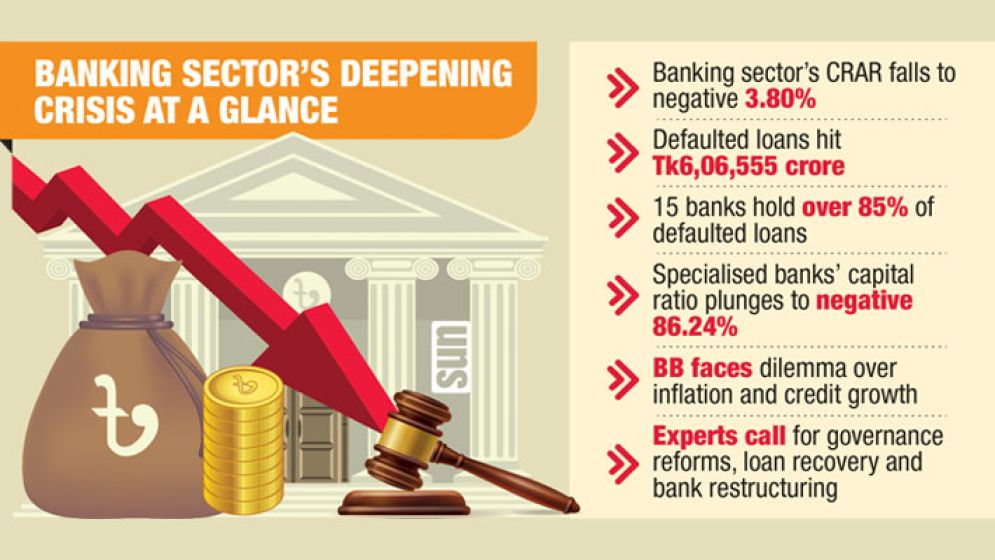
Bangladesh’s banking sector is facing a deepening crisis, with rising non-performing loans, persistent losses, huge provisioning requirements and capital shortfalls threatening overall financial stability.
At the end of June, the sector’s capital to risk-weighted assets ratio (CRAR) fell to negative 3.80%, down from negative 3.17% in March. It was 3.08% in 2024 before turning negative at 2.93% in September 2025. Under the Basel III framework and Bangladesh Bank regulations, banks must maintain a minimum CRAR of 12.50%, including a 10% minimum capital requirement and a 2.50% Capital Conservation Buffer.
Bangladesh’s position is alarming compared with neighbouring countries. At the end of June, Pakistan’s CRAR was 19.6%, Sri Lanka’s 18.07% and India’s 17.78%.
Capital positions also vary widely among local banks. State-owned commercial and foreign-owned banks maintained positive ratios at the end of June, while government specialised banks recorded negative 86.24% and private commercial banks negative 5.55%. Many specialised and private banks are failing to meet the regulatory requirement. Meanwhile, Bangladesh Bank (BB) faces a difficult policy trade-off: reducing money supply to contain inflation while expanding private sector credit to boost investment, production and employment. More credit could fuel inflation, while restrained lending could hamper economic activities.
A BB report highlighted mixed economic trends. Rising remittances, foreign financing and foreign exchange reserves have provided relief to the external sector, but domestic investment, agricultural production, private sector credit growth and banking sector strength remain concerns.
‘Liquidity support not enough for sustainable solution’
Zahid Hussain, former lead economist of the World Bank’s Dhaka office, told the Daily Sun that injecting fresh capital or providing liquidity support alone could not sustainably resolve the banking crisis.
He stressed the need to recover defaulted loans, end lending irregularities, properly assess banks’ asset quality, ensure financial accountability and take effective action against corruption.
Banks consistently failing to meet minimum capital requirements should undergo independent financial assessments and necessary restructuring, alongside reforms in their management and credit operations. Authorities must also prevent similar irregularities from recurring.
Liquidity and capital adequacy are different, he noted. Even banks with sufficient funds may be unable to extend fresh credit if they lack adequate capital against risky loans. The problem is particularly severe for banks with high defaulted loans and substantial capital shortfalls.
Md Ezazul Islam, director general of the Bangladesh Institute of Bank Management (BIBM), said individual banks' financial conditions should not be judged solely by aggregate figures, as their capital positions vary significantly. Many sound private commercial banks maintain capital adequacy ratios of 10-12%, while several others are extremely weak. Their severely negative ratios have dragged down the sector's overall CRAR.
He called for good governance, capital restructuring, fresh capital mobilisation and an end to all forms of corruption. Banks failing to meet minimum capital requirements should face restrictions on profit distribution, while banking laws and regulations must be strictly enforced.
A major cause of capital erosion is the uncontrolled rise in defaulted loans. BB data showed that defaulted loans reached Tk6,06,555 crore at the end of June, accounting for 32.78% of total outstanding loans. More than 85% were concentrated in just 15 banks, indicating that weaknesses in a handful of institutions are dragging down the entire banking system.
Four reasons behind sluggish credit growth
Private sector credit growth has also remained sluggish due to four major factors: rising defaulted loans, entrepreneurs' reluctance to invest, a lack of confidence in the business environment and global economic uncertainty, according to the BB report.
These factors have made entrepreneurs cautious about new investments and banks more reluctant to lend amid rising defaults and concerns over their financial strength, slowing both investment and bank lending.
The central bank and the government have taken measures to accelerate credit growth, including low-cost financing, greater policy support for exports and improvements in the investment climate through adequate supplies of gas, electricity and other essential services. The report said these initiatives had brought some improvement in the services sector.
Economic activities also gained momentum in FY26 compared with FY25. Despite Middle East conflicts and global uncertainty, remittance inflows increased and foreign financing remained strong, helping boost foreign exchange reserves and provide relief to the external sector.
However, boosting production, investment and employment requires more money supply and credit, while excessive market liquidity could fuel inflation. This creates a policy conflict among three objectives: controlling inflation, maintaining adequate liquidity and increasing private sector credit.
BB said the central bank must remain extremely cautious in formulating and implementing policies, as measures to improve one economic indicator could put pressure on another, making overall economic balance a major challenge.
Read More