


 For all latest news, follow the Daily Sun's Google News channel.


BB expands Tk1,500cr loans to remittance recipients
Revised policy offers loans at up to 7% interest, reserves 25% for women and extends scheme for five years
Daily Sun Report, Dhaka
Published: 13 Nov 2026, 12:00 AM
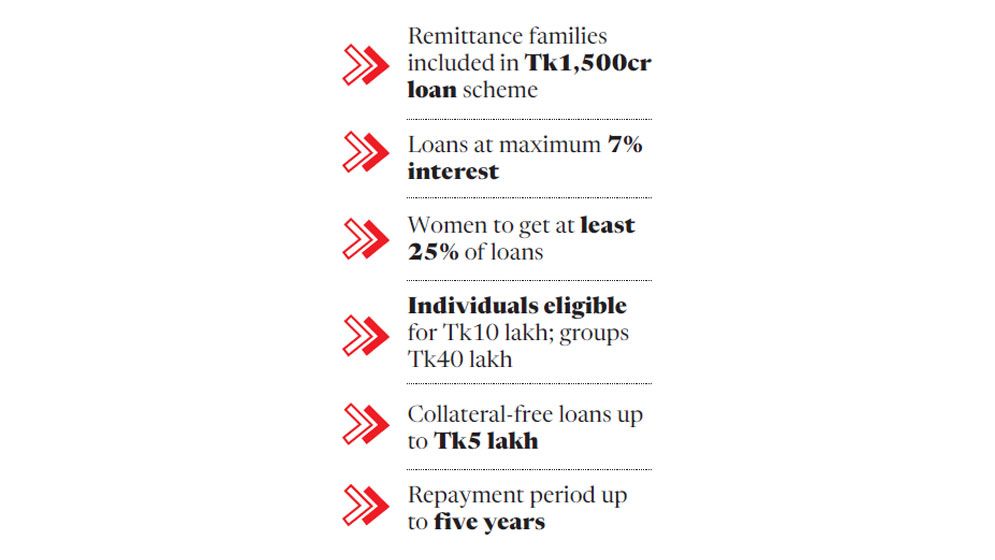
The Bangladesh Bank has expanded its Tk1,500 crore refinancing scheme for marginalised and low-income people, bringing members of remittance beneficiary families under its coverage alongside marginal farmers, small entrepreneurs, low-income professionals and students with student banking accounts.
Under the revised policy, banks will receive refinancing from the central bank at an annual interest or profit rate of 1% and can lend to eligible borrowers at a maximum rate of 7%.
The central bank issued the revised and consolidated policy on Thursday, extending the scheme’s validity to five years from the date of issuance.
The fund, financed from Bangladesh Bank’s own resources, will operate on a revolving basis, allowing recovered funds to be used for fresh lending.
The scheme has been renamed the “Tk1,500 crore Refinancing Scheme for Financial Inclusion of Marginal/Landless Farmers, Low-income Professionals, Small Entrepreneurs, Students with Student Banking Accounts and Members of Remittance Beneficiary Families”.
The revised policy consolidates and modifies earlier instructions to address growing demand for grassroots credit and expand financial inclusion among disadvantaged communities.
According to Bangladesh Bank, the initiative aims to help marginalised and underprivileged people engage in income-generating activities, improve their livelihoods and gain access to formal financial services.
Who will be eligible
The scheme covers marginal and landless farmers, micro and small entrepreneurs, low-income professionals and individuals engaged in legitimate income-generating activities.
Eligible borrowers include fishermen, cobblers, goldsmiths, barbers, blacksmiths, potters, tailors, hawkers, street vendors, rickshaw and van pullers, electricians, electronics repairers, carpenters, masons, painters, grill makers, plumbers, traditional food producers, small weavers, veterinary practitioners and tea workers.
Grocery and general merchandise shop owners, mobile clothing traders, mobile recharge service providers, mobile financial service agents, internet service providers, street food sellers, tea and betel-leaf vendors, book and newspaper sellers, packaging-material producers, and flower, fruit and vegetable traders are also eligible.
The scheme further covers people involved in poultry and livestock farming, fish and shrimp cultivation, crab and eel farming, organic fertiliser production, vegetable cultivation, nurseries and tree plantations.
Small and cottage industry operators, handicraft and embroidery workers, block-printing and batik entrepreneurs, food producers, freelancers and individuals engaged in promising innovative activities can also apply.
Trained members of the Village Defence Party (VDP) involved in income-generating activities will also be eligible.
At least 25% of loans reserved for women
The revised policy prioritises marginalised women and female micro and small entrepreneurs engaged in income-generating activities.
Banks must disburse at least 25% of total loans under the scheme to women borrowers and entrepreneurs.
Marginal and landless farmers holding Smart Farmer Cards issued under the Department of Agricultural Extension’s Smart Farmer Card Policy 2025 will receive priority in opening Tk10 accounts and obtaining loans.
However, banks must ensure that eligible farmers without Smart Farmer Cards are not excluded from the facility.
Priority will also be given to small businesses and low-income professionals affected by natural or man-made disasters, including river erosion, tidal surges, cyclones, floods, droughts, seasonal food insecurity, fires, earthquakes, building collapses and pandemics.
Low-income residents of coastal, char and haor areas, ethnic minority communities and other disadvantaged groups will also receive priority.
The revised policy specifically includes remittance senders and beneficiaries, returning migrant workers and their family members.
Persons with disabilities, people with special needs and members of the third gender will also receive priority for loans to support income-generating activities.
Loans for students’ training and higher education
The scheme also seeks to promote skills development, employment and financial inclusion among students holding student banking accounts.
Banks can provide loans to disadvantaged and financially insolvent student account holders aged up to 25 for vocational, technical, information technology and other training programmes. Students who have dropped out of education will also be eligible.
Such loans will require repayment guarantees from parents or guardians.
Students aged over 18 can also obtain loans to start businesses, pursue professions or undertake other income-generating activities based on skills acquired through training.
Student banking account holders may also receive priority loans to cover higher education expenses, including studies in medicine, dentistry, engineering and other disciplines, as well as the purchase of educational materials.
These loans will also require repayment guarantees from parents or guardians.
Loan limits and repayment conditions
Under the revised policy, individual borrowers and micro and small entrepreneurs can receive loans of up to Tk10 lakh, depending on their financing needs and banks’ assessments.
For group lending, groups of two to five members can receive up to Tk8 lakh per member, with a maximum total loan of Tk40 lakh.
All group members will be individually and jointly responsible for repayment.
Loan proceeds must be credited to borrowers’ Tk10, Tk50 or Tk100 no-frills accounts.
The maximum annual interest or profit rate for borrowers will be 7%, calculated on the declining loan balance.
Both banks and borrowers may receive a grace period of up to six months, while the total loan tenure, including the grace period, cannot exceed five years.
After the grace period, Bangladesh Bank will recover principal, interest or profit and applicable service charges from participating banks in quarterly instalments.
Banks may collect repayments from borrowers in monthly, quarterly, half-yearly or annual instalments, depending on the loan arrangement.
Banks cannot require collateral for loans of up to Tk5 lakh, although they may obtain personal guarantees from borrowers and up to two other individuals.
For loans exceeding Tk5 lakh, banks may seek reasonable additional collateral based on their assessment and relationship with borrowers.
Loans of Tk25,000 or more may qualify for coverage under the Credit Guarantee Scheme. However, participating banks must pay the guarantee fees from their own funds.
Loan defaulters will not be eligible for financing under the scheme.
Borrowers with outstanding and unadjusted loans under other government or Bangladesh Bank pre-financing, refinancing or interest subsidy schemes will also be excluded.
Banks must obtain Credit Information Bureau (CIB) reports before disbursing loans to verify borrowers’ repayment status.
However, they cannot charge borrowers CIB report fees for loans or investments of up to Tk3 lakh under the scheme.
Digital channels allowed for loan disbursement
Participating banks can disburse loans through branches, sub-branches, agent banking outlets, mobile financial services (MFS), online banking and internet banking platforms.
Agents and MFS providers involved in loan disbursement and recovery may receive service charges approved by the respective banks’ boards of directors.
Shariah-based banks can provide financing through their approved investment methods, provided the annual profit rate charged to customers does not exceed 7%.
Scheduled banks seeking refinancing must sign participation agreements with Bangladesh Bank’s Financial Inclusion Department.
Under the agreements, banks must commit to repaying the principal and interest or profit received through refinancing and submit separate demand promissory notes as repayment commitments.
Participating banks must submit monthly refinancing applications to Bangladesh Bank by the 15th of each month for loans disbursed during the previous month, using the prescribed formats.