


 For all latest news, follow the Daily Sun's Google News channel.


ADB shows interest in local IT, agribusiness investment
Mahdi Amin outlined the government's ongoing initiatives and future plans to modernise the country's education system
Daily Sun Report, Dhaka
Published: 12 Nov 2026, 06:47 PM
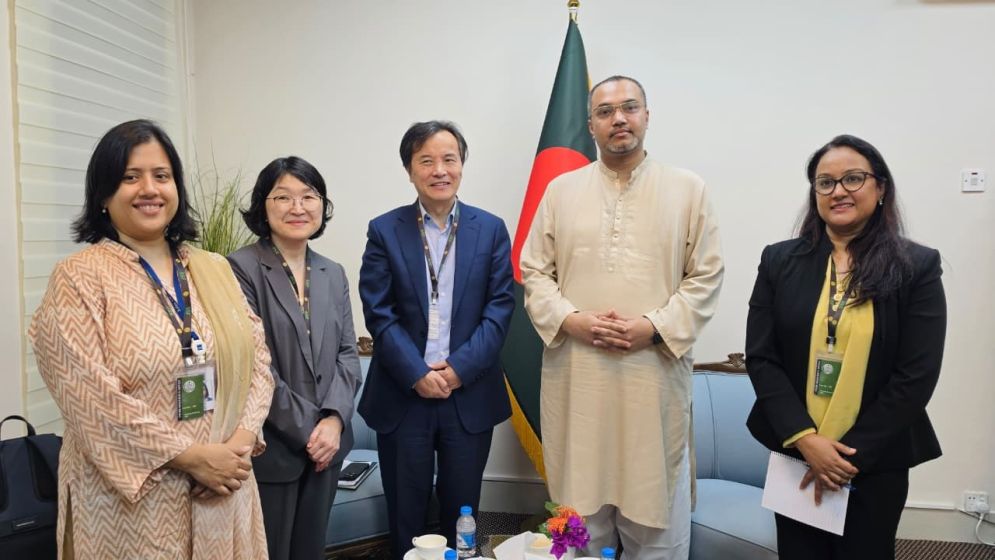
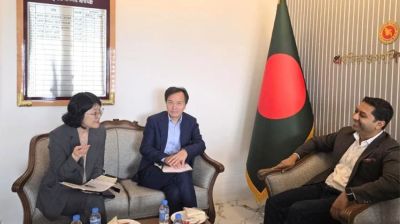
Photo: Courtesy
The Asian Development Bank (ADB) has expressed interest in providing investment and grants to Bangladesh in information technology, agricultural entrepreneurship and industry-academia partnerships.
ADB Country Director for Bangladesh Chun-Feng Zhang
conveyed the interest during a meeting with Mahdi Amin, Prime Minister’s
Adviser on Education, Primary and Mass Education and spokesperson for the Prime
Minister’s Office, at the Prime Minister’s Office in Tejgaon on Thursday
afternoon.
Other members of the ADB delegation included Gi Sun
Song, director of the bank’s Human and Social Development Division; Faiza Ahad,
project officer (education); and Farin Islam, programme officer.
During the meeting, Zhang outlined plans to invest
in research and development capacity in higher education, particularly in
computer science, information and communication technology (ICT) and software
engineering.
The ADB also expressed interest in strengthening
collaboration between industries and educational institutions and supporting
research-based entrepreneurship initiatives at agricultural universities.
In addition, the bank plans to explore initiatives
to improve teachers’ skills at secondary and higher education levels and
enhance classroom teaching through interactive learning materials and the use
of artificial intelligence.
Zhang said one of the key objectives of the ADB's
programme was to ensure that university research went beyond academic
publications and contributed to solving practical problems faced by industries.
During the meeting, Mahdi Amin outlined the
government's ongoing initiatives and future plans to modernise the country's
education system.
He said the government was introducing two
compulsory subjects, Sports and Culture, in Grade Four for the first time in
Bangladesh as part of a major reform aimed at making education more enjoyable
and participatory.
The initiative will be extended to Grade Five in the
next academic year and gradually introduced across all grades, he added.
Reaffirming the government's commitment to expanding
female education, Amin said the previous BNP government, led by former prime
minister Khaleda Zia, had introduced free education for girls up to Grade 12.
Building on that initiative, the current government
has announced free education for girls up to the undergraduate level, with
plans to extend the facility to postgraduate or master's level within the next
two to three years as part of its medium-term goals.
He also said the government's mid-day meal programme
was currently operating in 150 government primary schools, covering students
from Grade One to Grade Five. The programme is expected to be gradually
expanded to all primary schools across the country.
Outlining plans to improve the classroom
environment, Amin said the government was gradually replacing conventional
benches in government primary schools with individual chairs and tables for
students, alongside providing free school uniforms and mid-day meals.
The government is also introducing learning toys and
outdoor recreational facilities, including playground slides, at government
primary schools to support children's mental development and promote a learning
environment based on happiness and cultural engagement.