


 For all latest news, follow the Daily Sun's Google News channel.


S Alam-linked coal trader in race for Rampal supply deal
Daily Sun Report, Dhaka
Published: 12 Nov 2026, 12:00 AM
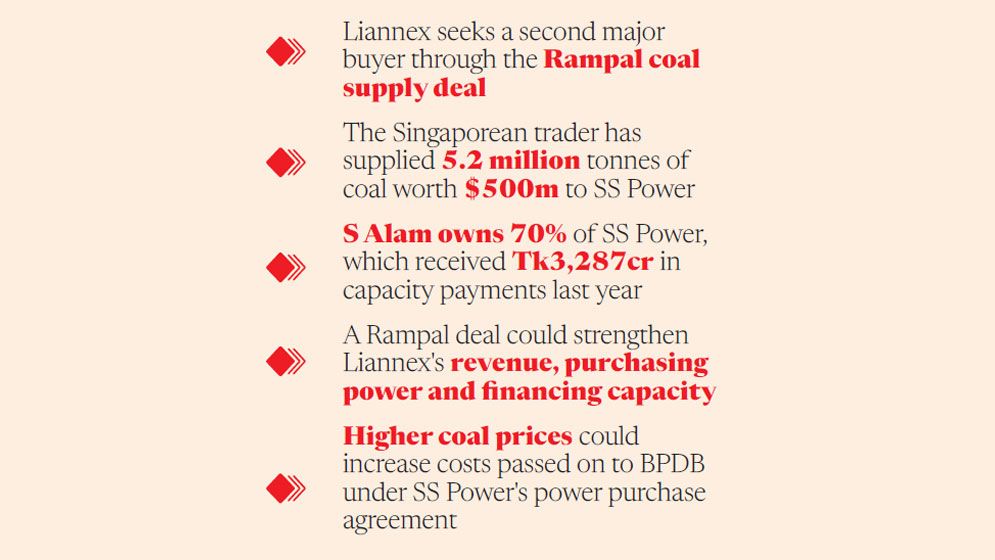
A coal trader whose business in Bangladesh has so far been centred on S Alam Group's Banshkhali power plant is seeking to expand its presence in the country's power sector through a major supply contract at Rampal.
Singapore-based Liannex Corporation (S) Pte Ltd is one of three foreign companies still competing for an 8-million-tonne coal supply contract for the Rampal power plant. Two Bangladeshi bidders, including the plant's existing supplier, have been disqualified over alleged irregularities in their tender documents.
The development has drawn attention to the procurement process, particularly because Liannex has so far supplied coal exclusively to SS Power I Limited, the 1,320MW plant controlled by S Alam Group in Banshkhali, Chattogram.
An examination of National Board of Revenue (NBR) customs records shows that Liannex imported around 5.2 million tonnes of Indonesian coal for SS Power between January 2025 and September 2026. The shipments were worth approximately $500 million.
All 216 bills of entry reviewed identified SS Power as the importer. No records of Liannex supplying other Bangladeshi customers were found in the documents examined.
Securing the Rampal contract would give the Singaporean trader another major buyer in Bangladesh and potentially reduce its dependence on SS Power, which has faced financial difficulties, loan defaults and constraints in opening import financing.
The additional business could also strengthen Liannex's purchasing and financing capacity, with possible benefits for its existing coal trade with SS Power.
S Alam Group owns 70% of SS Power. The plant received Tk3,287 crore in capacity payments during the last full year, according to figures reported by a local media outlet.
The continued availability of coal is important for keeping the Banshkhali plant operational and maintaining its eligibility for payments under the power purchase agreement, subject to the agreement's conditions.
Liannex's Bangladesh business
According to customs records from Chattogram, Liannex started supplying Indonesian steam coal to SS Power on 20 January 2025.
The company supplied approximately 5.2 million tonnes of coal worth around $500 million up to 24 September 2026 through 216 consignments.
A review of customs data dating back to January 2024 found no earlier shipments by Liannex to other power producers in Bangladesh. By the time the Rampal tender closed in May 2026, the trader had been operating in the country's coal market for about 16 months.
SS Power has experienced difficulties in importing coal amid disputes over unpaid electricity bills from the Bangladesh Power Development Board (BPDB).
In March and April 2026, the company informed the government that it could not unload a coal vessel because of outstanding payments from BPDB. Customs records also show that Liannex's coal clearances declined in March and stopped in April before resuming in May.
The declared prices were higher when imports restarted.
Liannex's coal prices generally ranged between $78 and $93 per tonne during 2025 and the first quarter of 2026. The average declared price rose to $109 per tonne in May 2026, while prices reached $118-$121 per tonne by September.
This represented an increase of around 30% in six months. International coal prices also increased during the period amid disruption in energy markets linked to tensions around the Strait of Hormuz and Bangladesh's greater reliance on coal.
In May 2025, Liannex's invoiced prices were below the regional Platts benchmark.
Under SS Power's power purchase agreement, eligible fuel costs are passed on to BPDB. This means the price of coal supplied to the plant is also relevant to the cost of electricity borne by the public power system.
On 16 August 2026, Bangladesh Bank granted a waiver allowing state-owned Rupali Bank to finance SS Power's coal imports against a 100% cash margin until December 2027, although the company was classified as a loan defaulter.
The waiver enabled SS Power to continue obtaining import finance that would otherwise have been restricted. Customs data show an increase in Liannex's shipments in August and September.
However, the available records do not establish whether the waiver directly financed each shipment made by Liannex.
Business links and ownership
Liannex Corporation (S) Pte Ltd was incorporated in Singapore in July 1993 and is registered at 18 Sungei Kadut Way.
The company initially worked in bus assembly before moving into cement and coal trading.
Its website says it trades around 2 million tonnes of coal annually, mainly sourced from Indonesia's Sumatra region. It is also a licensed user of the globalCOAL trading contract and has banking arrangements with DBS.
The company is associated with Malaysian businessman Lim Han Weng, founder and executive chairman of Yinson Holdings, a Bursa Malaysia-listed energy company. Yinson's corporate filings identify Liannex as a privately held business associated with Lim.
Liannex's business operations also include tug-and-barge subsidiaries that transport coal and gypsum across Indonesia, Malaysia and Vietnam.
Information cited in the investigation indicates that the company has recently supplied around 3 million tonnes of coal annually to SS Power.
Existing Rampal supplier dropped
The disqualified consortium of Bashundhara Multi Trading, Singapore-based Equentia Natural Resources and UAE-based Atro International secured Rampal's first long-term coal supply contract in 2023 after submitting the lowest of three bids.
By January 2026, the consortium had delivered 5.65 million tonnes of coal to the 1,320MW plant, operated by Bangladesh-India Friendship Power Company (BIFPCL).
Its supplies continued despite foreign currency shortages, delayed payments and difficulties in opening letters of credit. In November 2025, it delivered 5 lakh tonnes in a single month, described as a national record.
The consortium also provided interest-free bridging finance to BIFPCL to help arrange letters of credit for coal imports.
The two 660MW units of Rampal generated more than 9% of Bangladesh's electricity in April, according to figures cited in the investigation.
Despite its delivery record, the consortium was excluded from the latest tender. Akij Shipping, another Bangladeshi bidder, was also disqualified.
People familiar with the evaluation process said the objections included spelling differences, the positioning of signatures and inconsistencies in dates on powers of attorney.
They also said BIFPCL sought a legal opinion in support of the decisions. The company was contacted for clarification but did not respond.
The exclusions have prompted questions among procurement experts about whether the tender requirements were applied consistently.
Section 48(1) of the Public Procurement Act requires evaluation to follow the criteria stated in the bidding documents. Section 26(2) deals with bidder qualifications, including previous performance, production capacity and financial strength.
Rule 98 of the Public Procurement Rules 2008 distinguishes between minor defects that can be corrected and material deviations that affect a tender's scope, quality, performance or competitive position.
Whether the reported discrepancies were sufficient grounds for disqualification would depend on the specific tender conditions and the evaluation findings.
There are also questions about the sequence of the evaluation. People familiar with the process claimed that financial bids had already been opened while arrangements were being made for visits to coal mines in Indonesia.
BIFPCL has not confirmed these claims.
Under the single-stage, two-envelope tender procedure, technical evaluation must be completed and approved before financial proposals are opened. The timing of the proposed mine inspections could therefore be significant if they were part of the technical qualification process.
An official of BIFPCL, speaking on condition of anonymity, said a senior technical team was conducting the evaluation and no single individual controlled the process.
The company has previously argued that its joint-venture status places it outside the Public Procurement Act.
BPDB owns half of BIFPCL, while India's NTPC holds the remaining 50%. The evaluation committee reportedly includes a deputy secretary from the Shipping Ministry, a BPDB director and an official of the Bangladesh Shipping Corporation.
The applicable procurement framework and the committee's evaluation records were not available in the documents reviewed for the investigation.
Earlier controversy over Matarbari tender
The latest dispute at Rampal follows a similar controversy involving the Bashundhara-led consortium in a coal supply tender for the Matarbari power plant.
In 2024, the Coal Power Generation Company changed the technical requirements just three working days before the deadline for submitting bids. The revised conditions allowed companies experienced in transporting cement, fertiliser and grain to participate in the coal supply tender.
The Bashundhara consortium was later declared non-responsive because of the wording of its bid security, despite a contrary written opinion from the procurement authority, according to records cited in the investigation.
A consortium involving Unique Cement and the Singapore trading arm of Aditya Birla remained in the competition.
On 5 September 2024, the High Court ruled that the changes to the tender conditions were contrary to procurement rules and questioned the process. It did not, however, order a fresh tender, as the Matarbari plant had only 10 days of coal stock remaining.
The plant subsequently faced further supply problems. Within months, it rejected a coal shipment reportedly containing soil and operated with only one unit.
Potential gains for Liannex
A successful bid at Rampal would expand Liannex's role in Bangladesh's coal market, giving it supply arrangements with two major power plants.
The ownership structures of the plants are different. BPDB holds a 50% stake in the Bangladesh-India joint venture operating Rampal, while S Alam Group owns 70% of the privately owned SS Power.
SS Power receives capacity payments and reimbursement of eligible fuel costs under its power purchase agreement. Its ability to maintain generation therefore depends partly on securing coal and financing imports.
Experts said a Rampal contract could increase Liannex's revenue and improve its access to financing and coal supplies. Such commercial advantages could also strengthen its existing business with SS Power.
The outcome of the tender will determine whether the Singaporean trader can establish a second major foothold in Bangladesh's power sector.