



 For all latest news, follow the Daily Sun's Google News channel.


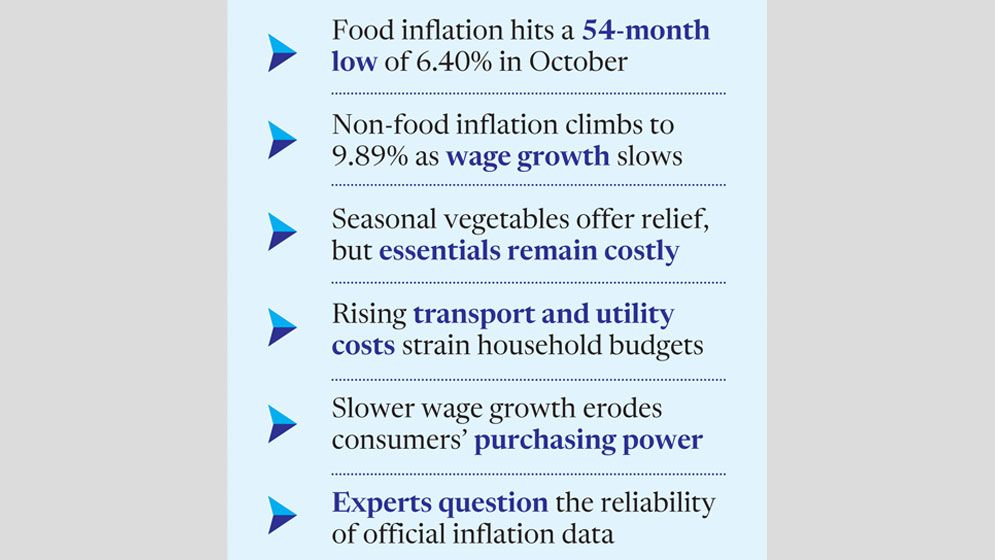
Food inflation fell to 6.40% in October, its lowest level in 54 months, as increased supplies of seasonal vegetables helped ease price pressures.
However, higher prices of several essential commodities and non-food services continued to weigh on household budgets amid slowing wage growth.
The latest Bangladesh Bureau of Statistics (BBS) data show that food inflation declined from 7.22% in September to 6.40% in October.
The rate was last lower in April 2022, when it stood at 6.24%. It was 6.34% in March, 6.22% in February and 5.60% in January that year.
General inflation also edged down to 8.27% in October from 8.34% in September.
However, non-food inflation rose to 9.89% from 9.30% over the same period, while point-to-point wage growth slowed to 7.63% from 7.90%.
The figures indicate that although food price increases have eased, rising non-food costs and slower income growth continue to put pressure on household budgets.
Seasonal vegetables bring some relief
The arrival of winter vegetables has helped lower the prices of some seasonal produce, offering consumers some relief. However, the decline in food inflation does not mean that prices across the entire food basket have fallen.
Rice, a staple for almost every household, remains a major component of food expenditure, while cooking oil, sugar and other essentials continue to account for a significant share of household spending.
Consumers Association of Bangladesh (CAB) President AHM Shafiquzzaman told the Daily Sun that rice prices should be examined over the past three to four years to understand the pressure on household food expenditure.
He also pointed to the continued high prices of essential commodities such as sugar and cooking oil despite the recent decline in food inflation.
Rising gas and petroleum prices have added to household expenses, while higher transportation costs affect the prices of goods brought to markets from different parts of the country, he said.
Lower inflation does not mean lower prices
Economists say the distinction between inflation and the actual price level is important in interpreting the latest figures.
Inflation measures the rate at which prices increase compared with the same period a year earlier. A decline in inflation therefore means prices are rising more slowly, not necessarily that goods and services have become cheaper.
Dr Mustafa K Mujeri, former chief economist of Bangladesh Bank and executive director of the Institute for Inclusive Finance and Development (InM), said that the fall in food inflation could partly reflect seasonal changes in vegetable supplies and prices.
However, he cautioned against interpreting the latest decline as evidence of a sustained improvement in the overall price situation.
Prices of different commodities move at different rates depending on supply, demand, market conditions and transportation costs.
Higher fuel prices, in particular, can increase the cost of bringing food and other goods to markets, he said.
Mujeri added that inflation had yet to show a consistent downward trend. Both food and non-food inflation would need to decline steadily before a sustained easing of price pressures could be established.
Non-food costs remain elevated
The rise in non-food inflation remains a concern for households, particularly as spending on essential services accounts for a significant share of monthly expenses.
BBS data show that non-food inflation increased to 9.89% in October from 9.30% in September. The rate stood at 10.21% in rural areas and 9.48% in urban areas.
Higher expenditure on housing, utilities, healthcare and transport can leave families with less money to spend on food, education and other necessities.
Shafiquzzaman said increases in gas and petroleum prices had raised living costs, with higher transportation expenses affecting prices across different sectors of the economy.
Economists say energy and transportation costs can have wider effects on consumer prices because they influence production, distribution and service delivery.
Wage growth continues to lag inflation
The latest figures also show that wage growth continues to fall behind inflation, affecting workers’ purchasing power.
The national wage rate index rose 7.63% in October, compared with 8.01% in the same month a year earlier.
Sector-wise wage growth stood at 7.55% in agriculture, 7.62% in industry and 7.96% in services.
Inflation outpaced wage growth for 57 consecutive months from February 2022 to October 2026, according to the figures cited in the report. Although the gap has narrowed since 2024, workers’ earnings continue to struggle to keep pace with rising living costs.
Mujeri said limited job creation and growing competition for available work were contributing to slower wage growth.
The movement of people from rural areas to cities in search of informal employment also reflected limited opportunities in the labour market, he said.
When wages rise more slowly than prices, workers’ real purchasing power declines. Low-income families may then have to reduce spending on nutritious food, protein and other essential items.
Mujeri warned that prolonged pressure on household purchasing power could worsen malnutrition and affect the health of women and children in vulnerable families.
Sustained easing needed for greater relief
Economists say the latest decline in food inflation is a positive development, but sustained improvement in household purchasing power will depend on broader price stability and stronger income growth.
Seasonal changes in agricultural production can provide temporary relief, while movements in fuel prices, transportation costs and other essential expenses continue to influence overall inflation.
Mujeri stressed the importance of interpreting inflation figures in context, taking account of year-on-year comparisons, seasonal supply changes and differences in the prices of individual commodities.
For consumers, the key measure of improvement will be whether the prices of essential goods and services stabilise and wage growth strengthens.
A sustained decline in both food and non-food inflation, alongside improved real wages, would help ease pressure on household budgets and support consumer spending.
Read More