


 For all latest news, follow the Daily Sun's Google News channel.


IDRA’s tougher CFO rules put insurers in a fix
Mandatory professional qualifications, regulatory nod raise concerns over job security of existing CFOs

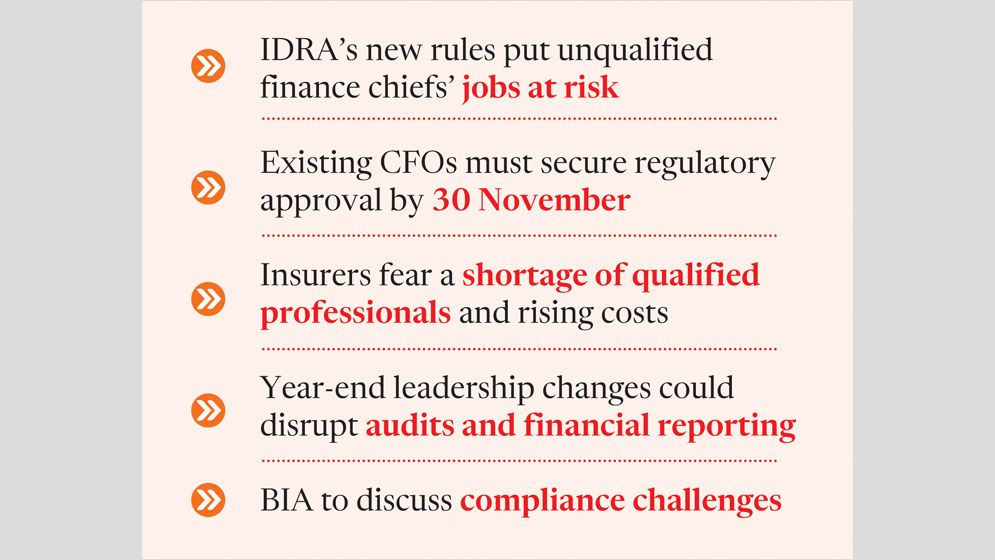
The Insurance Development and Regulatory Authority (IDRA) has introduced stricter qualification requirements for chief financial officers (CFOs) of insurance companies, making professional certification and regulatory approval mandatory to strengthen financial governance in the sector.
The new directive also applies to existing CFOs, raising concerns over the job security of experienced officials who lack the prescribed professional qualifications.
Insurance industry insiders say the requirements, coupled with a tight compliance deadline, could put additional pressure on companies already struggling with financial and operational challenges.
IDRA issued the directive through a circular dated 28 October, requiring insurance companies to ensure that their CFOs meet specified professional qualifications and obtain regulatory approval.
The Bangladesh Insurance Association (BIA) is set to hold a meeting to discuss implementation of the directive.
According to a notice signed by BIA Secretary Md Omar Faruk on 1 November, the meeting will discuss the appointment of qualified CFOs in line with IDRA’s requirements and other related matters.
Members of the association’s life and non-life insurance technical subcommittees have been asked to attend the meeting virtually.
The BIA president, first vice-president, vice-presidents and executive committee members have also been informed.
Industry insiders said Bangladesh currently has 82 life and non-life insurance companies, many of which have traditionally appointed CFOs based on professional experience and performance.
Under the new rules, however, companies must ensure that their CFOs possess the prescribed professional qualifications and relevant experience.
While the move is expected to improve financial discipline and corporate governance, industry representatives fear that recruiting qualified professionals within the stipulated timeframe will be difficult.
Professional qualifications mandatory
According to the IDRA circular, candidates must hold at least one of the specified professional qualifications to be eligible for appointment as CFO.
These include fellow or associate membership of the Institute of Chartered Accountants of Bangladesh (ICAB), the Institute of Chartered Accountants in England and Wales (ICAEW), the Association of Chartered Certified Accountants (ACCA) of the UK, or the Institute of Cost and Management Accountants of Bangladesh (ICMAB).
Candidates holding Certified Public Accountant (CPA) qualifications from the US or Canada, or the Chartered Financial Analyst (CFA) qualification from the US, will also be eligible.
Professional accounting qualifications obtained outside Bangladesh must be recognised by ICAB or ICMAB.
Besides meeting the qualification requirements, candidates must obtain IDRA approval before taking up the position.
Insurance companies will have to submit applications to the regulator with details of candidates’ professional qualifications and experience. Appointments can take effect only after regulatory approval.
The directive also covers CFOs already serving in insurance companies.
Companies employing CFOs who meet the prescribed requirements must apply to IDRA for approval, submitting details of their qualifications and professional experience.
Existing CFOs who fail to meet the requirements may have to be replaced with qualified professionals in accordance with the procedures outlined in the circular.
IDRA has set 30 November as the deadline for completing the required approval and appointment procedures for existing CFOs.
Concerns over experienced CFOs losing jobs
Insurance industry insiders say the directive could create difficulties for companies with limited financial resources, as recruiting professionals with chartered accountancy or equivalent qualifications may involve substantial costs.
They said many insurance companies have CFOs with 10 to 20 years of experience in financial management who may not possess the newly prescribed professional certifications.
Despite their extensive experience and familiarity with their companies’ financial operations, these officials could lose their positions under the new requirements.
Industry representatives argued that practical experience and institutional knowledge should also be considered when assessing the eligibility of existing CFOs.
Replacing experienced officials solely because they lack professional certifications could deprive companies of valuable expertise while increasing recruitment and training costs, they said.
They also warned that a simultaneous demand for professionally qualified CFOs across the insurance sector could create a shortage of suitable candidates and drive up recruitment costs.
Year-end deadline poses additional challenges
SM Nuruzzaman, chief executive officer of Zenith Islami Life Insurance, said the deadline would make it difficult for many companies to complete the recruitment and approval process.
He said the limited availability of professionally qualified candidates, combined with simultaneous recruitment requirements across the sector, could make finding suitable replacements particularly challenging.
Companies would also need time to recruit candidates, verify their qualifications and secure regulatory approval, he added.
Nuruzzaman warned that replacing CFOs towards the end of the financial year could disrupt the preparation of annual financial statements and audit-related activities.
Newly appointed CFOs would require time to familiarise themselves with their companies’ accounts, financial records and previous transactions before assuming full responsibility, he said.
As a result, changes in financial leadership at this stage could complicate the preparation and supervision of annual financial reports.
He stressed that the transition would require careful management to avoid disruptions to companies’ financial reporting and audit processes.