


 For all latest news, follow the Daily Sun's Google News channel.


Garment factories resume operations as workers return after days of unrest
NBR seeks freezing of 100 individuals' bank accounts over suspected financing of unrest
Daily Sun Report, Dhaka
Published: 06 Nov 2026, 12:00 AM
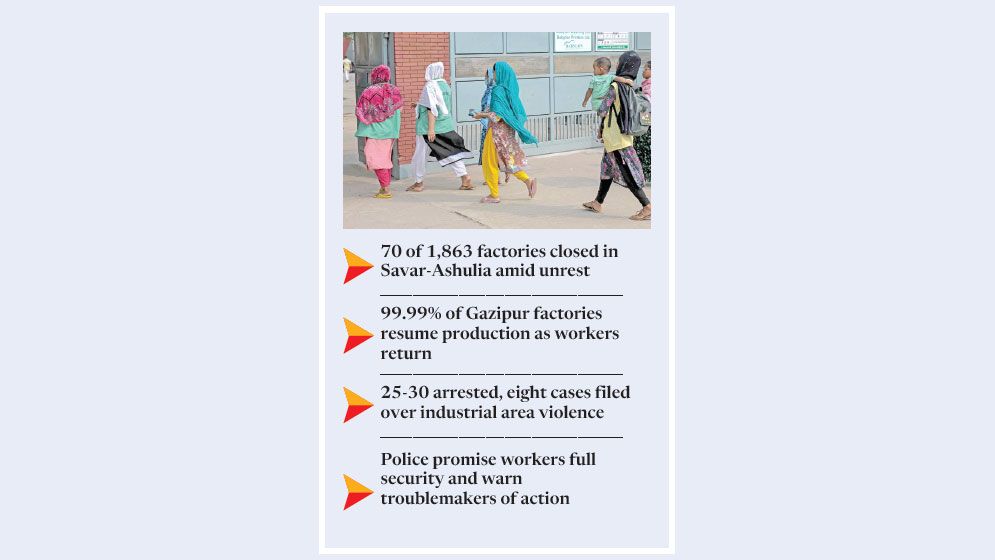
Garment workers returned to factories across the country on Thursday, bringing gradual normalcy to the readymade garment (RMG) sector after four days of unrest over demands to raise the minimum monthly wage from Tk12,500 to Tk30,000.
Almost all factories in Gazipur and most in Savar-Ashulia and Narayanganj reopened, though isolated protests and closures continued in Ashulia.
The government formed a six-member minimum wage board on Sunday, which held its first meeting on Wednesday. The new structure is expected to take effect in December, with salaries paid from January 2027.
Gazipur
In Gazipur, almost all factories reopened, including those that had announced sudden holidays the previous day. Workers queued to enter factories in Bhogra, Naojor, Board Bazar and Signboard around 8am, with production underway.
Gazipur Industrial Police Superintendent Amjad Hossain said 99.99% of factories were operational. Traffic on the Dhaka-Mymensingh and Dhaka-Tangail highways was normal, but Libas Garment Factory remained closed.
In Savar and Ashulia, most factories resumed operations in several areas, including Ulail and Baipail. But some workers in Ashulia left factories after marking attendance and urged others to stop work.
At around 8:30am, workers blocked the Abdullahpur-Baipail road in Jamgara. Clashes broke out when police tried to clear the road. Protesters threw bricks and stones, damaging an Industrial Police vehicle. Police used tear gas and sound grenades.
Around 400 to 500 protesters gathered outside Fabrica Knit Composite in Dosaid at about 9:30am and broke two gates. The factory and nearby units closed.
Industrial Police-1 Superintendent Mohammad Mominul Islam Bhuiyan said 70 of the 1,863 factories under his jurisdiction were temporarily closed over security concerns.
He said outsiders attacked factories and police after some people were detained. Police used tear gas and sound grenades.
He added that around 2,500 workers staged a peaceful procession from Jirabo to the Envoy factory to protest the killing of a worker in Gazipur.
BGB Dhaka Battalion commander Lieutenant Colonel Taimur Hasan Khan said the situation was better than on previous days, with no sabotage reported. Five BGB platoons remained deployed across the Savar-Ashulia industrial belt throughout Thursday.
Narayanganj
In Narayanganj, normal activities resumed after three days of demonstrations, road blockades and clashes. Workers returned to factories in Fatullah and nearby areas. No fresh protests were reported, and traffic moved normally. Police, BGB and Special Response Battalion personnel were deployed at key points.
Narayanganj Superintendent of Police Habibur Rahman said no unrest had been reported, while Additional Superintendent of Police Tarek Al Mehedi said extra personnel were deployed to prevent disorder.
FM Abu Sayeed, president of the Bangladesh Trust Workers Federation, said workers had returned and the situation was peaceful. He feared groups were fuelling discontent.
Mirpur
In Mirpur, workers tried to gather on a road in Rupnagar but dispersed after noticing police.
Rupnagar Police Station Officer-in-Charge AB Siddique said 3,000 to 4,000 Rising Group workers from Shialbari had joined work before stopping around 9:40am. The factory later announced a holiday. No incident occurred. Police, BGB and SRB personnel were deployed in Mirpur-10 and Mirpur-11.
Police assure workers of security
Dhaka Range DIG Mustafizur Rahman urged factory owners to reopen closed units, assuring workers of police protection at factories, on roads and at home.
Visiting DEPZ in Ashulia, he said factories in Gazipur, Narayanganj and Savar were operating, except a few in Ashulia, while all DEPZ units remained open. Uniformed and plainclothes police were deployed, with patrols in workers' residential areas.
He alleged outsiders were exploiting workers' emotions to create disorder. Labour representatives told a Wednesday meeting in Savar that the unrest did not represent them and that they had sought a wage board.
He said 25-30 people, none of whom were garment workers, had been arrested in Savar and Ashulia. Eight cases had been filed, with more pending. He warned troublemakers of legal action and urged residents and businesspeople to cooperate.
Industrial Police DG Gazi Jasim said the situation had improved considerably, workers had returned, and intelligence surveillance had contained attempts to spread rumours.
NBR seeks freezing of 100 individuals' bank accounts
The National Board of Revenue (NBR) has asked banks and financial institutions to identify and freeze the accounts of nearly 100 individuals over allegations of financing activities aimed at creating unrest in the country’s garment sector. It has also sought detailed transaction records of around 125 companies to determine whether their funds were used to fuel instability in the readymade garment (RMG) industry.
On Thursday, the NBR’s Central Intelligence Cell (CIC) reportedly emailed urgent instructions to all banks across the country. According to sources at different banks and the NBR, two intelligence units have sent letters to banks and financial institutions seeking the freezing of the listed individuals’ accounts and detailed transaction records of the 125 companies. The CIC has also emailed banks a list of the individuals and entities concerned.
Most of the individuals are reportedly linked to the ousted Awami League government, including former ministers, MPs and influential businesspeople.
Those named include former prime minister’s private industry and investment adviser Salman F Rahman, former lawmaker Abdus Salam Murshedy, former commerce minister Tipu Munshi, former state ministers Shahriar Alam and Nasrul Hamid, and former local government minister Tajul Islam.
Prominent business figures on the list include Tusuka Group’s Faizur Rahman, Well Group’s Abdus Salam, Nipa Group’s Khasru Chowdhury, Standard Group’s Mosharraf Hossain and former Bangladesh Garment Manufacturers and Exporters Association (BGMEA) president SM Mannan Kochi. Family members of some listed individuals have also been included.
A senior NBR official, speaking on condition of anonymity, said the initiative was based on information from several government agencies. Allegations suggest that the individuals and companies financed activities aimed at creating unrest in the garment sector, and their financial transactions are being examined to establish whether the claims are true.
Some of those named are in jail, while others are absconding.
The investigation is still ongoing, and officials concerned said the list could be expanded as the inquiry progresses. They could not specify when it would be completed.
The account-freezing requests and transaction-record demands aim to trace the flow of funds and determine whether money from the individuals and companies concerned was used to destabilise the country’s vital garment industry.
The reporter can be reached at [email protected]