


 For all latest news, follow the Daily Sun's Google News channel.


BGMEA, BKMEA call for collective, lasting solutions to secure RMG's energy future
Daily Sun Report, Dhaka
Published: 03 Nov 2026, 06:04 PM
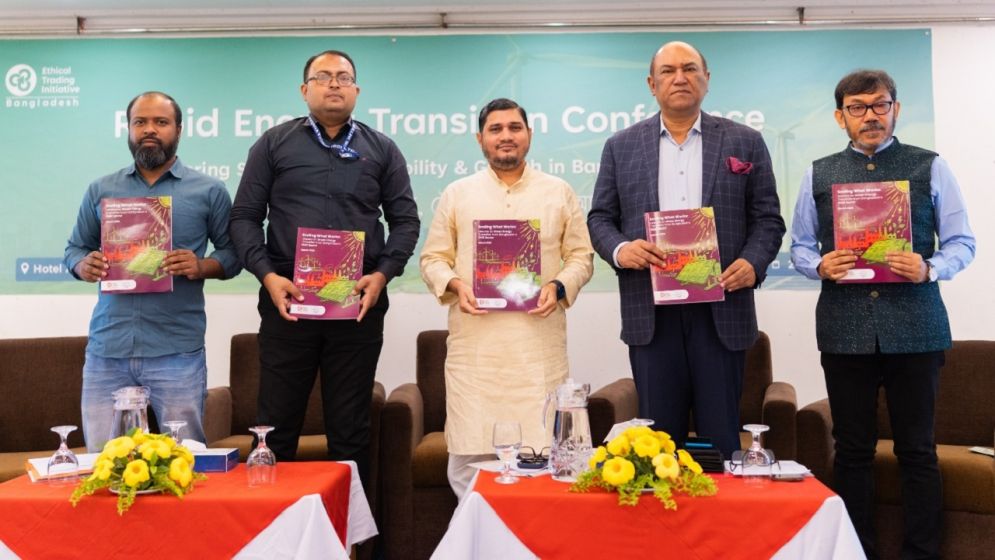
PHOTO: COURTESY
The garment and textile industry cannot achieve its green energy transition through individual factory initiatives alone but require coordinated action from government and other stakeholders to overcome the ongoing energy crisis and secure long-term competitiveness, BGMEA and BKMEA leaders stressed at a conference in Chattogram on Monday.
The call came at the third “Rapid Energy Transition
Conference: Powering Security, Sustainability and Growth in Bangladesh RMG,”
organised by Ethical Trading Initiative (ETI) Bangladesh at a hotel in Chattogram,
says a press release. Building on the previous conferences held in Dhaka and
Narayanganj, the event explored challenges and potential solutions for energy
transition in Chattogram.
The conference brought together 85 participants, including
70 factory representatives, eight members of BGMEA and BKMEA’s leadership based
in Chattogram, and one worker representative, alongside industry experts, bankers,
and renewable energy service providers.
Industry representatives warned that while factories are
under growing pressure to reduce carbon emissions and meet international
buyers' sustainability requirements, limitations in renewable-energy
availability, infrastructure and financing continue to constrain their ability
to complete transition.
Enamul Aziz Chowdhury, director and acting vice president of
the Bangladesh Garment Manufacturers and Exporters Association (BGMEA) and managing
director of HK TG Garments Ltd, emphasised that the current energy crisis has
exposed the vulnerability of Bangladesh's dependence on imported fossil fuels
and the need for a more sustainable energy system.
“Renewable energy and carbon reduction are no longer simply
environmental agendas or corporate social responsibility initiatives. They are
directly linked to our industry's ability to survive and remain competitive in
global markets,” Chowdhury said.
He warned that the industry must look beyond temporary
responses to the energy crisis and prepare for the changing global trade
environment, particularly Bangladesh's upcoming graduation from least developed
country (LDC) status and increasing environmental and climate-related
requirements in export markets.
He also added that this transition cannot be undertaken by
the manufacturers alone and rather require support from government, accessible
green financing, technical assistance and long-term partnerships with global
brands and buyers.
Echoing the urgency, Md Yasin, director of the Bangladesh
Knitwear Manufacturers and Exporters Association (BKMEA) and managing director of
Sonnet Group of Companies Ltd, warned that rising energy insecurity, global
economic pressures and changing international market requirements are
increasingly challenging the sustainability of Bangladesh's RMG industry.
“Renewable energy transition is no longer a luxury. It has
become a global necessity for the long-term survival of our industry,” Yasin
said.
He urged manufacturers to make effective use of the
preparation period before LDC graduation to improve energy efficiency,
accelerate renewable-energy adoption and strengthen compliance with emerging
global sustainability standards.
Chattogram's significance as one of Bangladesh's major
industrial and commercial centres made the discussion particularly relevant.
Home to a substantial garment, textile and export-oriented manufacturing base,
including factories within and beyond export processing zones, the region faces
energy challenges that directly affect production continuity, operating costs
and export competitiveness.
Speakers emphasised that the transition must reach
industrial regions outside Dhaka and respond to their region-specific
infrastructure, investment and operational challenges.
The discussion highlighted a critical limitation: rooftop
solar alone may not be sufficient for factories to meet growing
renewable-energy requirements from international buyers.
The discussions therefore called for solutions beyond
individual factory installations, including off-site expansion of renewable
power, mechanisms to purchase renewable electricity from external producers,
decarbonisation of the national grid and more effective incentives for
factories supplying surplus solar power.
Closing the conference, Lt Comd (retd) Md Kutubuddin, additional
secretary of BGMEA, highlighted the opportunities to utilise available land in
Chattogram, including potentially unused spaces within export processing zones,
for renewable-energy generation and supply to the national grid.
Md Althaf Uddin, Senior Joint Secretary (Admin) of BKMEA
and Member of the Labour Court, Chattogram, called for long-term planning to
ensure that the industry can sustain its operations over the next five to ten
years.
Drawing on the garment industry's collective efforts to
strengthen factory compliance following the Rana Plaza incidence, he emphasised
that similar cooperation would be necessary to ensure energy sovereignty in
Bangladesh.
Representing the workers' perspective, Md Hasan Ali, convenor
of the Worker-led Climate Action Network (Worker CAN) and president of the
Youth Committee of the Bangladesh National Trade Union Federation (BNTUF),
stressed that renewable-energy transition must protect not only production and
business competitiveness but also workers' rights, employment and livelihoods.
“This industry belongs to all of us. If factory owners engage
workers and trade unions in the transition process, we can play an effective
role in making the industry more sustainable,” Hasan Ali said.
Munir Uddin Shamim, director for programme, evidence and
learning at ETI Bangladesh, emphasised that the industry's transition requires
systemic change rather than isolated factory initiatives. He highlighted ETI’s
role in connecting and leveraging relationship with industry stakeholders such
as BGMEA, BKMEA, global brands and worker leaders along with advocating for
policy and systemic changes to accelerate a renewable-energy transition.
The conference featured two working sessions examining the
urgency of renewable-energy transition and available financing and technology
pathways.
Jannatul Ferdaus, research officer at ETI Bangladesh,
outlined the global, national and sectoral drivers of the energy crisis and its
impacts on factory operations, supply chains and workers' livelihoods.
Sadia Rowshon Adhora of the Coastal Livelihood and
Environmental Action Network (CLEAN) presented the environmental, social and
economic benefits of solar power.
The second session brought together financial institutions
and renewable-energy service providers to explore practical investment
pathways. SAIFUL A Chowdhury of BRAC Bank PLC and Gultekin Binte Azad of City
Bank PLC presented green financing and refinancing opportunities, while Nure
Alam, chief executive officer of the Greener Garments Initiative (GGI),
highlighted renewable-energy technologies and third-party financing
arrangements that could help factories overcome upfront investment barriers.
The discussions brought forward several priorities and
recommendations:
·
Strengthening BGMEA, BKMEA,
government agencies and other stakeholders to advance industry-wide
renewable-energy transition and address policy and implementation barriers;
·
Exploring shared energy
infrastructure and coordinated supply arrangements in Chattogram's industrial
zones;
·
Expanding renewable-energy
solutions beyond rooftop solar, including grid decarbonisation and external
renewable-electricity procurement;
·
Developing practical
factory-level energy-transition roadmaps and strengthening energy efficiency.