


 For all latest news, follow the Daily Sun's Google News channel.


Major crop outputs rise in FY26
Soybean output jumps 25.5%, onion rises 18.6%; potato and wheat production decline
Daily Sun Report, Dhaka
Published: 02 Nov 2026, 12:00 AM
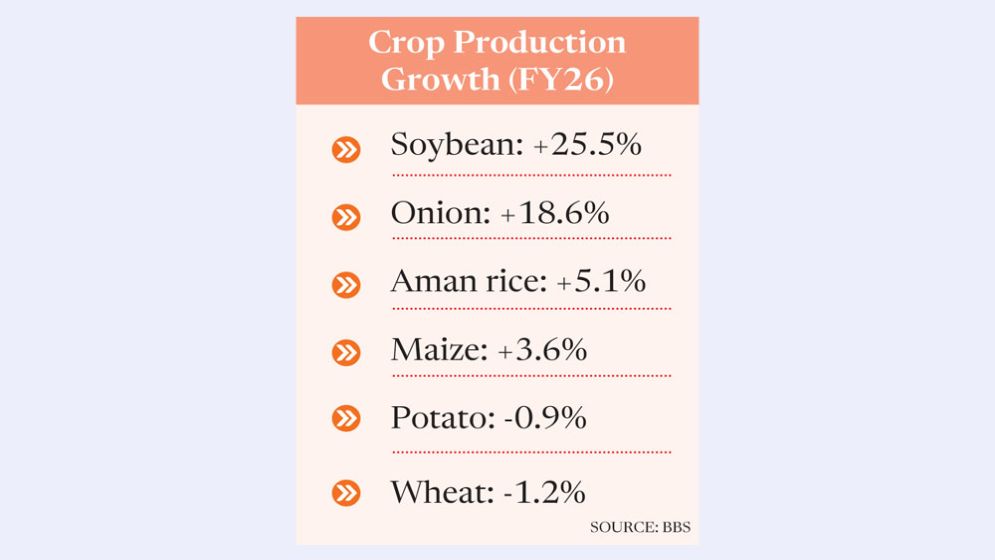
Bangladesh recorded higher production of several major crops, including soybean, onion, Aman rice and maize, in the 2025-26 fiscal year, although output of potato, wheat and some other crops declined, according to the Bangladesh Bureau of Statistics (BBS).
Soybean production posted the sharpest increase among the major crops highlighted in the latest BBS report, rising 25.5% to 136,183 tonnes from 108,481 tonnes a year earlier.
Onion output increased 18.6% to 3.82 million tonnes from 3.22 million tonnes, while Aman rice production grew 5.1% to 17.36 million tonnes from 16.51 million tonnes.
Maize production also rose 3.6% to 5.05 million tonnes from 4.87 million tonnes, reflecting higher output of several key agricultural commodities.
The figures were published in the BBS’s Quarterly Report on Crop Statistics and Agricultural Labour Wage (April-June 2026), which compares crop production estimates for FY26 with those of the previous fiscal year.
However, production of some major crops declined. Potato output fell around 0.9% to 11.27 million tonnes from 11.37 million tonnes, while wheat production dropped 1.2% to 1.03 million tonnes from 1.04 million tonnes.
The report also recorded declines in sugarcane, mung bean and sunflower production.
Oilseeds and spices record gains
The rise in soybean production was accompanied by an expansion in cultivation, with the area increasing to 171,101 acres from 142,780 acres in the previous fiscal year.
Onion cultivation also expanded to 569,787 acres from 535,599 acres, contributing to higher production.
Garlic output rose to 605,446 tonnes from 565,682 tonnes, while winter chilli production increased to 616,340 tonnes from 561,397 tonnes.
Sunflower production, however, declined slightly to 7,707 tonnes from 7,775 tonnes, as the cultivated area shrank to 11,381 acres from 11,523 acres.
Mixed trends in vegetables and fruits
Vegetable production showed mixed trends, with tomato output increasing to 565,018 tonnes from 538,693 tonnes and bean production rising to 249,681 tonnes from 233,906 tonnes.
Brinjal production, however, fell sharply to 366,752 tonnes from 496,918 tonnes, despite a relatively small decline in cultivated area.
Among fruits, banana production increased to 986,717 tonnes from 862,692 tonnes, while watermelon output rose to 2.08 million tonnes from 1.98 million tonnes.
Papaya production grew to 159,011 tonnes from 145,441 tonnes, while litchi output increased to 103,668 tonnes from 97,403 tonnes.
Strawberry production more than tripled to 1,506 tonnes from 435 tonnes, although cultivation remained limited to 328 acres.
Agricultural wages peak in May
The BBS report also showed fluctuations in agricultural labour wages between March and June 2026, with rates varying by gender and whether meals were provided.
Male agricultural workers receiving wages without meals earned Tk628 per day in March. The rate rose to Tk686 in April and peaked at Tk720 in May before falling to Tk648 in June.
For female workers under the same arrangement, daily wages increased from Tk461 in March to Tk493 in April and Tk510 in May, before declining to Tk478 in June.
May recorded the highest wages across the reported categories.
Male workers receiving two meals earned Tk757 per day that month, compared with Tk573 for female workers.
For those receiving one meal, daily wages stood at Tk697 for men and Tk587 for women in May, before declining to Tk622 and Tk437 respectively in June.
The figures also showed a persistent gender gap in agricultural wages across the categories.
How BBS collects the data
The BBS Agriculture Wing regularly estimates the cultivated area and production of six major crops and 140 minor crops through field surveys conducted after harvesting.
The bureau uses both subjective and objective methods. The subjective approach relies on interviews with farmers, while the objective method involves sample surveys, field measurements and direct observations.
For six major crops – Aus, Aman and Boro rice, wheat, potato and jute – the BBS uses 10,348 sampling clusters nationwide, each covering an average of five acres.
The clusters are distributed among districts according to their size, with at least 150 clusters allocated to each district.
For agricultural wage statistics, the bureau interviews 10 agricultural day labourers from each upazila every month on a sample basis. Where labourers are unavailable, information is collected from farmers who employ them.
The BBS calculates wage rates separately for male and female agricultural workers aged 15 and above, using district-level data to produce national estimates.
The bureau said the quarterly statistics were intended to provide regular updates on agricultural production and wages and support the compilation of quarterly gross domestic product estimates.