



 For all latest news, follow the Daily Sun's Google News channel.


Bangladesh loses $17.5b in potential earnings per year from heat: Report
The impact is particularly severe for vulnerable age groups
Daily Sun Report, Dhaka
Published: 01 Nov 2026, 06:25 PM
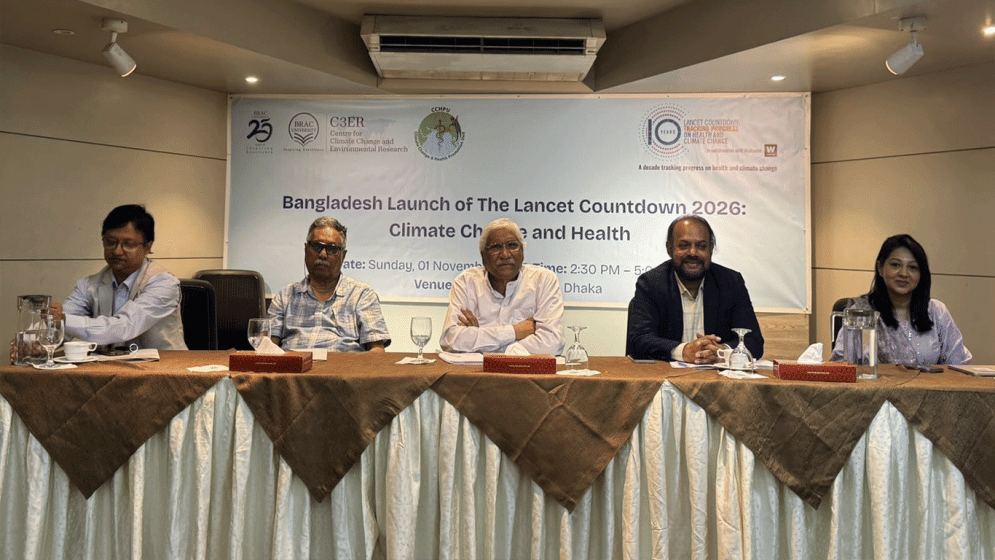
Photo: Daily Sun
Bangladesh lost an estimated USD$17.5 billion in potential earnings in 2025 due to heat exposure, highlighting the growing economic cost of climate change as rising temperatures increasingly threaten public health, productivity and livelihoods, according to the 2026 Lancet Countdown Report on Health and Climate Change.
The country also lost an average of more than 26
billion potential labour hours annually between 2016 and 2025 because of heat
exposure, 71% higher than the annual average in the 1990s, the report said.
The impact is particularly severe for vulnerable age
groups. During 2021-2025, infants experienced an average of 7.6 heatwave days
annually, while people aged over 65 faced 7.2 days. These figures represent
increases of 162% and 136%, respectively, compared with the 1986-2005 average.
The economic consequences of extreme heat are also
reflected in the rising value of heat-related mortality. The average annual
monetised value of heat-related deaths among people aged over 65 reached $3.8
billion during 2021-2025, equivalent to around 216,000 average annual incomes.
This was 495% higher than in 2000-2004.
The report warns that climate-related health risks
are intensifying, with many impacts growing faster during 2016-2025 than in the
preceding decade.
Air pollution is another major threat to public
health. Human-caused fine particulate matter (PM₂.₅) air pollution was
responsible for an estimated 239,000 deaths in Bangladesh in 2023, with deaths
linked to this pollution increasing by 40% between 2016 and 2023.
Fossil fuels contributed to 37.5% of those deaths in
2023, according to the report. Household air pollution was separately
associated with 77,500 deaths that year, down from 90,700 in 2016.
The monetised value of premature mortality from air
pollution reached $77.6 billion, equivalent to 16.4% of Bangladesh's gross
domestic product (GDP).
Despite the growing health burden, Bangladesh's
energy system became 9.9% more carbon-intensive between 2016 and 2023. Net
fossil fuel subsidies reached US$5.3 billion in 2024, equivalent to 52.9% of
the national health budget.
Md Ziaul Haque, additional director general of the
Department of Environment, said the report provides important evidence of
climate-related health risks, particularly for vulnerable communities.
He said Bangladesh must translate its commitments
under the Nationally Determined Contributions (NDCs) and National Adaptation
Plan into action. The estimated 239,000 deaths from human-caused particulate
air pollution highlight the urgent need to reduce pollution and fossil fuel
use, he added.
Dr Atiq Rahman, executive director of the Centre for
Advanced Studies, said climate change and health were directly linked, with
rising temperatures severely affecting working people and increasing health
risks for mothers and children.
“Unfortunately, we have delayed taking appropriate
action. Had we acted earlier, we could have better protected people from these
impacts,” he said.
The report also highlights gaps in financing for
climate-related health adaptation. Globally, 48 developing countries have
identified health adaptation needs of at least $3.3 billion annually, but only $1.1
billion was committed in 2024, around one-third of the stated requirements.
Finance and human resources were identified as the
leading barriers to implementing Health National Adaptation Plans.
Bangladesh has reported that its national
meteorological and hydrological services provide climate information to the
health sector to support preparedness and responses to climate-related risks.
Dr Ainun Nishat, emeritus professor at the Centre of
Climate Change and Environmental Research, BRAC University, said climate
adaptation efforts must reflect local realities, as many people have no choice
but to work outdoors even during extreme heat.
He stressed the need to implement the Health
National Adaptation Plan, particularly in areas such as food security,
nutrition and vector-borne diseases.
Accurate, locally relevant data is also essential to
understanding regional differences in temperature and climate-related health
risks, he said.
Tahrim Ariba Chaudhury, global climate and health lead
at GSCC, said climate-related health costs, including families' out-of-pocket
medical expenses, should be central to policy discussions at COP31.
She also emphasised the need to make renewable
energy an attractive and profitable investment in Bangladesh to support a
sustainable energy transition and protect public health.
The Bangladesh findings of the tenth annual Lancet
Countdown report were presented at a national launch at BRAC Centre Inn in
Dhaka on Sunday. The event was organised by the Centre for Climate Change and
Environmental Research (C3ER), BRAC University, with technical support from the
Climate Change and Health Promotion Unit of the Health Services Division,
Ministry of Health and Family Welfare.
The report calls for climate change to be recognised
and addressed as a global health emergency, urging governments to put health at
the centre of climate policies, including emissions reduction targets and
funding priorities.