


 For all latest news, follow the Daily Sun's Google News channel.


Experts urge urgent reforms as UN extends LDC graduation to 2029
Daily Sun Report, Dhaka
Published: 01 Nov 2026, 01:02 PM
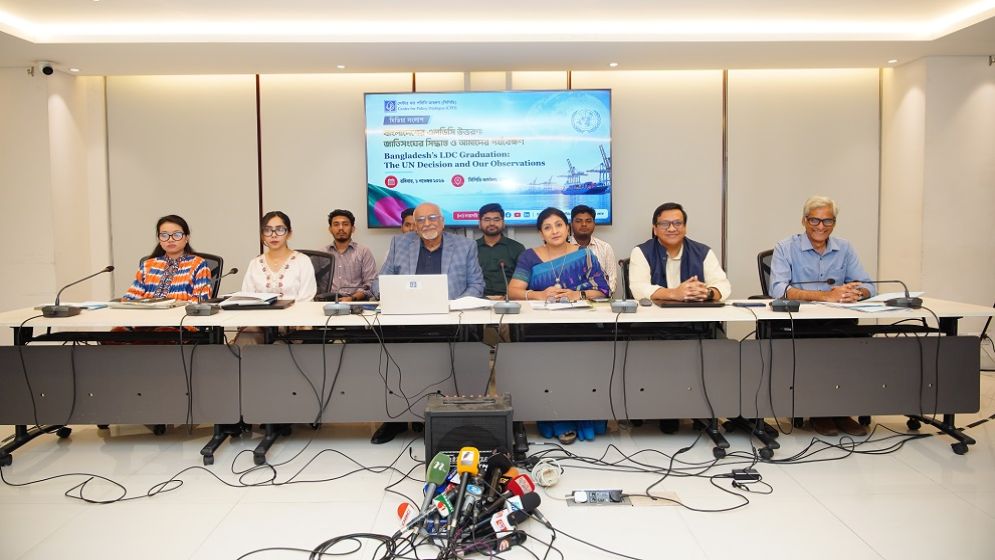
Experts urge urgent reforms as UN extends LDC graduation to 2029. Photo: Courtesy
The United Nations General Assembly (UNGA) has unanimously approved a three-year extension to Bangladesh’s graduation from the Least Developed Country (LDC) category, moving the deadline from 2026 to 24 November 2029.
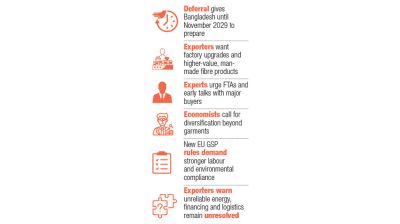
Economists have urged the government to use the additional time to carry out urgent economic and institutional reforms to ensure a smooth transition, warning that no further extension is expected.
The decision, adopted through UNGA Resolution A/81/L.8, gives Bangladesh more time to prepare for the challenges of graduation following domestic political upheaval and global economic uncertainty.
Speaking at a media briefing in Dhaka on Sunday, Dr Debapriya Bhattacharya, Distinguished Fellow at the Centre for Policy Dialogue (CPD) and a member of the UN Committee for Development Policy (CDP), warned that the extension should not lead to further delays in reform.
"An exceptional global decision demands exceptional domestic performance," he said, stressing that Bangladesh would not receive another extension beyond 2029.
Although Bangladesh has met all three UN graduation criteria, major trading partners have emphasised that numerical eligibility alone is not enough to ensure a smooth transition. Representatives of the European Union, Canada, Australia, France and New Zealand supported the extension but called for accelerated structural reforms.
Dr Debapriya also said the government's official press note had overlooked important conditions raised by international partners, including annual progress reports to the CDP on domestic financial reforms.
Bangladesh continues to face significant economic weaknesses. Its tax revenue-to-GDP ratio stands at 6.9 per cent, while non-performing loans account for 32.8 per cent of total loans. The RMG sector contributes 80.6 per cent of exports, private investment stands at 21.5 per cent of GDP, and the country ranks 88th on the Logistics Performance Index. Peak load shedding has also reached 3,757MW.
Economists warn that weak revenue collection and the banking sector's high volume of bad loans could constrain the government's ability to finance infrastructure and social protection after LDC-specific trade benefits expire.
To minimise the impact of graduation, Bangladesh has stepped up trade negotiations. The UK has agreed to provide three additional years of duty-free access after 2029, while Bangladesh has signed an EPA with Japan, pending ratification, and a CEPA with South Korea. The EU has also agreed to begin FTA negotiations, while Bangladesh is pursuing RCEP membership and CEPA consultations with India and China.
The CPD has recommended four key measures for the 2026–2029 transition period: transferring coordination of the Smooth Transition Strategy from the Economic Relations Division to the Prime Minister's Office, publishing a public progress dashboard, placing the graduation roadmap before Parliament and preparing a phased plan to withdraw export cash incentives that violate WTO rules.
"Bangladesh has historically been strong at drafting policy documents but weaker at executing them," Dr Debapriya said, urging the government to use the additional time to stabilise the banking sector, increase revenue collection and modernise logistics.