


 For all latest news, follow the Daily Sun's Google News channel.


Bangladesh-Malaysia FTA: New route to export diversification ahead of LDC graduation
Both sides aim to finalise deal in 2027 as first-round talks end on positive note; next round set for January

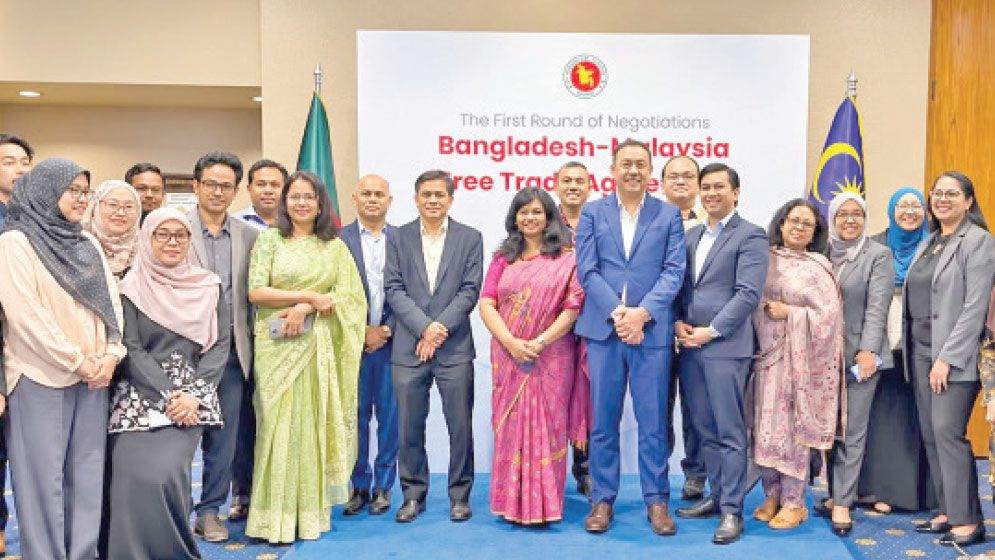
Officials from Bangladesh and Malaysia conclude the first round of free trade agreement (FTA) talks at Pan Pacific Sonargaon Hotel in Dhaka on Thursday, making progress towards expanding bilateral trade and investment. - PHOTO: COMMERCE MINISTRY
As Bangladesh prepares to graduate from the least developed country (LDC) category, a proposed free trade agreement (FTA) with Malaysia is expected to help diversify its export markets, attract investment and sustain competitiveness in international trade.
The two countries concluded their first round of formal negotiations in Dhaka on Thursday following three days of talks that began on 27 October at the Pan Pacific Sonargaon Hotel.
Both sides tentatively agreed to hold the second round in January 2027 and expressed their commitment to finalising a mutually beneficial agreement within the agreed timeframe.
During the negotiations, 13 working groups reviewed draft chapters and structural issues covering trade in goods and services, rules of origin, customs facilitation, digital trade, sanitary and phytosanitary measures, technical barriers to trade and the interests of small and medium enterprises (SMEs).
The proposed agreement comes amid a substantial trade imbalance between the two countries, with Bangladesh importing far more from Malaysia than it exports.
According to data from the Export Promotion Bureau (EPB) and Bangladesh Bank, bilateral trade stood at around US$2.84 billion in the 2024-25 fiscal year (FY25), compared with $2.89 billion in FY24, $3.86 billion in FY23 and $3.80 billion in FY22.
Bangladesh’s exports to Malaysia amounted to just $282 million in FY25, down from $293.51 million in FY24, $371.86 million in FY23 and $337.81 million in FY22.
The figures indicate a trade deficit of more than $2 billion in FY25, highlighting the need to expand Bangladesh’s export basket and improve access to the Malaysian market.
Bangladesh also received only $773.36 million in investment from Malaysia between 2001 and March 2025, according to the data.
Export diversification key to tapping Malaysian market
Speaking to the Daily Sun, Bangladesh-Malaysia Chamber of Commerce and Industry (BMCCI) President Md Anwar Shahid expressed hope that the FTA would be signed next year, as both governments seek to strengthen bilateral trade ties.
“The main reason for our trade deficit with Malaysia is our limited range of export products. We import much more than we export, so we need to focus on increasing exports rather than simply balancing trade,” he said.
He stressed the need to identify products with export potential and develop strategies to make them more competitive in the Malaysian market.
“It is important to keep these issues in mind during the negotiations,” he added.
Anwar said an FTA could create opportunities to expand trade, business and investment, contributing to economic growth and strengthening foreign investors’ confidence in Bangladesh’s economy.
Highlighting processed food as a promising sector, he said the chamber had long advocated greater attention to halal products.
“We need to improve our halal certification system and ensure Malaysia recognises our certificates. This would help more Bangladeshi products enter the Malaysian market,” he said.
Besides processed food, he identified ready-made garments, pharmaceuticals, chemicals, home textiles, frozen food and furniture as sectors with potential for export growth.
He also highlighted opportunities in services exports, particularly in technology and skilled employment.
“When we talk about manpower exports, we usually think of construction workers or plantation workers. But the services sector is much broader. We have opportunities in technology- and skills-based work as well, including semiconductor design,” he said.
With appropriate training and skills development, Bangladesh could create more employment opportunities for its workforce in Malaysia and other international markets, he added.
New export destinations crucial ahead of LDC graduation
M Masrur Reaz, chairman and chief executive officer of Policy Exchange of Bangladesh, said securing market access and diversifying export destinations would be critical as Bangladesh approaches LDC graduation.
He noted that more than 80% of Bangladesh’s exports were concentrated in the garment sector, while a similarly large share was destined for three major markets: the European Union, the United States and the United Kingdom.
Reaz said Asian markets could play a greater role in Bangladesh’s export expansion after graduation, making trade agreements with Malaysia, Japan, South Korea and other countries increasingly important.
Bangladesh’s export growth has benefited from preferential market access associated with its LDC status, he said, stressing the need to secure alternative trade arrangements as those preferences change.
He also identified Malaysia as a potential gateway to the wider Association of Southeast Asian Nations (ASEAN) market, offering opportunities for Bangladesh to diversify trade and participate in regional supply chains.
FTA could take bilateral ties to new economic level
Speaking at the closing ceremony of the first round of negotiations, Bangladesh’s chief negotiator Khadija Nazneen, an additional secretary at the Ministry of Commerce, said the proposed agreement could elevate the two countries’ longstanding friendly relations to a new level of economic cooperation.
She highlighted Malaysia’s strengths in electronics, semiconductors and digital technology, saying the agreement could facilitate technology transfer, investment and industrial collaboration.
Malaysia’s chief negotiator, Dr Rashidi Said, noted that Bangladesh’s graduation from LDC status could result in the loss of some preferential market access, making new trade partnerships increasingly important.
Both delegations reaffirmed their commitment to concluding a balanced and mutually beneficial agreement within the agreed timeframe. The next round of negotiations is expected to focus on resolving differences over various chapters and reaching mutually acceptable positions.
Experts said an FTA with Malaysia, a major ASEAN economy, could expand market access for Bangladeshi goods and services, strengthen industrial and technological capabilities and facilitate integration into regional supply chains.
However, they cautioned that the actual benefits would depend on the final terms of the agreement, particularly tariff concessions, safeguards for domestic industries and effective implementation.