


 For all latest news, follow the Daily Sun's Google News channel.


Call for coordinated action to tackle food insecurity
Daily Sun Report, Dhaka
Published: 30 Oct 2026, 12:00 AM
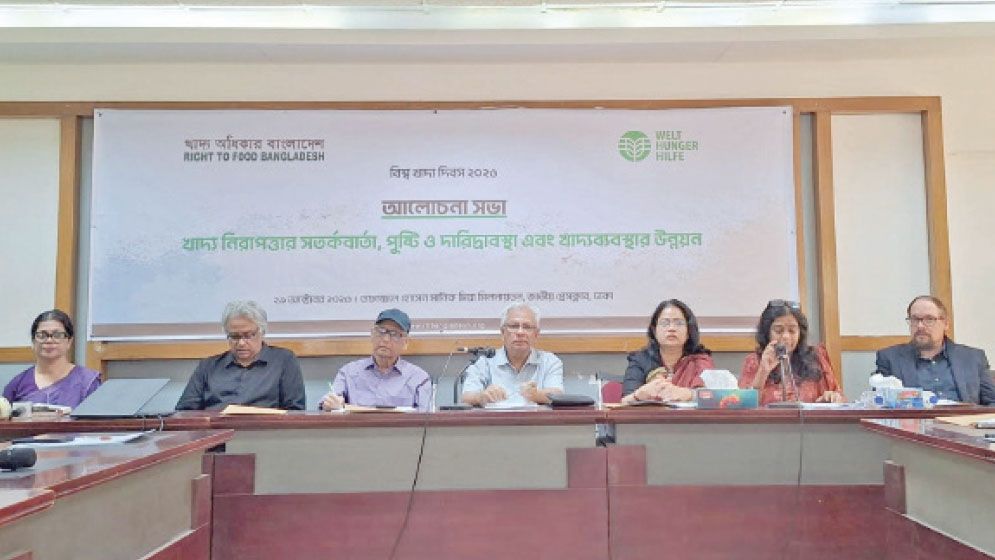
Speakers at a food security discussion at the National Press Club in Dhaka on Thursday call for stronger food security measures to mark World Food Day 2026. PHOTO: COURTESY
Speakers at a seminar in Dhaka urged the government to adopt research-based policies, strengthen social protection programmes, and take coordinated action to combat food insecurity, soaring prices, and malnutrition across Bangladesh.
The call was made at a discussion titled “Food Security Alert: Nutrition, Poverty and Development,” organised by the Khaadya Odhikar Bangladesh Network at the National Press Club on Thursday to mark World Food Day 2026.
Mohsin Ali, general secretary of Khaadya Odhikar Bangladesh and executive director of the Wave Foundation, emphasised that access to adequate food must be legally recognised as a fundamental human right.
He urged the government to enact a dedicated food rights law to protect poor and vulnerable communities, while also stressing the need for public advocacy to drive policy reforms that prioritise marginalised groups.
Dr A K Enamul Haque, director general of the Bangladesh Institute of Development Studies (BIDS), noted that achieving true food security relies on affordable prices, resilient supply chains, and strict measures against food adulteration.
He called for lower agricultural production costs, better training for food safety officials, and deeper research into how income, employment, and technological shifts influence public access to food.
Enamul Haque warned that inflation could rise further in the coming winter, putting additional pressure on household budgets.
He said the government alone could not address these challenges, stressing the need to adapt food habits and agricultural practices to climate change.
Economist and political analyst Prof Dr MM Akash warned that rising prices and a potential economic slowdown could deepen hardship among vulnerable communities.
He called for land reforms and open dialogue with the government on food rights and food security.
Malte Schümmelfeder, head of programmes at Welthungerhilfe Bangladesh, said women and children were disproportionately affected by climate change and urged policymakers to give greater attention to their needs.
Prof Dr Sayma Haque Bidisha of the University of Dhaka said food security was closely linked to energy security, inflation and nutrition.
She called for greater transparency in social protection programmes, increased allocations for the Trading Corporation of Bangladesh (TCB) and targeted support for low-income urban households.
Tania Sharmin, senior adviser on youth, child poverty and economic resilience at Save the Children in Bangladesh, emphasised the need for equitable, needs-based interventions to combat malnutrition among children and adults.
The discussion was chaired by Mohsin Ali and moderated by Kaniz Fatema, coordinator of Khaadya Odhikar Bangladesh and deputy director of Wave Foundation.
Dr Asif M Shahaan of the University of Dhaka presented the keynote paper.
Representatives of civil society organisations, university students and journalists also attended the event.