


 For all latest news, follow the Daily Sun's Google News channel.


Green transition needs policy boost, investment: Experts
Renewable Energy Fest adopts 12-point declaration calling for dedicated law, green financing
Daily Sun Report, Dhaka
Published: 29 Oct 2026, 12:00 AM
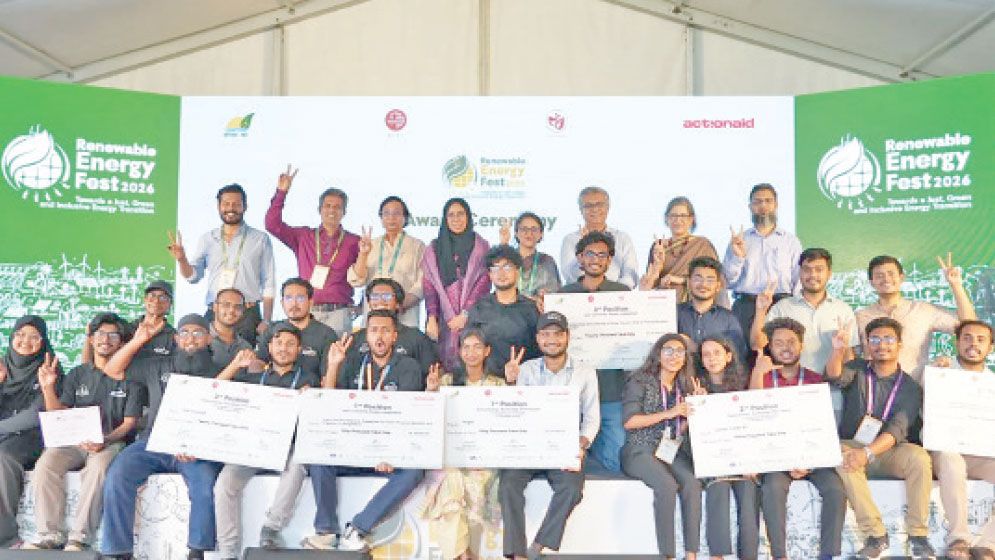
Winners celebrate as Felite Project, Carbon Credit BD Project and IUB Formula-E Project secure first, second and third places, respectively, at Renewable Energy Fest 2026 on Wednesday, receiving seed funding. - PHOTO: COURTESY
Bangladesh needs stronger policy support, increased investment, and modern infrastructure to accelerate its transition to renewable energy, according to experts and stakeholders speaking at the second Renewable Energy Fest 2026 in Dhaka.
The three-day festival concluded Wednesday with a 12-point declaration urging the government to enact a dedicated Renewable Energy Act, expand solar power, boost green financing, and implement stronger environmental and social safeguards to ensure a just and inclusive transition.
Held at the Central Field of the Bangladesh University of Engineering and Technology (BUET) under the theme “Towards a Just, Inclusive, and Green Energy Transition,” the festival was co-organised by ActionAid Bangladesh, BUET, the Just Energy Transition Network Bangladesh (JETnet-BD), and BUET’s Institute of Energy and Sustainable Development.
The declaration called for modernising the national electricity grid through smart infrastructure and battery storage, expanding agrivoltaics and mobilising investment through concessional loans, green bonds and public-private partnerships.
It also emphasised strengthening domestic manufacturing, developing technical skills among young people, creating green jobs and reducing carbon emissions in major industrial sectors.
At a panel discussion on renewable energy financing and investment, participants stressed the need for clear national policies, effective tariff structures and better coordination among policymakers, experts and private investors.
They also called for expanding solar-powered irrigation, increasing research funding and building domestic technical capacity to reduce reliance on foreign expertise and technology.
The declaration placed social equity and accountability at the centre of the energy transition, advocating a gender-responsive, community-led approach that ensures meaningful participation of women, Indigenous Peoples, workers and marginalised communities.
It also sought greater transparency in climate financing, independent environmental and social monitoring, and protection for workers affected by changes in the energy sector.
Regional cooperation across South Asia and technology transfer partnerships between Bangladesh and Australia were identified as important areas for advancing renewable energy development.
A youth-led dialogue on Bangladesh’s Nationally Determined Contribution (NDC) 3.0 called for stronger measures to reduce air pollution and dust, promote solar-powered irrigation and Internet of Things (IoT) technologies, and develop a roadmap within 12 months for youth skills development, green entrepreneurship and participation in the green economy.
Other sessions focused on renewable energy innovation, infrastructure, environmental safeguards and energy governance. Participants emphasised closer collaboration among researchers, academics, young entrepreneurs and relevant institutions to expand renewable energy solutions.
The festival also featured an innovation and technology fair showcasing locally developed renewable energy technologies alongside commercially available products and services. The Felite Project won first prize in the innovation awards, followed by Carbon Credit BD Project and IUB Formula-E Project. The winners received certificates and seed funding.
Jahrat Adib Chowdhury, a member of parliament and chairperson of the parliamentary standing committee on the Ministry of Foreign Affairs, attended the closing ceremony as chief guest, while Ibrahim Khalil Al-Zayad, board chair of ActionAid International Bangladesh Society, was the special guest. ActionAid Bangladesh Country Director Farah Kabir delivered the closing remarks.
The festival’s recommendations underscored the need to align energy policy, financing, technological development and social protection to strengthen renewable energy’s contribution to Bangladesh’s energy security and sustainable economic growth.