


 For all latest news, follow the Daily Sun's Google News channel.


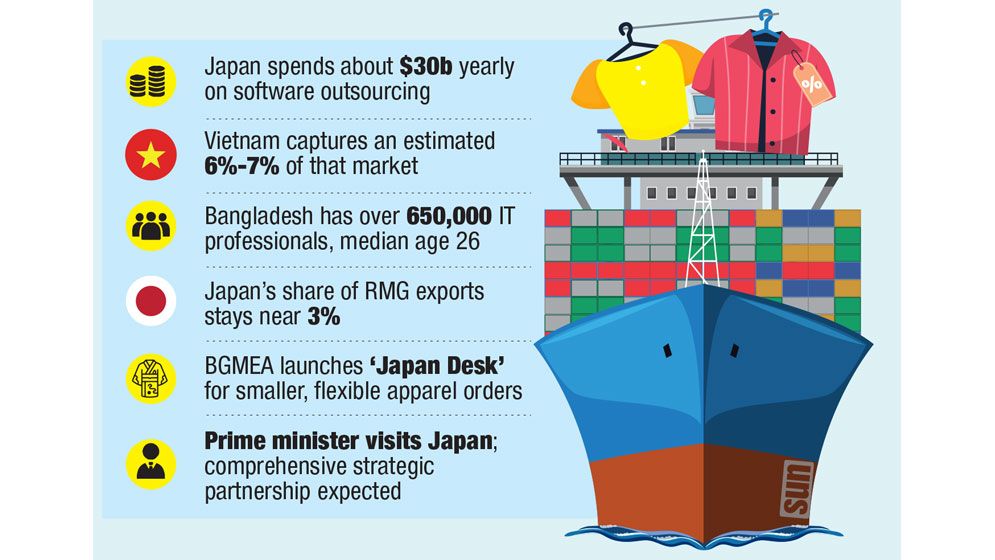
Bangladesh is looking to Japan as a destination for its growing technology industry, seeking to diversify exports beyond ready-made garments (RMG) and tap rising demand for software development, artificial intelligence (AI) and other digital services.
With Japan facing a shortage of skilled IT professionals and its businesses investing increasingly in digital transformation, Bangladeshi technology firms have an opportunity to gain a stronger foothold in one of Asia’s most advanced economies, industry stakeholders said.
They cited the country’s expanding pool of software engineers, competitive service costs and growing experience in international outsourcing. Realising that potential, they added, will require greater investment in skills, quality assurance, business development and Japanese-language proficiency.
Experts said Bangladesh has a young workforce, with a median age of 26 and more than 650,000 IT professionals, an engineering base they described as ready to build for the long term as Japan’s tech talent shortage grows.
‘Untapped’ technology partner
MJ Ferdous, executive director of Brain Station 23 PLC, which has served the Japanese market since 2018, told Daily Sun that Bangladesh remains one of Japan’s most untapped technology partners. Japanese companies could rely on Bangladeshi partners to support their technology development, he said, combining AI with skilled engineers to deliver to Japanese quality standards.
Japan is three hours ahead of Bangladesh throughout the year, he noted. When it is 9am in Dhaka, it is noon in Tokyo, allowing teams to share most of the Japanese working day. Delivery costs also remain competitive across the region.
“Japan spends around US$30 billion a year on software outsourcing, and Vietnam alone captures an estimated 6% to 7% of this market. Bangladesh’s share remains small, leaving considerable room for growth,” he said.
Ferdous said greater government support could help the sector reach its potential. “When Japanese IT companies show interest in working with Bangladesh, the Japanese government could introduce supportive measures that encourage and help them build these partnerships,” he said.
“At the same time, if the Bangladesh government includes IT business delegates in planned G2G visits to Japan, Bangladesh’s IT sector can grow much faster. Such direct business engagement at the government level can open new doors and build lasting trust with Japanese enterprises.”
He added that encouraging Japanese investors to explore the sector should also be a government priority, and that with the right policy support Bangladesh could become a trusted long-term technology partner for Japanese enterprises.
Regulatory bottlenecks, quality and consistency
Rabiul Alam, secretary general of the Japan Bangladesh Chamber of Commerce and Industry (JBCCI), told Daily Sun that Bangladesh has considerable export potential in Japan across high-value apparel, IT and IT-enabled services, leather goods and footwear, jute, agro-processing, marine products, healthcare and pharmaceuticals, and light engineering.
“To boost exports in Japan the products made in Bangladesh, there are some challenges such as regulatory bottlenecks, infrastructure, logistics, policy stability, customs process, and profit repatriation,” he said.
He said meeting strict Japanese quality standards could serve as a strategic gateway, easing subsequent access to demanding Western markets. Administrative hurdles, including bureaucratic red tape and complex customs and tax procedures, put Bangladesh at a competitive disadvantage against regional rivals such as Vietnam, which offer faster and more streamlined business processes, he said.
Dr Fahmida Khatun, distinguished fellow at the Centre for Policy Dialogue (CPD), said improved market access and deeper economic cooperation could help diversify Bangladesh’s exports and attract greater foreign investment. The partnership between the two countries offers an opportunity to deepen ties beyond traditional aid-driven cooperation, with a stronger focus on trade, investment and technological collaboration, she said. She called for coordinated policies on trade facilitation, industrial upgrading and other appropriate measures.
BGMEA launches ‘Japan Desk’
Japan’s share of Bangladesh’s RMG exports has stayed close to 3% since FY23, although values have fluctuated. Exports to Japan stood at $1.15 billion in FY23, fell 5.8% to $1.09 billion in FY24, rose 9.1% to $1.19 billion in FY25, and dropped 4.3% to $1.13 billion in FY26. Total RMG exports fell 1.6% to $38.70 billion in FY26, taking Japan’s share to 2.93%.
According to the Export Promotion Bureau (EPB), Bangladesh exported garments worth $343.65 million to Japan in July-September 2026, the first quarter of FY27. That was 3.25% of total RMG exports of $10.58 billion in the period, the highest share Japan has held in the past four years.
International Trade Centre (ITC) data show Japan imported apparel worth $24.96 billion in July 2022-June 2023. Imports fell 7.3% to $23.14 billion the following year, then rose 3.3% to $23.90 billion in FY25 and 1.2% to $24.19 billion in FY26. Japan imported $4.05 billion worth of apparel in July-August 2026.
The Bangladesh Garment Manufacturers and Exporters Association (BGMEA) has recently launched a dedicated ‘Japan Desk’ to help local exporters expand their presence in Japan’s $22 billion apparel market.
BGMEA President Mahmud Hasan Khan said the desk would connect Japanese buyers, particularly those seeking smaller and more flexible orders, with suitable Bangladeshi factories. “A small order is not a small customer. The desk would match buyers with factories based on their required order volumes,” he said.
He said the desk had been established as an institution rather than as the initiative of an individual office-bearer, in order to build long-term business ties between Bangladeshi manufacturers and Japanese buyers.
Md Fazlul Hoque, administrator of the Federation of Bangladesh Chambers of Commerce and Industry (FBCCI), said Bangladesh has many promising sectors, including leather and leather goods, pharmaceuticals and IT. The federation’s Export Research Cell has already held meetings with various chambers and associations on diversifying exports to markets including Japan, with the FBCCI acting as coordinator, he said.
“The government has to take strategies, and work in-depth to diversify exports, and bring more investment in new industries,” he said.
Prime Minister Tarique Rahman is on a four-day visit to Japan that will end tomorrow. The two countries are expected to elevate their existing strategic partnership to a comprehensive strategic partnership (CSP) during the visit. On 6 February 2026, Bangladesh and Japan signed an Economic Partnership Agreement (EPA) in Tokyo.