



 For all latest news, follow the Daily Sun's Google News channel.


Bangladesh’s readymade garment (RMG) industry faces mounting uncertainty as inflation-driven protests in parts of Europe, a global energy crisis and intensifying competition from rival producers threaten to erode export growth, industry leaders and economists said.
Falling shipments, rising production costs and aggressive competition are piling fresh pressure on the country’s largest export-earning sector, which depends heavily on the European Union (EU) market.
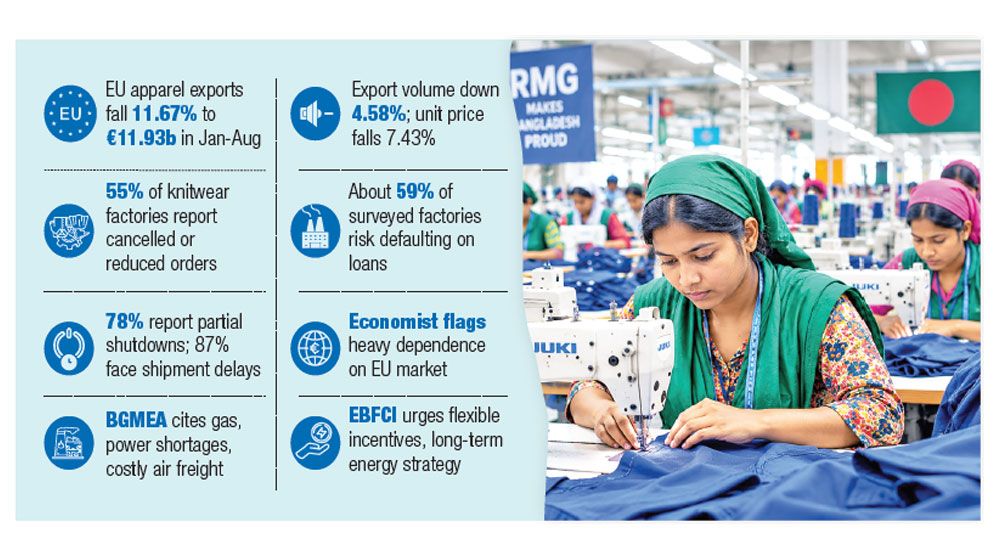
Eurostat data show Bangladesh’s apparel exports to the EU fell 11.67% to €11.93 billion in the first eight months of 2026 (January-August), from €13.50 billion a year earlier. Volume declined 4.58%, while the average unit price fell 7.43% to €13.76 per kilogramme from €14.87, indicating that lower prices accounted for much of the drop in earnings.
Energy crisis, inflation
Md Salauddin Chowdhury, senior director of the Europe-Bangladesh Federation of Commerce and Industry (EBFCI) and chairman of Stylish Garments Limited, told Daily Sun that the Russia-Ukraine war and prolonged Middle East tensions had triggered a global energy crisis, disrupting fuel supplies through the Strait of Hormuz and pushing up prices.
“The resulting inflation is fuelling protests in European countries, including France and Italy, and weakening consumers’ purchasing power,” he said.
Bangladeshi factories export garments to several EU countries, including both.
Salauddin said he expected the protests to subside but higher inflation to persist, curbing consumption and demand for Bangladeshi goods.
“As living costs rise, consumers are likely to buy fewer garments, putting further pressure on local exporters. If the crisis continues, more factories could shut down, threatening jobs and livelihoods,” he said.
Although energy supply had improved somewhat, he said, the risk remained.
He urged the government to introduce transparent and flexible incentives for struggling factories and to develop a long-term energy strategy built on domestic gas exploration, solar power and expanded LNG infrastructure.
Exporters, he added, should negotiate with international buyers over rising production costs, while any wage adjustment should be settled through practical talks among workers, employers and other stakeholders, ensuring fair wages without pushing factories towards closure. Bangladesh, he said, must act now to protect jobs and strengthen its long-term energy security.
Dr Mohammad Abdur Razzaque, chairman of Research and Policy Integration for Development (RAPID), said exporters supplying the EU could be affected, with gas demand and prices in Europe likely to rise further in winter.
Factoring in inflation and the current unrest, he expected trade with Europe to shrink in the coming days.
The economist said the concern was greater for Bangladesh because of market concentration, noting that the country had failed to build any major market outside the EU.
Orders hit at 55% of knitwear factories
A survey by the Bangladesh Knitwear Manufacturers and Exporters Association (BKMEA) found that 55% of knitwear factories had seen international retailers and brands cancel or reduce work orders amid the energy crisis.
The disruption also caused production losses, shipment delays and higher costs.
BKMEA Executive President Fazlee Shamim Ehsan said the association surveyed 20% of its member factories in Narayanganj, Gazipur, Chattogram, Dhaka and other areas between 21 August and 14 September.
Nearly 78% of the factories reported partial production shutdowns and 87% faced shipment delays. Around 60% had to offer buyers discounts, while about 89% said they risked losing buyers’ confidence. About 59% faced the risk of defaulting on bank loans, and around 7% had shut down production completely.
Competitiveness under strain
Mahmud Hasan Khan, president of the Bangladesh Garment Manufacturers and Exporters Association (BGMEA), said business and trade were directly linked to law and order.
Tourists are important buyers in many European countries, he said, and product sales could suffer if tourism and normal movement were disrupted by unrest, posing a risk of losses for Bangladeshi exporters.
Mahmud said uninterrupted gas and electricity supply was essential to domestic production. “However, rising energy prices, inadequate supply and frequent power outages have increased production costs and severely disrupted operational efficiency in the RMG sector,” he said.
Garment makers must meet strict lead times set by international buyers, he said, but gas and electricity shortages often make this difficult. To meet urgent deadlines, factories may have to resort to costly air freight or alternative power generators, squeezing margins and undermining competitiveness.
To ease the energy instability, he added, the BGMEA has taken steps to promote a transition to renewable and green energy.