


 For all latest news, follow the Daily Sun's Google News channel.


‘People will one day feel remorse over inequality,’ Kaushik Basu says at Dhaka event
Daily Sun Report, Dhaka
Published: 17 Sep 2026, 11:42 PM
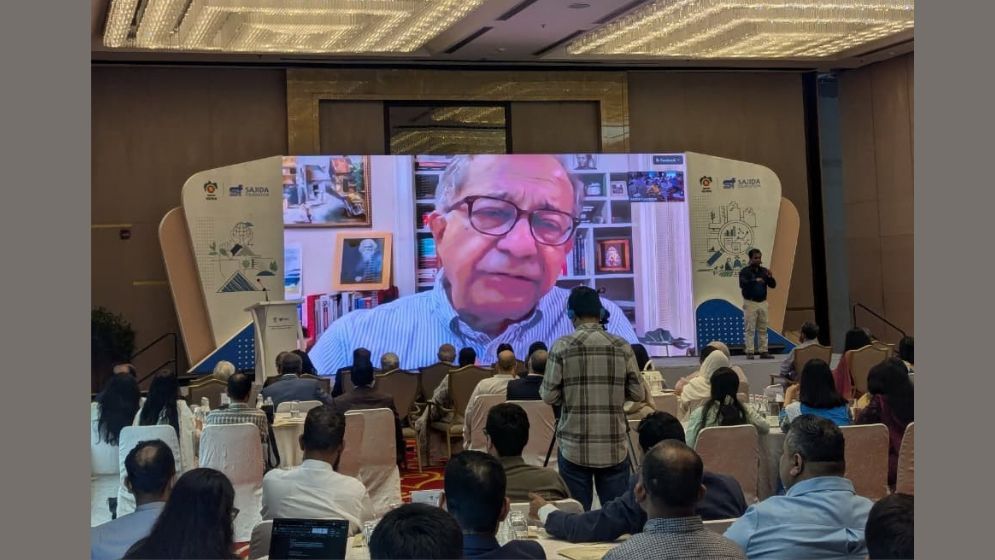
Photo: Collected
Indian Economist Kaushik on Thursday said that just as
people in modern days feel ashamed of the history of the slave trade, future
generations will feel remorse over the extreme inequality that exists in the
world at present.
Economic progress and human well-being cannot be fully
understood through gross domestic product (GDP) alone, said Kaushik Basu,
professor of economics at Cornell University, USA.
Indicators such as the quality of healthcare and education,
nutrition, inequality, ownership of assets and the distribution of economic
opportunities also need to be taken into account when measuring economic progress,
he added while speaking as the keynote speaker at the “Syed Humayun Kabir Memorial
Research Conference 2026”
The conference was jointly organised by Banglar Pathshala
Foundation and Sajida Foundation at a hotel in Dhaka on Thursday.
Professor Rehman Sobhan chaired the session titled “Equity,
Capabilities and Well-being”. Ahmed Javed Chowdhury, founder of Banglar
Pathshala Foundation, delivered the welcome address. Sajida Foundation
Chairperson Farooq Sobhan and the foundation’s senior research adviser Sajeda
Amin delivered the opening remarks.
In his opening remarks, Ahmed Javed Chowdhury said economic
development is not the only basis for the development of a society.
Societies also progress through ideas, intellectual life, a
critical public sphere, rational thinking and engagement with education.
Joining the conference virtually from the United States, Kaushik
Basu said economic inequality is increasingly turning into inequality in
people’s voices. The influence of the ultra-rich in the public sphere is
growing as they are able to buy newspapers, television channels and social
media platforms.
He said broader indicators are needed alongside GDP to
measure economic performance and human well-being.
Basu said his model contains 21 indicators for measuring
economic performance and human well-being. These include the quality of
healthcare, the quality and reach of education, nutrition, inequality and the
distribution of asset ownership.
He also stressed the importance of expanding ownership
opportunities among a broader section of society to widen economic
opportunities. In this context, he cited the ownership structures of Renata and
Sajida Foundation as examples.
Basu said creating opportunities for a broader section of
society, including workers, to have ownership in the corporate sector could
help expand economic opportunities.
Mere showmanship in the name of CSR is not enough
In his concluding remarks as chair, economist and Centre for
Policy Dialogue (CPD) Chairman Professor Rehman Sobhan said new models of
corporate ownership are needed to improve the welfare of disadvantaged people.
He said such a model should allow workers to have a stake in
corporate ownership. A huge amount of wealth is concentrated in the hands of a
small group of people, while inequality has reached extremely high and
unacceptable levels. Policy alternatives therefore need to be considered, he
said.
Sobhan said mere showpiece activities in the name of
corporate social responsibility (CSR) are not enough. A portion of a company’s
shares or ownership should be allocated to a foundation that can serve as a
permanent and sustainable source of funding for public welfare activities.
He said a capability-based approach is an important element
of such a model. Ensuring quality and universal healthcare for all is also a
key part of this approach.
Institutions cannot survive without good governance
Transparency International Bangladesh (TIB) Executive
Director Iftekharuzzaman said clear goals and objectives, along with good
governance, values and ethical leadership, are necessary to keep an institution
effective over the long term.
He said a commitment to equality, justice and ensuring
people’s rights regardless of identity should also be embedded in the
foundations of an institution.
Iftekharuzzaman said eliminating corruption from Bangladesh
would be difficult, but efforts to control and prevent corruption must
continue. Civil society should continue to demand accountability even from
outside formal government and institutional power structures, he said.
Coordination needed between government and society
Sajida Foundation Chairman and former foreign secretary
Farooq Sobhan said leadership, accountability, merit-based systems and a focus
on outcomes are essential to building strong institutions.
He said Bangladesh still has shortcomings in developing an
integrated system of governance. Coordination among government ministries needs
to improve, while communication between the government and society also needs
to be strengthened.
The government does not have all the knowledge or solutions,
he said, adding that Bangladesh needs an approach that brings together the
‘whole government’ and the ‘whole society’.
More resources needed for health and education
M Saiduzzaman, a member of the Board of Trustees of the
Centre for Policy Dialogue and a former finance minister, said Sajida
Foundation’s work focuses on health, livelihoods and building people’s
capabilities.
Progress in these areas requires adequate public resources
alongside good governance, transparency and accountability, he said.
He stressed the need to raise Bangladesh’s tax-to-GDP ratio,
saying it is lower than that of many countries in South and Southeast Asia.
Increasing the ratio would allow the government to allocate more resources to
health and education, he said.
Saiduzzaman also expressed concern over the quality of
education. The number of universities in the country has increased, he said,
but the quality of education has not improved at the same pace. Improving the
quality of education and research should therefore be given priority.
Succession and transfer of management
Shehzad Munim, adviser to Sajida Foundation and an
independent director of Linde Bangladesh, said succession planning and passing
an institution’s values and principles on to the next generation are important
for building institutions that last.
He said the values, objectives and principles of Sajida
Foundation have been firmly embedded in its organisational culture. As the
organisation grows, he said, responsibility for its day-to-day operations
should gradually be transferred to professional management.
At the same time, efforts are under way to further strengthen its frameworks for transparency, accountability and talent management, he said.