


 For all latest news, follow the Daily Sun's Google News channel.


Black Sugarcane brings new hope for farmers in Gazipur
BSS, Gazipur
Published: 14 Sep 2026, 10:33 PM
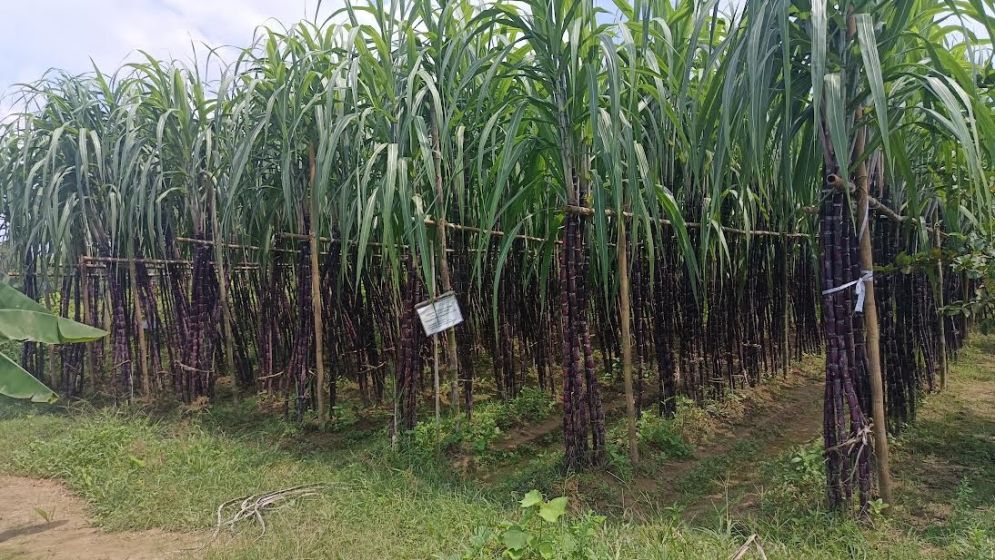
Photo: BSS
As rising production costs and declining profits push many
farmers away from traditional sugarcane cultivation, a new cane variety is
gaining attention in Bangladesh, offering fresh hope for growers and the
country’s struggling sugar industry.
Locally known as “Black Sugarcane” or “Black Ruby”, the
Philippines Black Sugarcane has been officially released by the Bangladesh
Sugarcrop Research Institute (BSRI) as BSRI Akh 49.
Field-level research by the Research and Development
Division of Bashundhara Agro Chemical Industries Limited (BACIL) in Kaliakair,
Gazipur, indicates that scientific cultivation methods can significantly
increase its yield while keeping production costs relatively low.
The success has generated fresh interest among farmers,
agricultural researchers and private-sector investors, particularly in the
commercial market for chewing and juice-producing sugarcane.
Sugarcane has long been cultivated in Gazipur, particularly
for molasses and direct consumption. According to Department of Agricultural
Extension (DAE) sugarcane were cultivated on 1,603 hectares of land in the
district this year.
Kapasia has the largest area under the cultivation on 1,220
hectares, followed by Sreepur 189 hectares, Gazipur Sadar 100 hectares,
Kaliganj 60 hectares and Kaliakair 34 hectares of land.
Among existing varieties, Ishwardi-16 occupies the largest
area at 542 hectares. Popular chewing varieties include BSRI Akh 41 (Amrit),
cultivated on 384 hectares, BSRI Akh 42 (Rangbilash) on 329 hectares and BSRI
Akh 47 on 150 hectares.
BSRI Akh 49 (Black Sugarcane) is now adding a distinctive
new dimension to this landscape. Its dark purple-to-black appearance, soft
stalk, high juice content and ease of chewing have attracted considerable
interest from both farmers and consumers.
BACIL began experimental cultivation of the variety in
January 2025 on a 20-decimal at Sakashwar Madhyapara research farm in
Kaliakair. The project forms part of the company’s broader agricultural
research and crop-diversification programme.
Faisal Ahmed, who is responsible for the field research,
said the project achieved notable results by introducing a modified planting
technique.
Under conventional methods, sugarcane seedlings are
generally planted two to three feet apart. BACIL, however, reduced the
plant-to-plant distance to 1–1.5 feet, while maintaining three feet between
rows. This allows approximately 3,500–4,000 cuttings or seedlings per bigha,
nearly double of the conventional density.
Despite the increased plant population, researchers observed
no significant adverse effect on stalk height or diameter. Instead, yields
reportedly doubled under proper management.
The cane reaches 10–11 feet within eight months and grows to
around 13–15 feet after 12 months. Regular removal of old lower leaves every
10–14 days, leaving six to eight healthy leaves, helps maintain plant health
and supports rapid growth.
Loamy and clay-loam soils are considered suitable, with
January-February and September-October identified as favourable planting
periods. Another advantage is that vegetables and other short-duration crops
can be cultivated between the cane rows without significantly affecting
production. The variety also requires relatively little pesticide use.
Dr Nilufar Islam, Chief Scientific Officer and
Officer-in-Charge of the BSRI Gazipur Regional Office, said the variety
popularly known as Black Sugarcane is officially BSRI Akh 49, developed and
approved by BSRI.
She explained that the variety is primarily suitable for
chewing and juice production, rather than commercial sugar or molasses manufacturing.
For direct consumption, however, BSRI Akh 49 has significant
advantages. Its outer skin and nodes are relatively soft, making the cane easy
to chew. Its maximum average yield can reach 171 tonnes per hectare.
Researchers also report the presence of antioxidants,
flavonoids and minerals including calcium, potassium, phosphorus, magnesium,
sodium, zinc and iron in the sugarcane.
The economic prospects are perhaps the most attractive
aspect of the variety. Field estimates suggest that cultivation costs—including
seedlings, land preparation and maintenance—range between Tk60,000 and Tk70,000
per bigha.
A farmer can reportedly harvest 15–18 tonnes of cane per
bigha, with an estimated market value of Tk170,000–180,000. According to the
field calculation, this can generate a net profit of roughly Tk100,000–150,000
in the first year, depending on production and market prices.
After harvesting the variety, 10–15 new shoots can emerge
from each harvested clump. Consequently, farmers may obtain second- and
third-year crops without bearing the same initial expenses for land preparation
and planting materials.
According to project-level estimates, net returns could rise
to approximately Tk200,000–320,000 per bigha in the second and third years,
subject to yield, management and market prices.
MZ Hossain Arzu, Head of the company’s Research and
Development Division, said Bashundhara Group is planning commercial cultivation
on around 400 bighas after completing further trials.
The proposed business model includes fresh cane marketing as
well as processing the crop into juice, premium molasses and paper-industry raw
materials. Bottled cane juice and processed products could potentially be
exported to international markets.
Kaliakair Assistant Agricultural Officer Suraiya Sultana
said she personally visited BACIL’s research field and tasted the cane.
“It is extremely sweet, soft and juicy. It is undoubtedly an
excellent chewing variety,” she said, adding that its ability to produce crops
for three consecutive years with comparatively low costs and labour could
improve farmers’ livelihoods.
She said the DAE was providing farmers with technical
guidance, including advice on cultivation practices and pest and disease management.
Despite the promising results, wider commercial expansion will require
institutional support.
With appropriate government-private sector cooperation, farmer training, quality planting materials and reliable marketing and processing infrastructure, BSRI Akh 49 could become more than an alternative sugarcane variety, she said.