


 For all latest news, follow the Daily Sun's Google News channel.


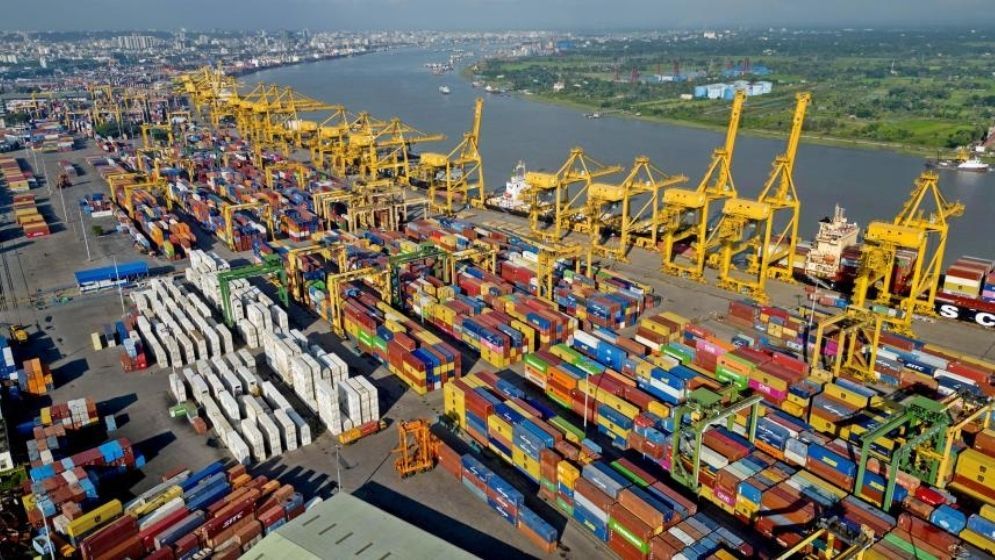
File Photo
They argue that the country’s future export success will depend not only on expanding production but also on transporting goods more efficiently, sustainably and at lower cost.
A modern green logistics system – combining digital technology, multimodal transport, coordinated policymaking and efficient resource management – would reduce business costs, strengthen competitiveness and help Bangladesh meet the challenges of post-LDC graduation.
Experts say the country also needs to modernise its logistics network to achieve Sustainable Development Goal 9 by 2030 while reducing the cost of doing business.
A pressing need
Bangladesh’s logistics sector remains heavily dependent on diesel-powered road transport, outdated infrastructure and inefficient freight movement, resulting in higher carbon emissions and rising business costs.
With around 85% of freight transported by road, reducing emissions remains a major challenge.
Experts say shifting cargo to railways and inland waterways, introducing electric vehicles, renewable-powered warehouses, energy-efficient cold chains and digital supply chains will be essential to building a greener transport system.
Industry leaders warn that exporters could face mounting pressure from international buyers – particularly in the European Union – where environmental compliance is becoming an increasingly important part of supply chain decisions.
Ahamedul Karim Chowdhury, adjunct faculty member at Bangladesh Maritime University and former head of the Inland Container Depot at Kamalapur and Pangaon Inland Container Terminal under Chittagong Port Authority, said sustainable logistics rests on three pillars: environmental, economic and social sustainability.
“By strengthening all three dimensions, Bangladesh can enhance its competitiveness in the global market while building a more efficient and sustainable logistics system,” he told the Daily Sun.
Describing green logistics as environmentally sustainable transportation and port operations, he said Bangladesh must begin preparing now for the post-LDC era, when international shipping companies and global buyers will place greater emphasis on green ports and eco-friendly logistics.
He noted that inland waterways are the most environmentally friendly mode of transport, followed by rail, while road transport generates the highest carbon emissions.
He also stressed the need for river dredging, real-time information systems, modern navigation technologies and greater private-sector participation to develop inland waterways.
He called for supportive legislation and an independent National Logistics Commission to improve coordination among the agencies involved in the sector.
Global competitiveness at stake
Dr Mohammad Abdur Razzaque, chairman of the Research and Policy Integration for Development (RAPID), said carbon performance has become an important element of export competitiveness, with global buyers increasingly seeking lower-carbon sourcing, renewable energy use and emissions data.
“Sustainable competitiveness needs structural reforms. Long-term success depends on quality upgrading, compliance, logistics efficiency and lower costs of doing business,” he said.
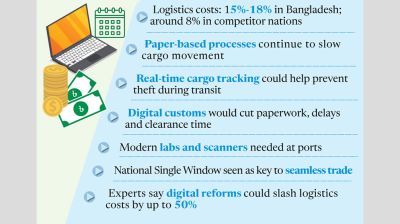
He warned that port and customs delays continue to increase export costs and undermine Bangladesh’s competitiveness.
Referring to the EU’s Carbon Border Adjustment Mechanism (CBAM), he said carbon transparency would become increasingly important in international trade and suggested using green credit, guarantees and upgrading funds to support compliance investments.
“Infrastructure bottlenecks continue to weaken Bangladesh’s export competitiveness. Energy unreliability, administrative burden and weak trade facilitation raise costs before goods even reach the port,” he added.
M Masrur Reaz, chairman of Policy Exchange Bangladesh, said shifting freight from roads to rail and waterways would cut both emissions and logistics costs.
He warned that Bangladesh’s target of US$100 billion in exports would remain difficult without major improvements in trade facilitation and logistics capacity.
Bangladesh ranks 88th in the World Bank’s Logistics Performance Index, well behind India, Vietnam and Indonesia. Vietnam’s merchandise exports stand at about US$475 billion, compared with Bangladesh’s nearly US$48 billion.
Importance of multimodal connectivity
Abul Kashem Khan, Chairperson of Business Initiative Leading Development (BUILD), said rail transport is far more efficient than road transport.
A truck carries only one container at a time, meaning 30 containers require 30 trucks, whereas a single freight train can transport around 100 containers in one trip without adding pressure to highways.
“Rail and inland waterways cost roughly one-third of road transport, making them far more economical. Expanding these modes of transport would substantially reduce logistics costs, improve efficiency and strengthen Bangladesh’s competitiveness,” he said.
Professor Md Shamsul Hoque of BUET’s Civil Engineering Department said Bangladesh lacks integrated transport planning, with roads, railways, waterways and aviation developed separately rather than as a unified network.
“Even when facilities are located close to each other, such as an airport and a railway station, there is still no seamless connectivity between rail, metro, road and air transport,” he said.
Former Bangladesh Freight Forwarders Association (BAFFA) Vice-President Nurul Amin said green logistics would reduce fuel consumption, operating costs and carbon emissions while promoting the use of electric vehicles, clean energy and energy-efficient warehouses.
Unlocking investment
Abul Kashem Khan, also a former president of the Dhaka Chamber of Commerce and Industry (DCCI), said Bangladesh currently invests only about $2 billion annually in logistics, while sustainable infrastructure development requires investment equivalent to 6%-8% of GDP, or around $18-20 billion a year.
“To bridge this massive financing gap, Bangladesh must attract both domestic private investment and foreign direct investment. With proper planning and supportive policies, the logistics sector alone could attract around US$10-15 billion in FDI annually,” he said.
Mohiuddin Rubel, additional managing director of Denim Expert Ltd and former BGMEA director, stressed the importance of public-private collaboration.
He noted that Bangladesh now has 53 of the world’s top 100 highest-rated LEED-certified factories and 290 LEED-certified factories overall, reflecting significant progress in environmentally responsible manufacturing.
“To ensure a green supply chain, dependence on road transport must be reduced. Road traffic can be disrupted at any time. Exporters need a sustainable transport system,” he said.
Policy implementation remains slow
Although the National Logistics Policy 2025 aims to modernise logistics services and improve trade competitiveness, implementation has been slow.
Industry stakeholders say Bangladesh still lacks dedicated green logistics guidelines, incentives for clean freight transport and financing mechanisms to help logistics companies invest in cleaner technologies.
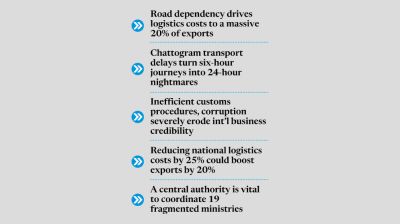
Abul Kashem Khan said effective implementation remained difficult because logistics responsibilities are spread across 19 ministries.
“There is a need to establish a central National Logistics Authority that will oversee planning, implementation, research and monitoring from a single platform,” he said.
Finance Minister Amir Khosru Mahmud Chowdhury said the government’s roadmap includes building new seaports, expanding airports and transforming Chattogram into a regional logistics hub.
(This is the final instalment of a three-part series on the logistics sector in Bangladesh.)