


 For all latest news, follow the Daily Sun's Google News channel.


PM pledges to restore discipline in economy
BSS, Sangsad Bhaban
Published: 29 Jun 2026, 07:37 PM
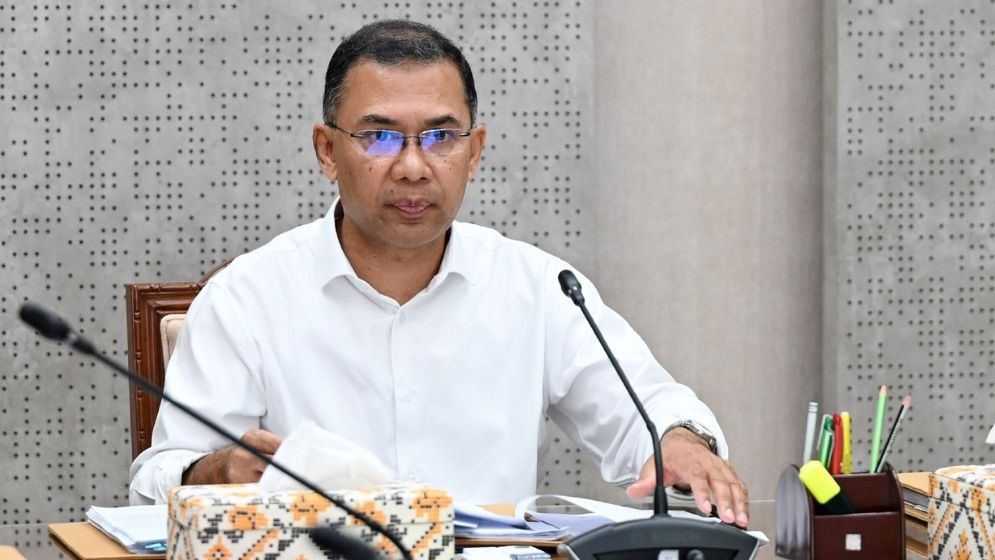
Prime Minister Tarique Rahman. File Photo: PID
Prime Minister Tarique Rahman on Monday pledged to restore discipline in the country’s economy expressing his government’s commitment to recover the money laundered abroad as quickly as possible.
The prime minister proposed several people-friendly amendments to the national budget for the fiscal year 2026-27 including reducing the tax burden on ordinary citizens, withdrawing the controversial provision of whitening black money, and promoting domestic industries and private higher education.
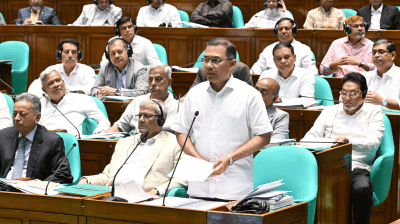
He presented the proposals to Finance and Planning Minister Amir Khosru Mahmud Chowdhury while participating in the budget debate in the House.
Tarique Rahman said in the proposed budget, the tax-free income threshold for individual taxpayers has been proposed at Tk375,000.
He requested the finance minister to increase the limit to Tk400,000 for the 2026–27 and 2027–28 tax years, Tk450,000 for the 2028–29 and 2029–30 tax years, and Tk500,000 for the 2030–31 tax year.
Referring to the provision regarding voluntary disclosure of investments, he said, “We have observed public concern over this provision through newspapers, social media, MPs, and civil society representatives. Many people in our country do not register land at its actual market value.”
On the issue of legalising undisclosed income, the prime minister said, “Unfortunately, many people perceive this provision as another opportunity to legalise black money.”
With full respect to public opinion, he requested the finance and planning minister to withdraw this proposed provision.
Turning to private universities, he said private universities currently pay tax at the reduced rate of 10%. He proposed lowering this rate further to 5%.
However, there is one condition, he said, explaining that universities benefiting from the reduced tax rate should invest in research and development, establish and operate language laboratories to help students become proficient in multiple languages, and provide tuition-free education to talented students from underprivileged backgrounds.
At this point, lawmakers from both the ruling and opposition parties applauded the prime minister’s proposal by thumping their desks.
The prime minister also proposed expanding tax exemptions for indigenous communities living in the three Chattogram Hill Tracts districts.
He said the budget proposed for exempting income earned from economic activities in the Hill Tracts, excluding salaries and financial assets. He requested the finance minister to extend tax exemption on their salary income as well.
This benefit should apply equally to indigenous communities living in both the hill districts and the plains, he explained.
To promote shrimp farming and exports, the prime minister proposed eliminating all import duties, regulatory duties, supplementary duties, and VAT on key production inputs such as aqua feed, feed additives, probiotics, vitamins, and minerals.
He also urged the finance minister to remove taxes and duties on machinery used in the shrimp farming sector.
To support local industries, he requested concessional treatment for the import of raw materials used by manufacturing industries.
The prime minister further proposed removing the existing 10% supplementary duty on imported honey, which is used as a raw material in pharmaceutical and other local manufacturing industries.
He also requested for reducing the proposed 10% import duty on PVC and petro-resin to 5% as it’s widely used as industrial raw materials.
In addition, he urged the complete withdrawal of the proposed 10% regulatory duty on imported cold-rolled sheets, flat-rolled products, and potassium chlorate used as industrial raw materials.
The prime minister also requested the withdrawal of the proposed 15% VAT and 7.5% advance tax on certain industrial imports.
For manufacturers of electrical cables, he proposed abolishing the existing 10% regulatory duty on imported copper. He further requested reducing the proposed 15% customs duty on unprocessed cashew nuts to 5%.
The prime minister proposed extending existing concessional import facilities for raw materials used by local LED lamp manufacturers until 30 June 2030.
He also recommended extending similar tax concessions until 30 June 2030 for manufacturers of prefabricated buildings.
Highlighting support for freelancers and start-up entrepreneurs, the prime minister said the government has made an unprecedented allocation in this year’s budget. “For the first time in Bangladesh the government has allocated Tk500 crore for a Startup Fund.”
He expressed his firm belief that this fund will provide our young entrepreneurs with tremendous opportunities. Successful startups will not only benefit individual entrepreneurs but also create significant employment opportunities for the country’s youth, he added.
Referring to digital advertising, the prime minister noted that many Bangladeshi businesses advertise through social media platforms, OTT platforms, search engines, online marketplaces, and other digital media.
“Because a 15% VAT currently applies, many businesses avoid formal payment channels and instead make payments through informal means. As a result, neither the businesses nor the government benefits, and the state is losing revenue.”
He therefore requested the finance minister to reduce the VAT on such advertising services from 15% to 5%, expressing confidence that businesses would then be encouraged to make payments through official channels.
The prime minister also proposed several additional VAT reforms aimed at creating a more business-friendly tax system.
He called for a review of VAT rates on gold, platinum, diamonds, and silver jewellery, including the fixed tax amounts imposed per bhori or per gram.
He further proposed granting a full VAT exemption on the 15% VAT applicable to revenue-sharing arrangements with the Bangladesh Telecommunication Regulatory Commission (BTRC).
He also requested a complete exemption of the 10% supplier-level VAT on all types of field equipment.
To promote domestic automobile manufacturing, he proposed reducing the 15% VAT on locally produced double-cabin pickup trucks and microbuses to 5%.
He noted that double-cabin pickups are widely used not only in business but also by political parties during rallies, meetings, and election campaigns.
The prime minister also urged the finance minister to consider easing documentation requirements by relaxing mandatory coefficient submission rules in certain cases to simplify VAT compliance.
In response to a proposal of the opposition leader for withdrawing all duties on bicycles, the prime minister requested the finance minister to examine it carefully and consider it to the extent possible.
Earlier in the day, the parliamentary session began with Speaker Hafiz Uddin Ahmad, Bir Bikram, in the chair.
Opposition leader Shafiqur Rahman also delivered a speech on the proposed budget for the fiscal year 2026-27.