


 For all latest news, follow the Daily Sun's Google News channel.


BB opens up alternative trade finance channels beyond LCs
Daily Sun Report, Dhaka
Published: 19 Jun 2026, 12:00 AM
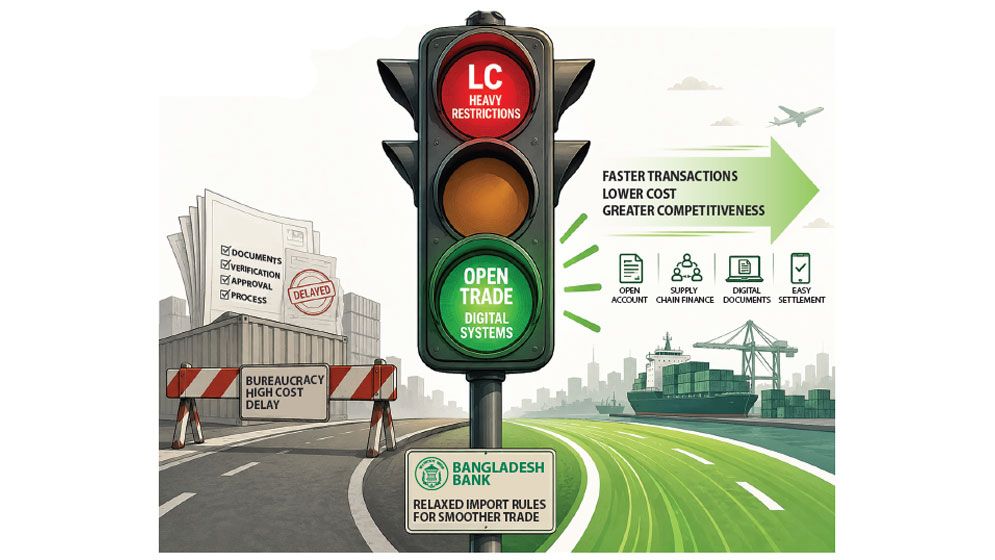
The Bangladesh Bank (BB) has introduced a comprehensive trade finance framework allowing businesses to utilise alternative financing mechanisms beyond traditional Letters of Credit (LCs), a move aimed at modernising international trade and lowering transactional friction.
While Documentary LCs will remain a core instrument, a new circular issued by the central bank permits Authorised Dealer (AD) banks to facilitate a wider spectrum of trade solutions.
These include Open Account Trade, Documentary Collection, Supply Chain Finance (SCF), factoring, receivables financing, and other structured trade finance mechanisms.
According to the central bank, the initiative is designed to offer exporters and importers greater flexibility, improve liquidity access, cut transaction costs, and sharpen the competitive edge of Bangladeshi enterprises in global markets.
Under the updated guidelines, exporters can now ship goods under open account credit terms. This enables international buyers to receive products first and settle payments within an agreed timeline without the need to open an LC.
However, this facility remains subject to compliance with export proceeds realisation requirements and existing foreign exchange regulations.
Furthermore, the central bank has sanctioned the expanded use of Documentary Collection arrangements, specifically Documents against Payment (DP) and Documents against Acceptance (DA). Under this mechanism, banks will serve as intermediaries handling trade documents between exporters and buyers.
Buyers will gain access to these documents either upon immediate payment or by providing a formal commitment to pay at a future date.
Unlike LCs, banks will not assume payment liability unless explicitly contracted under a separate agreement.
A pivotal component of the new policy is the scaling up of Supply Chain Finance (SCF) tied to genuine trade transactions.
Under reverse factoring arrangements, banks can fast-track early payments to suppliers against invoices already approved by financially robust buyers. The buyer then reimburses the bank on the agreed maturity date.
The framework also permits banks to finance creditworthy importers under usance import arrangements and discount accepted import bills on a non-recourse basis – a step expected to significantly ease liquidity for exporters and stabilise local supply chains.
Banks planning to roll out SCF products must notify the BB’s Foreign Exchange Policy Department-1 and secure regulatory acknowledgement prior to launch. Submissions must detail product structures, risk management frameworks, exposure limits, and monitoring systems.
Advance payment rules relaxed
In tandem with the structural overhaul, the central bank has revised the rules governing advance import payments.
Banks are now authorised to process advance payments of any amount, provided they are backed by repayment guarantees from reputable foreign banks.
In the absence of such guarantees, advance payments of up to $20,000 will be permitted under general permission. This threshold rises to $50,000 for payments financed via Exporters’ Retention Quota (ERQ) accounts.
Any advance payments exceeding these ceilings will require formal clearance from the Bangladesh Bank. The central bank noted that urgent electronic applications will typically be processed within 48 hours of receiving complete documentation.
To eliminate bureaucratic red tape and improve operational efficiency, the central bank has urged financial institutions to adopt digital trade processing systems.
Banks are encouraged to accept electronic trade documents, including digital invoices and transport papers, subject to rigorous verification and legal compliance.
Crucially, the BB emphasised that these measures do not signal the end of the LC system. Instead, the central bank clarified that the new options are meant to complement existing structures, offering traders the freedom to select the most efficient financing methods based on their specific operational needs.
Concurrently, banks have been directed to maintain stringent risk management protocols. AD banks must conduct rigorous credit assessments of buyers and importers, enforce strict exposure limits, preserve comprehensive transaction trails, monitor settlement performances, and ensure uncompromised compliance with anti-money laundering (AML), countering the financing of terrorism (CFT), tax, and foreign exchange regulations.