



 For all latest news, follow the Daily Sun's Google News channel.


Experts urge meaningful and effective change in labour law
Daily Sun Report, Dhaka
Published: 29 Apr 2026, 07:56 PM
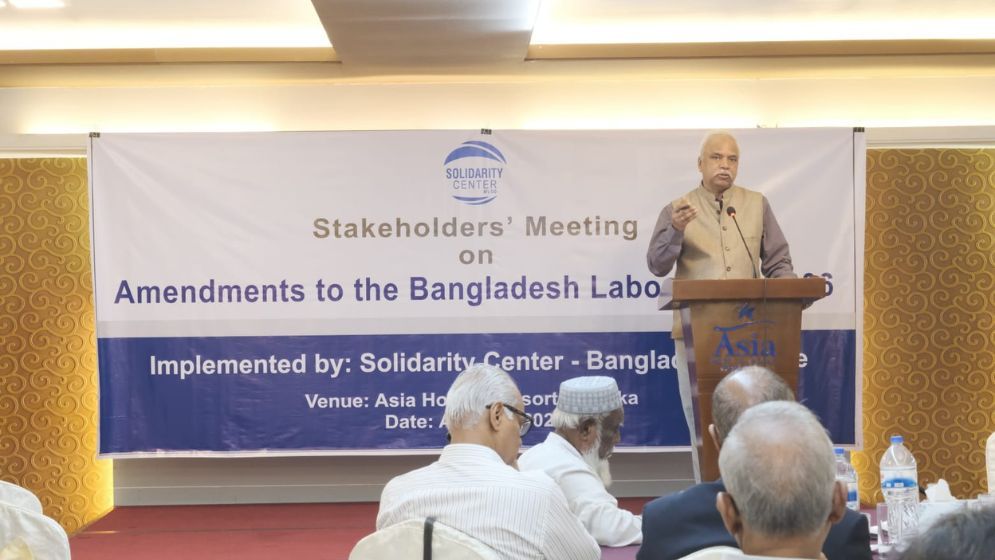
Photo: Daily Sun
Labour experts on Wednesday opined that while the recent amendments to the Bangladesh Labour Act, 2006 mark an important step forward in expanding workers’ rights, certain provisions may limit workers’ freedom of association, collective bargaining, and democratic practices in the workplace.
Speakers discussed in detail the positive aspects, limitations, and potential impacts of the amendments to the labour law at a stakeholder meeting organised by the Solidarity Center at a hotel in the capital.
They further observed that the lack of clarity in distinguishing between workers and managerial staff could complicate the union registration process.
Ensuring transparency and verifiability in worker records is essential to prevent arbitrary barriers to union formation, they noted.
Presenting keynote paper there, Country Program Director of Solidarity Center AKM Nasim, said, “These amendments, developed through years of discussion and tripartite consultations, reflect a genuine effort to align the law with International Labour Organization (ILO) Conventions 87 and 98.
However, many important proposals raised by workers’ representatives were not incorporated into the final law, thereby limiting the opportunity for a more inclusive reform, he added.
Nasim highlighted several positive changes introduced through the amendments. These include the partial recognition of domestic workers, improved provisions for lay-off compensation, an increase in maternity leave to 120 days, new safeguards to ensure workplace safety, and the proposed introduction of an Employment Injury Scheme for workers.
He cautioned that the new membership thresholds for forming trade unions are inconsistent and, in many cases, confusing.
“Limiting the number of trade unions in an establishment to three may restrict workers’ representation. As a result, many workers may remain outside union structures, effectively hindering their right to organize,” he stated.
Supreme Court Advocate Md Borkot Ali, also director (legal) of Bangladesh Legal Aid and Services Trust, said, “The constitution has given us the fundamental right to organise. Limiting the number of trade unions is contradictory to that.”
Addressing as the chief guest, Syed Sultan Uddin Ahmmed, former chair of Labour Reform Commission, said, “What is meant to be a tripartite meeting was not properly carried out in this amendment process. Opinions were collected, but there was no real discussion. If employers and workers together can establish a proper foundation for dialogue, then we will be able to ensure a meaningful and effective change.”
Bangladesh Garment Manufacturers and Exporters Association’s standing committee Chairman Wasim Zakariah said, “There are still some inconsistencies in the amendments to the labour law. We hope the government will take steps to address these issues. On our part, as representatives of the employers, we will remain committed to implementing the amended law.”
Salahuddin Shapon, president of the Bangladesh Revolutionary Garment Workers' Federation, Rashadul Alam Raju, general secretary of Bangladesh Independent Garment Workers’ Union Federation, and Taslima Akhter, president of Bangladesh Garments Sramik Sanhati, were also present at the meeting.