


 For all latest news, follow the Daily Sun's Google News channel.


No money printing or excessive borrowing; protecting pvt sector at core of govt policy: Khosru
Daily Sun Report, Dhaka
Published: 25 Apr 2026, 10:25 PM
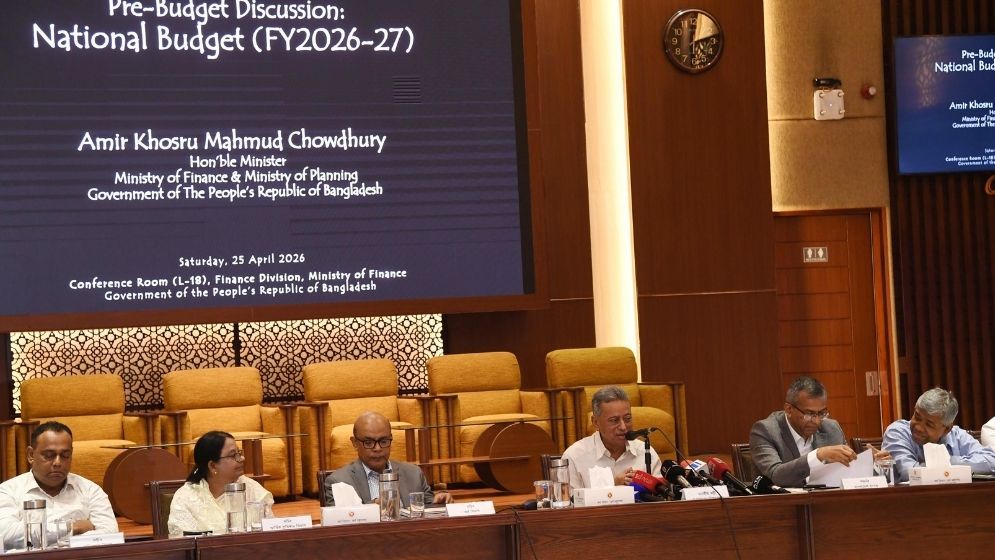
Photo: PID
Finance Minister Amir Khosru Mahmud Chowdhury on Saturday reiterated that the government will not resort to printing money or excessive borrowing from domestic banks, underscoring that protecting the private sector remains a core pillar of its economic strategy.
Speaking at a series of pre-budget consultations with newspaper editors, television chief executives and members of the Economic Reporters Forum (ERF) at the Secretariat, the finance minister said Bangladesh must move away from past practices of monetary expansion and heavy reliance on local borrowing.
“We must come out of the economic damage caused by printing money and borrowing from local banks. We will not deviate from this position,” he said.
He warned that such approaches tend to push up interest rates, crowd out private investment and ultimately undermine long-term economic stability.
He further dismissed recent speculation that the government was planning to print Tk20,000 crore, stating clearly that “this is not true”, and reaffirming that no such inflationary financing would be undertaken.
Amir Khosru Mahmud Chowdhury also criticised earlier economic practices, arguing that excessive concentration of wealth had distorted growth.
“Bangladesh’s economy had fallen into the hands of oligarchs,” he said, adding that the current administration is working towards the “democratisation of the economy” to ensure a wider and more equitable distribution of economic benefits.
Turning to fiscal priorities, the finance minister said the upcoming national budget will place strong emphasis on health and education as key drivers of human capital development and long-term growth.
He noted that increased allocations will be directed towards improving healthcare services, expanding access to education and strengthening vocational and technical training to better align workforce skills with market demand.
He also highlighted plans to gradually increase health and education spending as a share of GDP, stressing that such investment is essential for harnessing Bangladesh’s demographic dividend. In the health sector, measures are being considered to reduce out-of-pocket expenses and reinforce primary healthcare services, with the long-term goal of ensuring more inclusive healthcare coverage.
On social protection and gender empowerment, the minister said programmes such as the “Family Card” initiative are being used to empower women directly.
“Women are the most efficient managers of household expenses. If money reaches their hands, it positively impacts both savings and investment,” he said.
Meanwhile, Bangladesh Bank Governor Md Mostaqur Rahman indicated that a support package is being prepared to reopen closed factories in order to revive industrial activity and employment generation.
He also noted that no final decision has yet been taken regarding the proposed merger of five Islamic banks, and discussions are still ongoing.
The finance minister acknowledged that the private sector is currently under pressure due to weaknesses in the banking sector, currency depreciation and persistent inflation.
He said several industries are underperforming and employment generation has slowed. Boosting investment, he stressed, remains a key priority, alongside reducing regulatory barriers that discourage investors.
He also underlined the importance of supporting SMEs, startups, rural cottage industries and the creative economy, describing them as the backbone of employment generation.
The government, he said, is working to integrate artisans and rural enterprises into mainstream value chains, with support in design, branding and marketing to help them access international markets.
Amir Khosru Mahmud Chowdhury further emphasised the role of sectors such as sports, culture, theatre, cinema and music, noting their growing contribution to GDP despite being historically overlooked.
On broader economic challenges, he admitted that raising the tax-to-GDP ratio remains difficult under current conditions, as revenue growth is closely tied to business performance.
He also stressed the need for improved energy security through reduced import dependence and greater investment in renewable energy sources.
He added that market stability cannot be achieved through enforcement alone.
“Markets must operate based on demand and supply,” he said, calling for stronger supply chains and lower business costs.
During the consultation, ERF leaders led by President Doulot Akter Mala presented a set of pre-budget proposals for FY2026–27, describing the current economic environment as “unusual and challenging”.
They called for macroeconomic stability alongside growth, stronger banking sector reforms, and improved foreign exchange reserves ahead of LDC graduation.
The ERF also urged measures to tackle inflation beyond monetary tightening, including dismantling market syndicates, preventing extortion and ensuring fair pricing of essential goods.
Their proposals emphasised expanded social protection, increased health investment, tax reforms, SME support, capital market strengthening and stronger governance to ensure equitable and sustainable development.