


 For all latest news, follow the Daily Sun's Google News channel.


Trump's team underestimated chances of Strait of Hormuz closure
CNN
Published: 13 Mar 2026, 09:23 PM
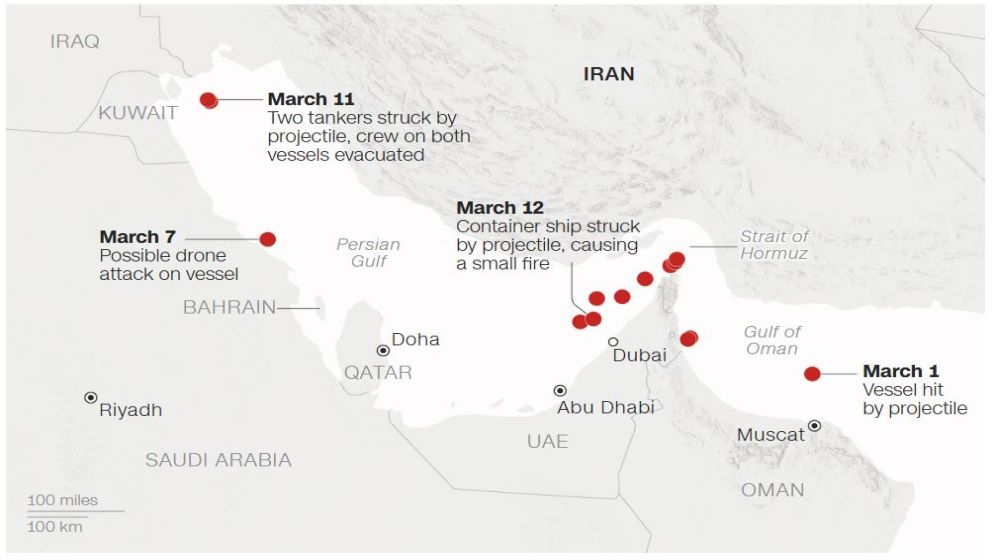
There have been at least 14 reports of attacks on ships in the Persian Gulf and near the Strait of Hormuz since war broke out between Iran on one side and the US and Israel on the other on 28 February. Source: UKMTO
The Pentagon and National Security Council significantly underestimated Iran’s willingness to close the Strait of Hormuz in response to US military strikes while planning the ongoing operation, according to multiple sources familiar with the matter.
President Donald Trump’s national security team failed to fully account for the potential consequences of what some officials have described as a worst-case scenario now facing the administration, the sources said.
While key officials from the Departments of Energy and Treasury were present for some of the official planning meetings about the operation before it started, sources said, the agency analysis and forecasts that would be integral elements of the decision-making process in past administrations were secondary considerations.
Treasury Secretary Scott Bessent and Energy Secretary Chris Wright have been key players throughout the planning and execution stages of the conflict, the sources acknowledged. But Trump’s preference of leaning on a tight circle of close advisers in his national security decision making had the effect of sidelining interagency debate over the potential economic fallout if Iran were to respond to US-Israeli strikes by closing the strait.
And now it may be weeks before the administration’s efforts to alleviate the intensifying economic fallout take hold, officials said Thursday, including high-risk naval escorts of oil tankers through the strait that the Pentagon believes are currently too dangerous to conduct. The president, meanwhile, has continued to downplay the tumult in energy markets and the danger. He told Fox News in an interview airing Friday that oil tanker crews should “show some guts” and go through the strait.
The reality in the strait has left diplomatic counterparts, former US economic and energy officials and industry executives who spoke with CNN in a state of confusion and disbelief.
“Planning around preventing this exact scenario — impossible as it has long seemed — has been a bedrock principle of US national security policy for decades,” a former US official who served in Republican and Democratic administrations said. “I’m dumbfounded.”
Shipping industry executives have made regular requests to the US Navy for military escorts, all of which have been rebuffed. In regular briefings for industry participants in the region, US military officials have repeatedly made clear they have not received orders to begin any escort operation and the risks to US assets remained extremely high, according to two executives with knowledge of the matter.
Bessent told Sky News’ Wilfred Frost on Thursday that those escorts would begin “as soon as it is militarily possible.”
“That was always in our planning, that there’s a chance that US Navy, or perhaps an international coalition, will be escorting oil tankers through,” he said.
But the path to this point, sources said, appears to mark the complex convergence of geopolitical assumptions, energy market forecasts and cross-cutting strategic priorities.
Top Trump officials acknowledged to lawmakers during recent classified briefings that they did not plan for the possibility of Iran closing the strait in response to strikes, according to three sources familiar with the closed-door session.
The reason, multiple sources said, was administration officials believed closing the strait would hurt Iran more than the US — a view that was bolstered by Iran’s empty threats to act in the strait after US strikes on Iranian nuclear facilities last summer.
The White House touted the administration’s planning in a statement on Thursday.
“Through a detailed planning process, the entire administration is and was prepared for any potential action taken by the terrorist Iranian regime,” spokeswoman Anna Kelly said, while touting the US military’s success.
“President Trump has been clear that any disruptions to energy are temporary and will result in a massive benefit to our country and the global economy in the long-term,” she added.
During a press briefing Friday, Defense Secretary Pete Hegseth said the idea that officials underestimated the war’s impact on the Strait of Hormuz is “patently ridiculous.”
“Of course, for decades, Iran has threatened shipping in the Strait of Hormuz,” Hegseth told reporters. “This is always what they do hold the Strait hostage. CNN doesn’t think we thought of that. It’s a fundamentally unserious report.”
CNN had reached out to the Pentagon for comment prior to publication.
Multiple current and former US officials told CNN that plans for any military action against Iran would account for the possibility of Iran closing the waterway. The US military has long maintained and updated plans to address Iranian military action in the critical corridor.
But at a moment where global oil and LNG supplies were plentiful, US oil production sat at record highs and Trump officials were basking in a pliant Venezuelan government and the potential for rapid expansion of new production from a former foe, the global scale of the downside risks was not viewed as a major consideration.
Even in weighing the potential for disruption in the strait, the administration has been far more focused on its overwhelmingly positive — if still aspirational — view of how markets would respond to eliminating the threat of Iranian disruptions entirely.
“To win in life, you’ve got to suffer short-term pain for the long-term gain, and that’s what we’re in the middle of doing right now,” Wright said in a Wednesday interview on NewsNation. “I think the American people will be thrilled with a peaceful world on the other side and more secure supplies of energy for decades to come.”
The prospect of naval escorts
On Thursday, in his first public comments since being elevated, new Iranian Supreme Leader Mojtaba Khamenei said the strait would remain closed as a “tool of pressure,” according to a statement read on his behalf on Iranian state TV.
That leaves the US with few options.
Energy executives have conveyed to administration officials they want an early end to the war, according to multiple sources familiar with the discussions. For now, they are wary of putting their assets and people at risk by running tankers through the strait and do not foresee that changing until the kinetic nature of the war slows dramatically, sources said.
Military officials have been holding daily calls and briefings with energy industry representatives for the last several days, according to sources familiar.
But from nearly the start of the conflict, US officials have told energy company representatives it was not safe enough for the Navy to conduct the escorts in the war’s early days.
A US military official told CNN that Iranian drones and missiles, followed by mines, are the chief threat facing vessels trying to cross the strait. In wargaming a possible conflict with Iran in recent years, one of the biggest risks to the US military was ships being packed tightly into the waterways in the strait, Bab-el-Mandeb and Red Sea, vulnerable to attack by Iranian missiles and drones, another source said.