


 For all latest news, follow the Daily Sun's Google News channel.


CA for setting up independent institution on power, energy
BSS, Dhaka
Published: 07 Jan 2026, 10:08 PM
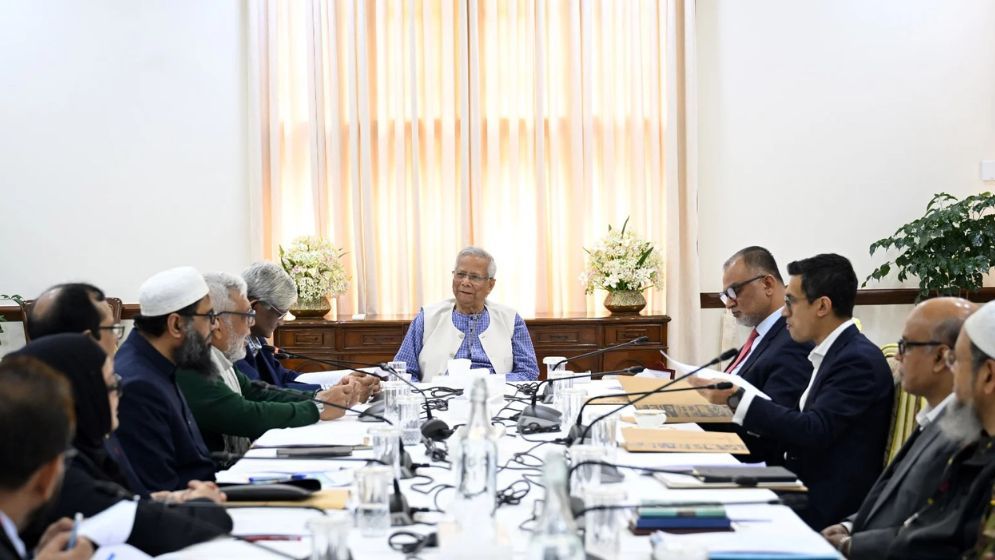
Chief Adviser Professor Muhammad Yunus presided over a meeting on the ‘Power and Energy Sector Master Plan 2026–2050’ at the State Guest House Jamuna, Dhaka on Wednesday. Photo: CA's Press Wing
Chief Adviser Professor Muhammad Yunus on Wednesday
instructed the authorities concerned to set up an independent institution for
conducting research on power and energy sectors, saying that it must not
operate under a ministry.
“There must be a separate institution for research and
development. It will not operate under a ministry. It will be a separate and
strong entity, which will maintain communication with all relevant global
institutions and support the government in policy formulation,” he said.
The Chief Adviser gave the instruction while presiding over
a meeting on the Power and Energy Sector Master Plan 2026–2050 at the State
Guest House Jamuna in the capital, said the Chief Adviser’s Press Wing.
At the outset of the meeting, the Ministry of Power, Energy
and Mineral Resources presented a “Master Plan” on sustainable power to the
Chief Adviser.
The master plan aims to ensure reliable, affordable, and
sustainable primary energy and electricity for the people of Bangladesh through
optimal use of domestic resources, enhanced energy security, improved
efficiency, and environmental responsibility.
Prof Yunus thanked all concerned for their detailed
presentations, saying, “This sector is the lifeline of Bangladesh’s economy. If
it becomes strong, the economy will stand firm. It affects the lives of every
citizen.”
Noting that everything, what was done in the sector in the
previous time, was fragmented, he said, “We must think everything from the
beginning. Just because something has been done a certain way does not mean it
must continue”.
Many projects were implemented in the wrong locations and
with flawed structures, the Chief Adviser said, adding, “This must not be
repeated. We have to ensure that everything will remain within a framework and
rules. That's why research centers are essential”.
Prof Yunus also instructed officials to conduct research on
alternative energy sources.
Power, Energy and Mineral Resources Adviser Muhammad Fouzul
Kabir Khan, Finance Adviser Dr Salehuddin Ahmed, Commerce Adviser Sk Bashir
Uddin, Industries Adviser Adilur Rahman Khan, Bangladesh Investment Development
Authority (BIDA) Executive Chairman Chowdhury Ashik Mahmud Bin Harun, Special
Assistant to the Chief Adviser for Posts, Telecommunications and Information
Technology Faiz Ahmad Taiyeb and senior officials of the ministries concerned
attended the meeting.
During the meeting, policy gaps in the previous three master
plans were identified and briefly reviewed. Discussions were held on
implementing the new master plan in three phases- Phase-I (2026–2030), Phase-II
(2030–2040), and Phase-III (2040–2050).
Under the first-track priority projects from 2026 to 2030,
plans include launching an offshore exploration round, boosting gas production,
ensuring LNG supply security, expanding refinery capacity, and increasing
strategic energy storage capacity.
Long-term strategic projects, including offshore gas
development, large-scale refining and petrochemical industry expansion,
development of hydrogen and ammonia infrastructure, geothermal energy
development, and tidal and ocean wave-based power generation, were discussed in
the meeting.
The ministry informed the meeting that the master plan
outlines how, despite rapid growth in the energy sector, climate impacts can be
reduced by increasing efficiency and ensuring the use of clean fuels while
creating significant economic opportunities.
Electricity demand is projected to rise from 17 gigawatts to
59 gigawatts by 2050, creating environmental and social pressures.
Although total emissions will increase due to higher
generation, the use of cleaner and more efficient technologies will
significantly reduce emissions per unit of electricity—from 0.62 to 0.35 tonnes
of CO? per megawatt-hour.
By 2050, through climate-related initiatives, it will be
possible to reduce annual carbon dioxide emissions by 64.5 million tons and
total carbon dioxide emissions by 1,600 million tons.
As part of the master plan, several reforms have already
been implemented. These included the repeal of the Quick Enhancement of
Electricity and Energy Supply (Special Provisions) Act-2010 (commonly known as
the Quick Rental Act), adoption of the Merchant Power Policy-2025, and approval
of the Renewable Energy Policy-2025, Rooftop Solar Programme-2025, and Net
Metering Guidelines-2025.
Some recommendations on power generation, transmission,
supply, environmental and economic sustainability, and institutional reforms
were presented in the meeting while goals have been set to make the primary
energy sector more secure, efficient, less import-dependent, and financially
sustainable by 2050.
According to the master plan, an investment of $70-85
billion will be required in the energy sector and $107.25 billion in the power
sector over the period 2026-2050.