




 For all latest news, follow the Daily Sun's Google News channel.


DAE orders withdrawal of six substandard pesticide batches
Companies given seven working days to withdraw affected batches or face legal action

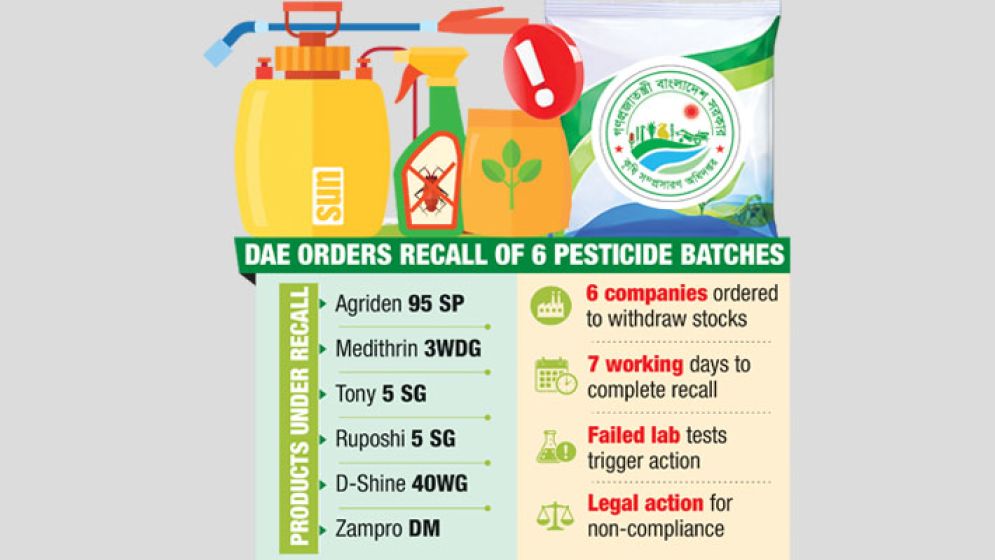
The Department of Agricultural Extension (DAE) has ordered six pesticide companies to withdraw specific batches of their products from the market after laboratory tests found they failed to meet quality standards. Recommended Stories
In separate notices issued by its Plant Protection Wing, the DAE directed the companies to withdraw the affected batches and take necessary corrective measures following laboratory examinations.
The six products are Agriden 95 SP, Medithrin 3WDG, Tony 5 SG, Ruposhi 5 SG, D-Shine 40WG and Zampro DM.
According to official documents, samples collected by local agricultural offices in different districts were sent to the Plant Protection Wing’s laboratory for chemical analysis.
The tests found unsatisfactory results for the identified batches, prompting the withdrawal orders.
The companies have been instructed to remove all remaining stocks of the affected batches from the market within seven working days of receiving the notices. Failure to comply could result in legal action.
Professor Dr Gopal Das of the Department of Entomology at Bangladesh Agricultural University said farmers had been affected by the use of such pesticides and called for a central task force to coordinate action against those responsible.
“Strict legal action must be taken against those involved, alongside efforts to raise awareness and strengthen capacity at the grassroots level,” he said.
He stressed that stronger institutional coordination, accountability and public awareness were essential to preventing irregularities in the pesticide market and protecting farmers’ interests.
The withdrawal orders have renewed concerns over the effectiveness of pesticide quality control and regulatory oversight in Bangladesh.
Pesticides play a crucial role in protecting crops from insects, diseases and other threats.
However, substandard products can undermine crop protection, increase production costs and pose potential risks to agricultural production and the environment.
Farmers generally purchase pesticides from dealers and agricultural input retailers, relying on product labels and recommendations from local agricultural officials.
They often have limited opportunities to independently verify the chemical composition or effectiveness of the products.
The six notices have also raised questions about the adequacy of quality monitoring before pesticides reach farmers.
Experts say effective regulatory oversight requires regular market surveillance, timely laboratory testing and strict enforcement against companies that fail to meet quality standards.
They also emphasise the need to determine whether the quality problems are confined to the identified batches or reflect broader weaknesses in manufacturing, storage, distribution or quality assurance.
Although the DAE has ordered the withdrawal of the affected batches, the official documents do not indicate how widely the products have been distributed, how much stock remains in the market or whether farmers have reported crop damage linked to their use.