



 For all latest news, follow the Daily Sun's Google News channel.


Bangladesh among top countries in bank money laundering
BB task force adviser says Tk19,000cr in overseas assets remain unsecured as authorities pursue civil and criminal proceedings
Daily Sun Report, Dhaka
Published: 17 Nov 2026, 12:00 AM
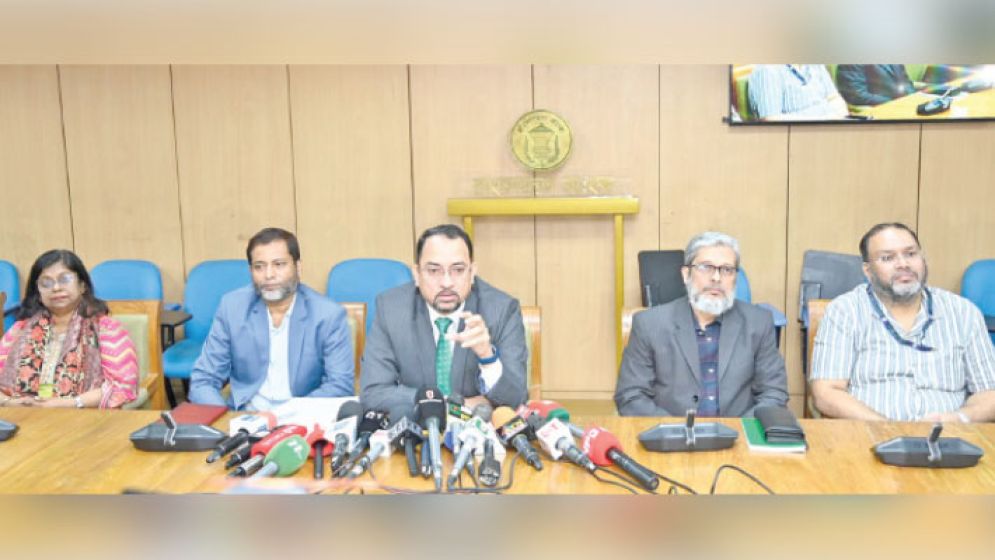
Farhanul Ghani Chowdhury, adviser to the Bangladesh Bank’s Stolen Asset Recovery Task Force, speaks at a press conference on money laundering at Bangladesh Bank on Monday. -PHOTO: COURTESY
Bangladesh could rank among the countries worst affected by money laundering through its banking sector, with financial crimes occurring on a scale rarely seen globally, said Farhanul Ghani Chowdhury, an adviser to the Bangladesh Bank’s Stolen Asset Recovery Task Force.
Speaking at a press conference at Bangladesh Bank on Monday, he warned that recovering funds laundered abroad could take five to 10 years, citing complex international legal hurdles and the country's limited experience in cross-border asset recovery.
"Such an experience is rare in the world," he said.
Bangladesh Bank spokesperson Arief Hossain Khan and Bangladesh Financial Intelligence Unit (BFIU) Director Mahbub Alam also attended the briefing.
Farhanul Ghani noted that authorities have spent the past two years learning the intricacies of asset recovery – a process that requires identifying where stolen funds and properties were moved, tracing ownership, and securing court injunctions to prevent further transfers.
Because laundered assets are routinely routed through multiple layers to obscure ownership, investigators must compile substantial evidence to prove in foreign courts that the wealth was acquired illegally.
Civil proceedings could take three to five years, while criminal cases may require five to 10 years, depending on their complexity and the legal requirements of the countries involved.
Tk19,000cr in overseas assets yet to be secured
Of approximately Tk77,000 crore in assets subject to freezing orders, around Tk58,000 crore is located in Bangladesh and Tk19,000 crore abroad, Farhanul Ghani said, citing a recent statement by the finance minister in parliament.
Although Bangladeshi courts have ordered the overseas assets frozen, the orders have yet to be enforced in the countries concerned.
Some foreign assets have been temporarily frozen following mutual legal assistance requests (MLARs) from Bangladesh, but Farhanul did not disclose their value.
The countries concerned have sought additional information to maintain the temporary freezing orders.
Citing an example, he referred to UK authorities' disclosure of assets worth approximately £250 million belonging to former land minister Saifuzzaman Chowdhury. Legal proceedings involving those assets are underway.
Asked whether delays in providing information had allowed funds to be moved elsewhere, BB spokesperson Arief Hossain said Bangladesh had completed its part within the stipulated timeframe.
However, funds were transferred to another jurisdiction 30 days after being temporarily frozen, he said, adding that efforts to trace them were continuing. He declined to disclose the amount or identify the countries involved.
Farhanul said legal assistance requirements differed across countries, requiring separate requests tailored to their respective legal frameworks. Authorities were exploring ways to expedite the process through domestic and diplomatic channels.
Three of six cases at advanced stage
The task force, formed in October 2024, is pursuing asset recovery through both criminal and civil proceedings.
It initially focused on criminal cases before launching civil recovery efforts last year, with affected banks acting as plaintiffs.
Of six cases selected in the first phase, three have made substantial progress, Farhanul Ghani Chowdhury said, expressing optimism about recovering the funds.
The task force initially began working on 11 institutions before expanding its efforts in a second phase to around 40 institutions with substantial defaulted loans.
The first phase prioritised major loan default cases. International legal firms and institutions reviewed documents in several cases and found at least two had sufficiently strong evidence, including loan agreements, collateral records and personal guarantees, to pursue legal action abroad.
For the second phase, the task force considered loans in default of at least Tk200 crore, evidence suggesting funds had been transferred overseas and whether the borrowers concerned had left Bangladesh.
Banks will share loan documents with foreign institutions under confidentiality agreements. These institutions will assess the prospects for legal action and the availability of litigation funding.
Third-party funding to cover legal costs
Farhanul Ghani said tracing overseas assets, securing freezing orders and pursuing litigation in foreign courts could cost several million dollars.
To finance the proceedings, the task force is exploring third-party litigation funding, allowing banks to pursue cases without upfront payments. In return, funders would receive an agreed share of recovered assets if the cases succeed.
Asked about progress in recovering assets linked to the Sikder Group, Farhanul Ghani said the boards of the banks concerned had given in-principle approval to the proposed arrangement, while legal documents were being prepared.
BB spokesperson Arief Hossain said authorities were examining ways to prevent individuals' criminal activities from adversely affecting their associated institutions. He said banks had strengthened monitoring mechanisms, making it harder for business groups to siphon off fresh funds.
Investigations found that several groups had borrowed from banks and subsequently laundered the money abroad, while some funds remained in Bangladesh.
Responding to questions about the task force's limited public disclosures, Farhanul Ghani said money laundering investigations and asset recovery proceedings were highly sensitive.
Revealing investigative details or legal developments could alert those involved, enabling them to transfer assets or adopt new strategies to evade recovery.
He said the task force was maintaining confidentiality to protect ongoing proceedings and maximise the prospects of recovering the stolen funds.