


 For all latest news, follow the Daily Sun's Google News channel.


Operators seek further cuts in spectrum renewal fees
Mobile operators say proposed fees remain above global norms, limiting investment in network expansion and service quality
Daily Sun Report, Dhaka
Published: 05 Nov 2026, 12:00 AM
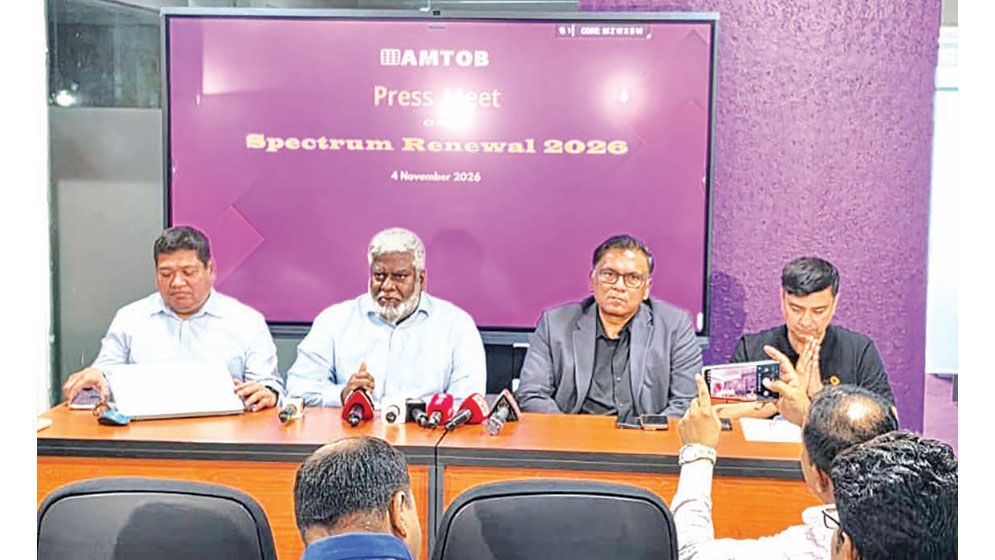
Mobile operators urge the government to lower proposed spectrum renewal fees, citing their impact on network investment and service quality, at a press conference organised by AMTOB in Banani on Wednesday. PHOTO: AMTOB
Mobile operators have urged the government to lower proposed spectrum renewal fees, warning that high costs are hindering investment in network coverage and service quality.
Speaking at a press conference organised by the Association of Mobile Telecom Operators of Bangladesh (AMTOB) in Banani on Wednesday, executives from Banglalink, Grameenphone, and Robi Axiata argued that current valuations remain significantly above international and Asia-Pacific benchmarks relative to industry revenue.
Moderated by Lt Col Mohammad Zulfikar (retd), the briefing acknowledged recent adjustments to proposed rates but emphasised that the pricing remains disconnected from local market conditions.
Citing independent international studies, operator representatives noted that spectrum fees in Bangladesh consume a far larger share of revenue than global and regional averages.
The operators highlighted growing pressure on the sector, citing stagnant revenues, low Average Revenue Per User (ARPU) growth, rising operational expenses, and mounting capital requirements for network expansion.
Grameenphone Chief Corporate Affairs Officer Tanveer Mohammad challenged the pricing formula for 20-year licenses, arguing against simply scaling up the cost of a standard 15-year renewal.
"The economic value of additional years declines over time due to technological evolution, shifting market demand, and investment risks," he said, advocating for a revised valuation model.
Banglalink Chief Corporate and Regulatory Affairs Officer Taimur Rahman noted that while data consumption is surging as users shift away from traditional voice services, revenues are not keeping pace.
He urged policymakers to prioritise long-term economic gains over immediate revenue collection.
"The government should take a holistic view of spectrum pricing, recognizing its critical role in accelerating digital transformation and long-term national development," Taimur Rahman said.
Robi Axiata Chief Corporate and Regulatory Officer Shahed Alam said spectrum affordability should be assessed against industry revenues and operators' investment capacity.
"Spectrum affordability should be assessed in the context of industry revenues, investment capacity, and the need for continued network expansion," he said.
He added that a balanced, investment-friendly pricing framework would help operators improve service quality, expand connectivity and accelerate digital inclusion.
The operators said future spectrum requirements would be driven primarily by rising data traffic and network capacity needs.
They urged the government to adopt a valuation framework that considers network efficiency, digital demand and broader socioeconomic benefits.
They welcomed the proposed extension of spectrum licence tenure, saying it would support long-term investment planning.
However, they stressed that the benefits of longer licences would depend on affordable renewal fees and a commercial framework aligned with international best practices.
Earlier, on 15 October, BTRC proposed reducing spectrum prices by 10% to 30% across the three bands in a letter to the Posts and Telecommunications Division. The proposal covered 79.2 MHz of spectrum held by Grameenphone, Robi and Banglalink.
Under the proposal, the total price would fall from Tk16,845.20 crore to Tk13,100.50 crore, reducing potential government revenue by Tk3,744.70 crore, or around 22%.