



 For all latest news, follow the Daily Sun's Google News channel.


Operators seek deeper cuts in spectrum renewal fees
AMTOB questions 20-year pricing formula, seeks easier payment terms
Daily Sun Report, Dhaka
Published: 01 Nov 2026, 12:00 AM
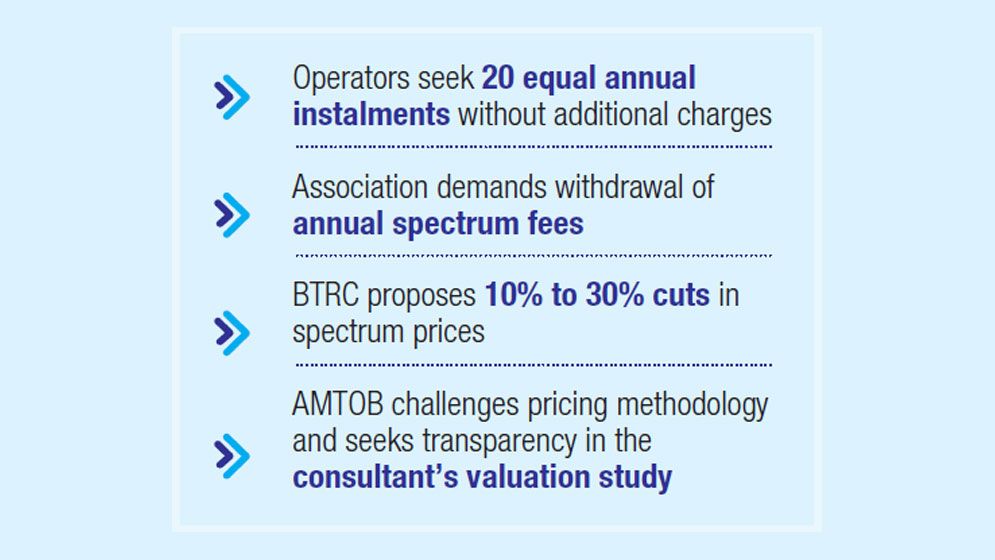
Mobile operators have called for further cuts in spectrum renewal prices and a 20-year payment plan, arguing that the Bangladesh Telecommunication Regulatory Commission (BTRC) has simply scaled up its earlier short-term rates to determine the cost of a 20-year licence.
With their existing spectrum rights set to expire on 10 November, operators have urged the regulator to lower the base prices and allow payments in 20 equal annual instalments.
In a letter to BTRC Chairman Md Emdad Ul Bari on 25 October, the Association of Mobile Telecom Operators of Bangladesh (AMTOB) welcomed the proposed 20-year renewal term as a progressive step in line with international best practices.
However, it questioned the pricing method, saying the proposed fees appeared to have been calculated by simply scaling up the rates outlined in BTRC’s 19 October letter.
The letter, signed by AMTOB Secretary General Lt Col (retd) Mohammad Zulfikar, outlined three key demands: further reductions in base prices for the 900, 1800 and 2100 MHz bands, payment in 20 equal annual instalments without additional charges for the longer tenure, and withdrawal of the annual spectrum charge.
AMTOB said lower spectrum costs would help operators sustain investment in network coverage, capacity and service quality while ensuring fair value for a national resource.
Earlier, on 15 October, BTRC proposed reducing spectrum prices by 10% to 30% across the three bands in a letter to the Posts and Telecommunications Division. The proposal covered 79.2 MHz of spectrum held by Grameenphone, Robi and Banglalink.
Under the proposal, the total price would fall from Tk16,845.20 crore to Tk13,100.50 crore, reducing potential government revenue by Tk3,744.70 crore, or around 22%.
The initial proposal covered a period ending on 10 March 2039, equivalent to around 12 years and four months, with taxes, VAT and other charges payable separately.
BTRC subsequently proposed extending the renewal term to 20 years and allowing payment in 12 instalments, up from eight in the earlier proposal.
BTRC Chairman Md Emdad Ul Bari has defended the proposed rates, saying they were based on a consultant’s study using four valuation methods. The regulator also aims to sell at least 80% of the spectrum available for renewal.
However, AMTOB said operators had not been given access to the study’s assumptions, methodology or findings, making it difficult to assess how the final prices were determined.
Citing publicly reported findings, the association said the study had produced a range of valuations using economic, engineering and international benchmarking methods rather than a single figure.
It argued that the proposed prices appeared to reflect neither the lower end nor the average of those valuations.
AMTOB said its request for a 20-year renewal term was not intended to justify a proportionate increase in the earlier valuation. Instead, it expected BTRC to apply its existing reference pricing framework to the longer tenure.
The association argued that spectrum prices should not be calculated by simply multiplying shorter-term rates, as long-term licences involve different economic considerations, including inflation, market uncertainty, technological changes, investment risks and the time value of money.
It also said a 20-year licence should not necessarily cost proportionately more than a 15-year or shorter-term licence, citing the GSMA’s position that longer licence terms and greater renewal certainty encourage investment.
According to AMTOB, longer licence terms would help operators plan investments in network modernisation, 4G capacity, 5G readiness, fibre infrastructure and rural connectivity, which require substantial capital and take years to generate returns.
The association warned that excessive spectrum costs could limit investment, delay network expansion and increase financing pressure, ultimately affecting coverage, service quality and affordability.
It urged BTRC to treat spectrum pricing not merely as a source of government revenue but as a strategic tool for advancing Bangladesh’s digital economy.