


 For all latest news, follow the Daily Sun's Google News channel.


Instant payments could cut remittance costs: Experts
Daily Sun Report, Dhaka
Published: 24 Jul 2026, 12:00 AM
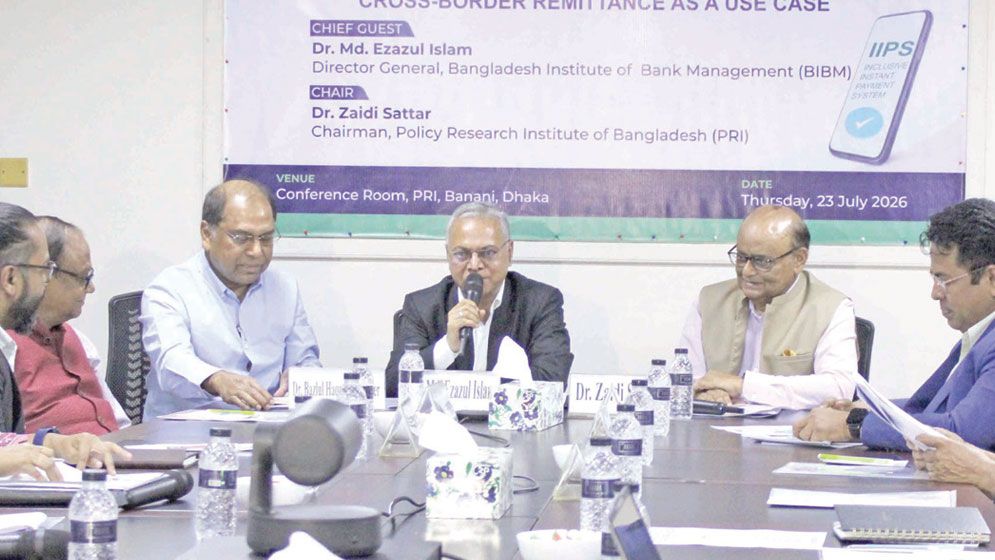
Bangladesh could reduce remittance costs, bring millions more people into the formal financial system and curb reliance on informal hundi networks by introducing an Inclusive Instant Payment System (IIPS), experts said at a workshop in Dhaka on Thursday.
The workshop, organised by the Policy Research Institute of Bangladesh (PRI) with support from the Gates Foundation, marked the launch of a study on how an interoperable instant payment system could transform digital financial services by making transactions faster, cheaper and more secure.
As remittances remain a lifeline for millions of Bangladeshi families and a key pillar of the economy, cross-border transfers have been identified as one of the major use cases for the proposed system.
Opening the event, PRI Chairman Dr Zaidi Sattar said remittances, which account for around 6% of Bangladesh’s GDP, should increasingly be directed towards productive investment rather than consumption.
He also highlighted the continued use of informal hundi channels by many migrant workers, stressing the need for affordable, accessible and trusted digital payment solutions.
Presenting the keynote paper, PRI Research Director Dr Bazlul Haque Khondker said the study would examine how an IIPS could connect banks, mobile financial service providers and other payment operators through a shared interoperable platform.
Such a system, he said, would enable faster and lower-cost transactions while supporting financial inclusion, digital commerce and transparent remittance flows.
Dr Ezazul Islam, director general of the Bangladesh Institute of Bank Management (BIBM), said an inclusive instant payment system could significantly reduce digital transaction costs, expand financial inclusion and strengthen the competitiveness of Bangladesh’s payment ecosystem.
However, he said its success would depend on effective governance, sustainable pricing, dispute resolution mechanisms and strong risk management.
Bangladesh Bank Additional Director Mohammad Jahid Iqbal said the central bank is developing the IIPS using the open-source Mojaloop platform to improve interoperability and reduce transaction costs by connecting banks, payment service providers and eventually microfinance institutions.
The platform, launched in November 2025, is also designed to support feature phones, simplify account opening and enhance fraud prevention.
Sharing the private sector perspective, Sayed Shaikh Ibna Jilany, vice president for remittance and financial services at bKash, stressed the importance of integrating digital payment platforms into a nationwide interoperable ecosystem while ensuring affordability, consumer protection and public trust.
In his closing remarks, PRI Distinguished Fellow Dr Ahsan H Mansur said financial inclusion, instant payments and the transition to a cashless economy should be pursued under a unified national strategy.
He said Bangladesh Bank spends around Tk20,000 crore annually on cash management and argued that reducing digital transaction costs, restoring confidence in the banking system and making smartphones and internet services more affordable would encourage wider adoption of digital payments.
He also said dedicated financial mechanisms for non-resident Bangladeshis could help attract an estimated $2-3 billion in diaspora investment through formal channels.