


 For all latest news, follow the Daily Sun's Google News channel.


High telecom taxes slowing digital growth: Study
Reforms could raise GDP growth to 7.2%

Bangladesh’s ambition to emerge as a high-growth digital economy is being significantly constrained by an excessive tax burden on the mobile telecommunications sector, according to a new economic study.
The report warns the current regime is slowing digital inclusion, weakening investment and suppressing long-term economic growth.
The study, prepared by Frontier Economics for global telecom operator VEON, argues that despite Bangladesh achieving near-universal 4G coverage, millions of people remain excluded from the digital economy due to high taxes on mobile services and devices.
According to the report, mobile operators in Bangladesh have expanded 4G coverage to 99% of the population, exceeding the 94% average among lower-middle-income countries. Yet only 38% of people own smartphones, while average revenue per user (ARPU) stands at just $1.20 per month, among the lowest globally.
The report, titled “Bangladesh Can Increase Economic Growth by Lowering Barriers to Digital Connectivity”, released on Thursday, describes the country’s telecom landscape as a “digital paradox”, where strong network availability stands in sharp contrast to weak usage levels and limited investment capacity.
It warns that high taxation is limiting operators’ ability to improve network quality and roll out next-generation technologies, leaving Bangladesh ranked 91st out of 105 countries in average mobile download speeds.
Mobile sector paying ‘55% revenue tax’
The report says the telecom sector has effectively become a major source of government revenue collection despite Bangladesh maintaining one of the world’s lowest tax-to-GDP ratios at 7.6%.
Researchers found that nearly 55 cents from every dollar generated by the mobile sector goes towards taxes and regulatory charges.
Among the key concerns highlighted in the report are the unusually high taxes imposed on mobile usage and services.
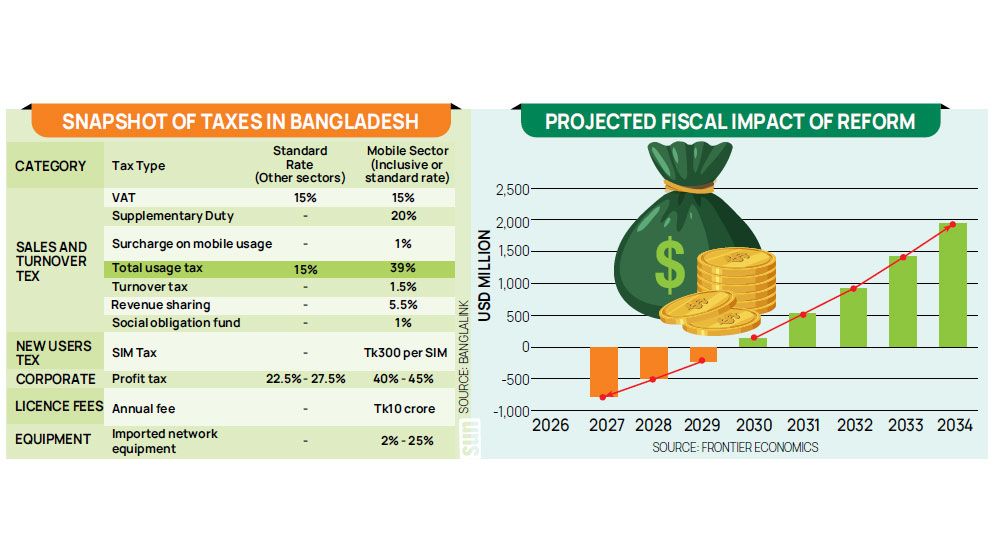
Total sales, usage and turnover taxes on mobile services amount to around 47%, compared with the standard 15% VAT applied to most other sectors of the economy.
The report also identifies the Tk300 SIM tax as a major barrier for low-income consumers seeking access to digital connectivity.
In addition, mobile operators are subject to corporate tax rates ranging from 40% to 45%, almost double the rates imposed on many other industries.
Tax reform could accelerate GDP growth
Frontier Economics modelled a reform scenario in which mobile sector taxes are gradually aligned with the broader economy.
The proposed reforms include reducing combined usage taxes to 23%, lowering corporate tax rates to 30% and abolishing the SIM tax altogether.
Under this scenario, the study estimates that Bangladesh’s annual real GDP per capita growth could increase from 6.6% to 7.2%.
The reforms could also drive a 5% increase in mobile penetration and a 4% rise in average mobile data usage, strengthening digital participation and productivity across the economy.
Short-term revenue loss, long-term fiscal gain
The study acknowledges that the government would face a short-term fiscal impact following tax reductions.
It estimates that direct tax proceeds from the mobile sector could decline by approximately $761 million in the first year, equivalent to around 2.5% of total government tax revenue.
However, the report argues that the losses would be temporary and manageable.
According to the analysis, stronger economic growth and wider digital adoption would gradually expand the national tax base, allowing the government to reach fiscal break-even by 2030, after which annual tax revenues could surpass current levels.
“Entry costs matter disproportionately in mobile-first economies,” the report noted, urging policymakers to move away from excessive consumption-based taxes that raise consumer costs and exclude marginal users from the digital economy.