


 For all latest news, follow the Daily Sun's Google News channel.


CPD urges tax system overhaul ahead of LDC graduation
The think tank estimates that Bangladesh lost Tk2.26 lakh crore in FY23 due to tax evasion, while VAT collection captures only 28%-29% of its potential
Daily Sun Report, Dhaka
Published: 23 Apr 2026, 12:00 AM
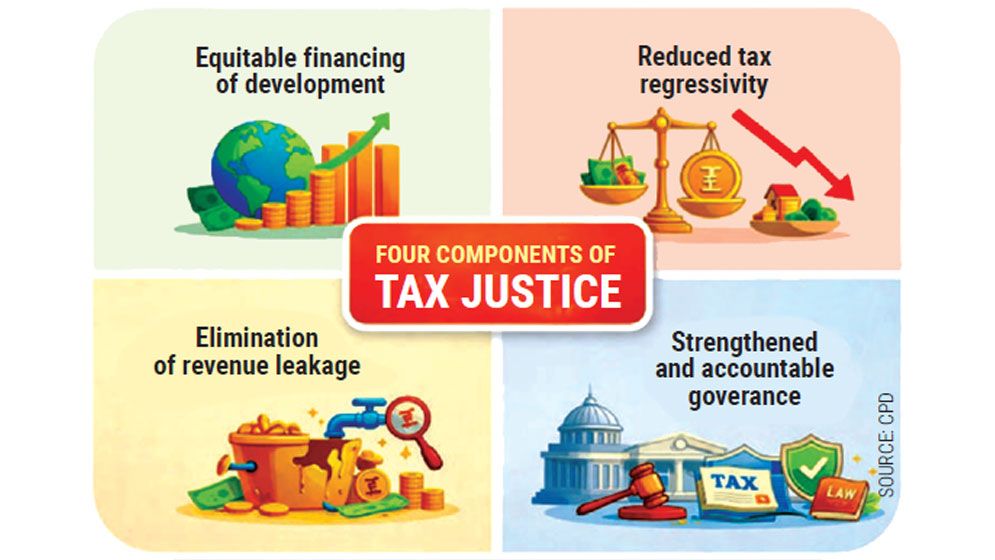
The Centre for Policy Dialogue (CPD) has called for a fundamental restructuring of the tax system, urging a shift from a narrow revenue-centric approach to a broader tax justice framework.
The call came as the country prepares for the fiscal 2026-27 national budget and its graduation from Least Developed Country (LDC) status.
In a joint report with Christian Aid titled “Tax Justice for Graduating Bangladesh: The Case of Corporate Income Tax and Value Added Tax,” CPD said the country’s tax system remains structurally weak, with a tax-to-GDP ratio of just 7.3%, the lowest in South Asia.
The think tank warned that this reflects deep inefficiencies in revenue mobilisation and heavy reliance on indirect taxation.
The report estimated that Bangladesh lost Tk2.26 lakh crore in FY23 due to tax evasion, while Value Added Tax (VAT) collection captures only 28%-29% of its potential.
CPD attributed the gap to widespread evasion, excessive exemptions and weak enforcement.
It cautioned that an excessive focus on revenue targets without addressing structural weaknesses could worsen inequality and undermine social progress.
Instead, CPD recommended adopting a tax justice framework that emphasises equity, accountability, reduced regressivity and improved governance.
The think tank said the country’s fiscal strategy must be reoriented ahead of LDC graduation, which will reduce access to preferential trade benefits and development support.
Strengthening domestic revenue capacity is now a strategic necessity rather than a policy choice, it added.
On corporate taxation, CPD recommended gradually aligning the country’s system with the OECD/G20 global minimum tax threshold of 15%.
It also pointed to distortions in the current structure, noting that the effective tax rate averages about 31% for listed firms and 33.5% for non-listed firms, with some sectors facing rates as high as 60-70% due to compliance burdens and disallowed deductions.
The report proposed replacing reduced tax rates for listed companies with performance-based incentives tied to measurable outcomes such as investment, exports and job creation.
On VAT reforms, CPD suggested simplifying the existing eight-tier system into three tiers – standard, reduced and zero rates – with a long-term goal of moving to a two-tier structure.
It also recommended lowering the standard VAT rate from 15% to 10%, provided the tax base is broadened and enforcement strengthened.
Recognising the regressive nature of VAT, the report proposed ring-fencing a portion of VAT revenues for targeted social protection programmes and cash transfers for low-income households.
It also recommended reinvesting VAT collected from essential sectors such as private health and education to improve access for disadvantaged groups.
CPD further called for phasing out tax incentives for fossil fuel-based power producers, arguing that such benefits disproportionately favour high-emission industries while contributing to environmental harm.
It also recommended introducing sunset clauses for all tax incentives to ensure time-bound benefits and a gradual transition to standard taxation.
Export cash incentives should be phased out in line with LDC graduation and replaced with WTO-compliant mechanisms such as duty drawbacks and investment credits, the report said.
To modernise tax administration, CPD urged the use of artificial intelligence and data analytics in revenue collection, along with integrated data-sharing among the National Board of Revenue (NBR), Bangladesh Bank and commercial financial institutions.
It also recommended making Electronic Fiscal Devices (EFDs) mandatory nationwide.
Institutionally, CPD proposed separating tax policy formulation from tax collection functions within the NBR to enhance transparency and efficiency, and establishing an independent authority to manage tax refunds.
The report also highlighted the burden of advance tax payments on small and medium enterprises (SMEs), recommending their removal to ensure fairness in tax administration.
To improve compliance culture, CPD suggested introducing tax literacy education at schools, colleges and universities.
It also recommended expanding the taxpayer base to cover at least 59% of registered companies by removing inactive entities and strengthening enforcement. Public disclosure of tax compliance status was proposed to promote accountability.
The think tank further called for bringing emerging sectors, such as the gig economy, entertainment industry and NGOs, into the tax net, alongside stricter measures against repeated non-filing of tax returns.
CPD said its recommendations are essential for ensuring fiscal resilience and equity as Bangladesh navigates a critical economic transition following LDC graduation.