


 For all latest news, follow the Daily Sun's Google News channel.


Over half of Japanese firms plan expansion in Bangladesh: Survey
The survey finds rising business confidence among Japanese firms, with strong interest in expansion amid improving demand and policy outlook following EPA deal
Daily Sun Report, Dhaka
Published: 31 Mar 2026, 12:00 AM
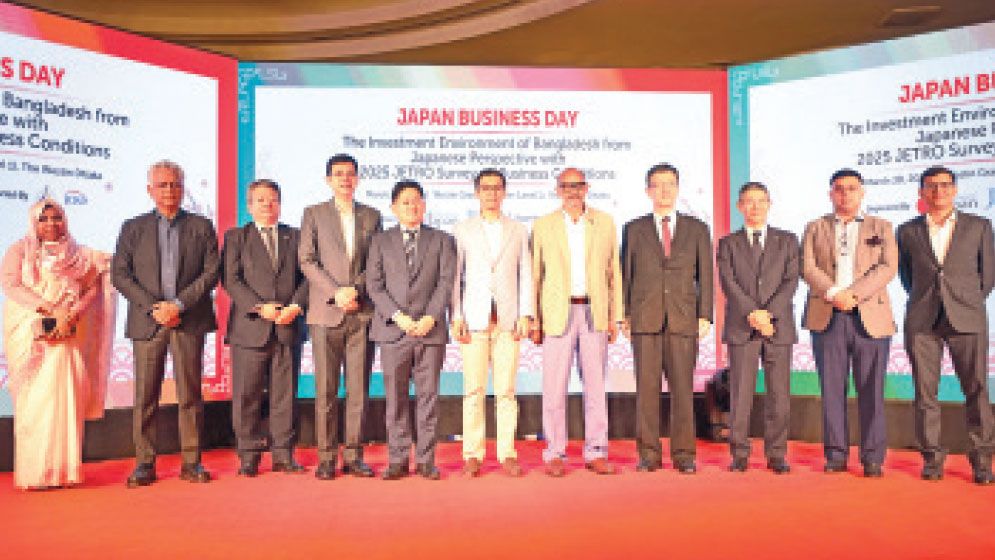
Some 56.9% of Japanese firms plan to expand their businesses in Bangladesh within the next one to two years, according to a new survey.
The survey also found that 50% of Japanese companies operating in the country expect to post operating profits, driven by rebounding business confidence after the national election, strong domestic demand, and cost competitiveness.
Japan External Trade Organization (JETRO) Country Representative Kazuiki Kataoka revealed the findings of the “Business Conditions Survey 2025” at an event held at a hotel in Dhaka on Monday.
The non-manufacturing sector showed stronger optimism, with 62.2% of firms planning expansion, compared to 47.6% in the manufacturing sector, he said.
Conducted between 19 August and 17 September 2025, the survey noted that Bangladesh is emerging as a high-potential frontier market for growth.
The Embassy of Japan in Dhaka, in collaboration with JETRO and supported by the Japanese Commerce and Industry Association in Dhaka (JCIAD) and the Japan Bangladesh Chamber of Commerce and Industry (JBCCI), organised “Japan Business Day” to mark the Economic Partnership Agreement (EPA) with Bangladesh.
In the morning session, Japanese Ambassador to Bangladesh Shinichi Saida, Head of Economic Section Yutaro Mochida, JBCCI President Tareq Rafi Bhuiyan (Jun), and Japan’s Deputy Director General (Ambassador) at the Ministry of Foreign Affairs Izuru Kobayashi (virtually) spoke at the event.
In the afternoon session, Bangladesh Investment Development Authority (BIDA) Executive Chairman Chowdhury Ashik Mahmud Bin Harun attended as chief guest, while Prime Minister’s Adviser on Finance and Planning Dr Rashed Al Mahmud Titumir spoke as special guest.
A panel discussion moderated by JBCCI President Tareq Rafi Bhuiyan featured BIDA Director Shah Nusrat Jahan, JCIAD President Manabu Sugawara, Mitsubishi Corporation Country Representative Hiroshi Uegaki, Apex Footwear Managing Director Syed Nasim Manzur, and Policy Exchange Bangladesh Chairman and CEO Dr M Masrur Reaz.
Speakers stressed the need for policy consistency, technology adoption, skilled manpower, quality production, and industrial diversification to attract more foreign direct investment (FDI) and boost economic growth.
EPA seen as ‘game changer’
Bangladesh signed the Economic Partnership Agreement (EPA) with Japan on 6 February 2026, to boost bilateral trade and investment.
Experts described the deal as a “game changer” and a milestone in economic and diplomatic relations.
Speaking at the programme, Japanese Ambassador Shinichi Saida praised the new government’s “well-conceived plan” focused on restoring law and order, breaking past cycles, and accelerating economic growth through increased investment.
“All these will positively affect investors’ confidence and help accelerate growth through higher FDI,” he said, also appreciating the peaceful elections held earlier this year.
Highlighting longstanding ties, he said Japan has remained a consistent development partner of Bangladesh since independence, regardless of political leadership, with cooperation evolving into a strategic partnership based on trust and shared values.
Referring to the EPA, the ambassador said such agreements should be viewed from a long-term perspective, citing Japan’s experience with ASEAN countries where EPAs have supported sustained economic growth.
He also described the agreement as highly concessionary and important for providing legal certainty to businesses, traders, and investors, while signalling both countries’ commitment to free trade amid global uncertainties.
Around 350 Japanese companies are currently operating in Bangladesh, with the number steadily increasing.
According to Bangladesh Bank and the Export Promotion Bureau (EPB), bilateral trade between the two countries stood at US$3.12 billion in the 2023-24 fiscal year.