


 For all latest news, follow the Daily Sun's Google News channel.


US-Bangladesh trade deal: Tariff relief comes at high cost?
A marginal duty cut to 19% and billions in purchase commitments and strategic clauses reshaping Dhaka’s economic posture
Daily Sun Report, Dhaka
Published: 12 Feb 2026, 12:00 AM
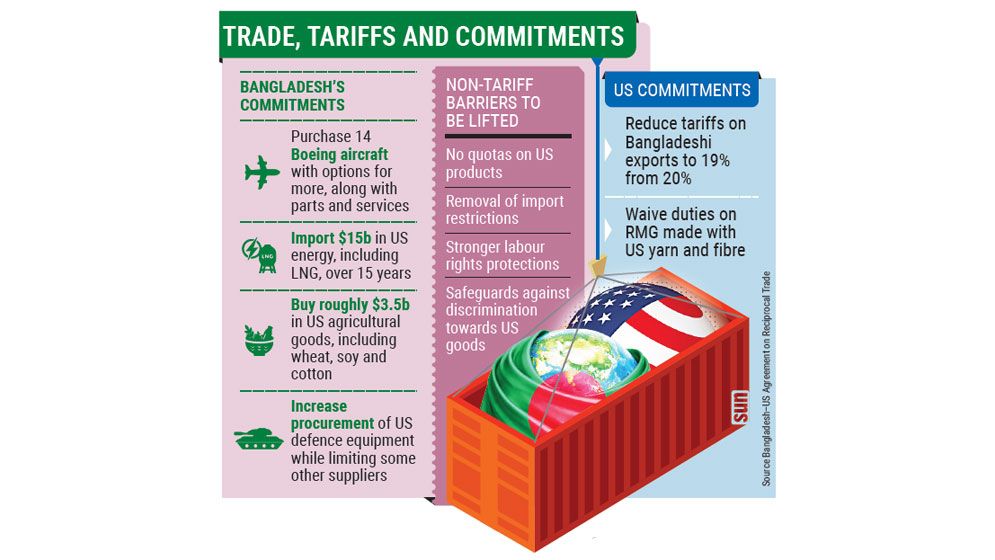
Bangladesh has secured a modest reduction in US tariffs under a newly signed trade pact, but the agreement binds Dhaka to billions of dollars in purchases and wide-ranging policy, security and regulatory commitments that could reshape its economic and geopolitical posture.
The interim government signed the “Agreement on Reciprocal Trade” with Washington on 9 February, just days before the national election.
Under the deal, the US reduced its reciprocal tariff on Bangladeshi exports to 19% from 20% and granted duty-free or preferential access to around 2,500 Bangladeshi products.
In exchange, Bangladesh will open its market to approximately 4,400 US goods, including machinery, vehicles, ICT equipment, chemicals, medical devices and agricultural products.
The 32-page agreement extends far beyond tariffs. Bangladesh has committed to purchasing US$15 billion worth of US energy commodities, including liquefied natural gas, over 15 years.
It will also import at least $3.5 billion in American agricultural products such as wheat and soybeans and acquire 14 Boeing aircraft for state-owned Biman Bangladesh Airlines.
Strategic provisions feature prominently in the pact. Bangladesh has agreed to increase purchases of US military equipment while restricting procurement from unspecified “certain countries,” widely interpreted as a reference to China.
The agreement also limits future nuclear cooperation with suppliers deemed to threaten US interests, effectively narrowing options involving Russia or China.
Another clause allows Washington to terminate the agreement and reimpose tariffs if Bangladesh enters into a free trade or preferential arrangement with a “non-market country,” a US regulatory term commonly applied to China and Russia.
Additionally, if the US adopts border measures or trade actions on national security grounds, Bangladesh must implement “complementary restrictive measures” following consultations, aligning its trade posture more closely with US policies.
US Trade Representative Jamieson Greer described the deal as “a meaningful step forward in opening markets, addressing trade barriers, and creating new opportunities for American exporters.” The Office of the US Trade Representative has published the full text of the agreement.
The pact also entails significant domestic policy changes. Bangladesh must remove restrictions on the right to strike, increase penalties for anti-union discrimination, and bring Export Processing Zones under the general labour law within two years, ending their separate regulatory framework.
In logistics and data governance, Bangladesh is required to adopt digital platforms for ports, terminals and shipping fleets designed to prevent access by “other foreign governments.”
It must also strengthen controls on US-origin goods subject to American export regulations and share customs transaction data with Washington to help identify “transactions of concern.”
Non-tariff barriers are another central component. Bangladesh will automatically recognise US Food and Drug Administration approvals for medical devices and pharmaceuticals, eliminating separate local testing or marketing authorisation requirements.
The agreement is also expected to streamline entry procedures for US agricultural exports, including cotton, in line with Dhaka’s purchase commitments.
Supporters argue that the tariff reduction and expanded market access could provide relief for Bangladeshi exporters and deepen bilateral trade ties.
However, the limited cut from 20% to 19% has drawn scrutiny in light of the scale and scope of the commitments undertaken in return.
With a new government set to take office, the agreement is likely to face close examination over whether the modest tariff relief justifies the sweeping economic, regulatory and strategic obligations embedded in the pact.