




 For all latest news, follow the Daily Sun's Google News channel.


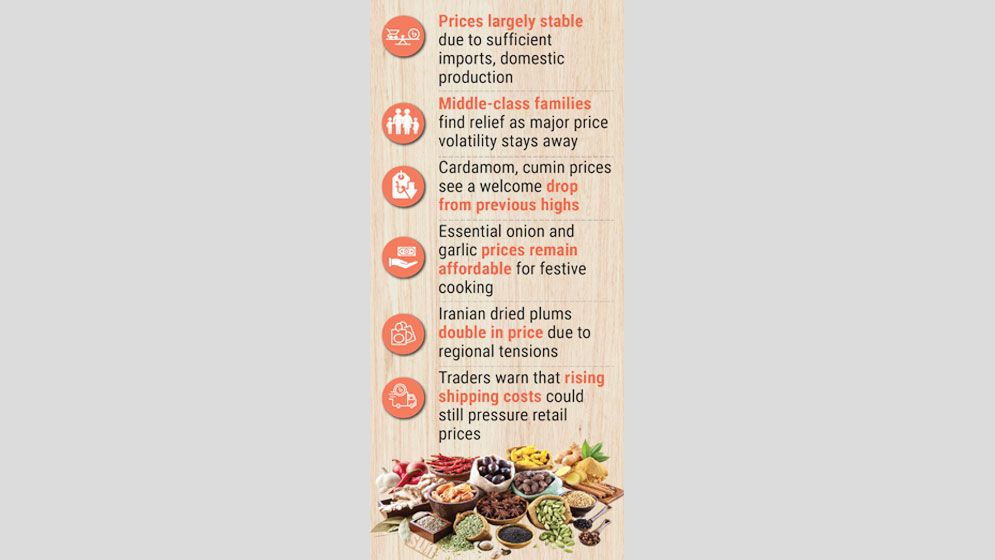
In a departure from the seasonal volatility that typically precedes Eid-ul-Azha, the spice markets in both wholesale and retail sectors have remained remarkably stable this year.
Market analysts attribute the steady prices to a combination of healthy import volumes, a boost in domestic yields, and a resilient supply chain that has weathered recent logistical hurdles.
The Qurbani festival traditionally exerts significant pressure on the Bangladeshi kitchen, with demand for staples such as dried chillies, cumin, cardamom, and garlic usually sending prices into a tailspin.
However, while some commodities have seen marginal fluctuations, consumers have expressed a sense of relief at the absence of the “abnormal” price hikes that have marred previous festive seasons.
Traders remain cautiously optimistic but warned that any eleventh-hour spike in haulage and transport costs as the holiday approaches could yet weigh on the market.
Retail fluctuations
A survey of Chattogram’s key retail hubs, including Bahoddarhat and Chawk Bazar, showed that imported Indian dried chillies were trading at Tk480 per kilogramme on Wednesday – an increase of roughly Tk30 over the past fortnight. Similarly, chillies sourced from Panchagarh rose to Tk250 per kg from a previous Tk220.
Conversely, some staples have become more affordable. Locally produced turmeric fell by Tk10 to trade at Tk220 per kg, while coriander prices dipped to approximately Tk150 per kg depending on quality. The most significant surge was noted in mace, which is currently fetching between Tk2,800 and Tk2,900 per kg, up from Tk2,600 just 15 days ago.
Meanwhile, cumin prices eased slightly to Tk560, and cinnamon remained static at Tk430. Cloves and black pepper saw modest increases, trading at Tk1,300 and Tk1,060 respectively.
In a welcome turn for those preparing for the feast, cardamom prices have softened to between Tk4,000 and Tk4,500 per kg, down from a high of Tk4,700.
Reductions were also seen in nutmeg (Tk800) and black cumin, which fell sharply from Tk480 to Tk380.
The ‘plum’ problem
The most dramatic outlier in the market is the Iranian dried plum (alubokhara). A month ago, the item was priced at Tk600; it has since more than doubled to Tk1,300.
Md Suman, proprietor of the Khaja Azmir Store in Bahoddarhat, told the Daily Sun that wholesalers were justifying the hike by pointing to the conflict in Iran.
“Aside from that, the price of almost every other product is normal, and in many instances, they are actually coming down,” he noted.
Wholesale trends at Khatunganj
The sentiment was echoed at Khatunganj, the port city’s largest wholesale commodity hub. Indian dried chillies were quoted at Tk400 per kg, while local turmeric wholesale prices dropped by up to Tk15 to settle at Tk218.
Onions and garlic – the backbone of Eid catering – provided further reassurance.
Local onions are currently trading between Tk22 and Tk28 per kg in the wholesale market; while newly harvested, lower-quality onions, hampered by high moisture and early signs of rot, are being cleared at between Tk7 and Tk15 per kg.
Amal Saha, manager of Messrs Nizam Enterprise in Khatunganj, explained the market dynamics: “A month ago, we saw prices climb due to geopolitical tensions. Now, many of those items have begun to cheapen again. Those that were already stable have stayed that way.
“While dried chillies and coriander have ticked up slightly, the rise is by no means abnormal,” he said, before reiterating the concern that rising transport costs remain the primary risk to market stability.
Consumer relief
For the middle-class shopper, the relative calm in the marketplace is a welcome change.
Kamrul Hasan, a private sector employee spotted shopping at Bahoddarhat, said, “Compared to recent years, the market feels much more tolerable this time. The drop in cardamom and cumin prices is a real help for families like ours. We just hope the authorities keep a close eye on things to prevent any manipulation in the final days before Eid.”
Read More