


 For all latest news, follow the Daily Sun's Google News channel.


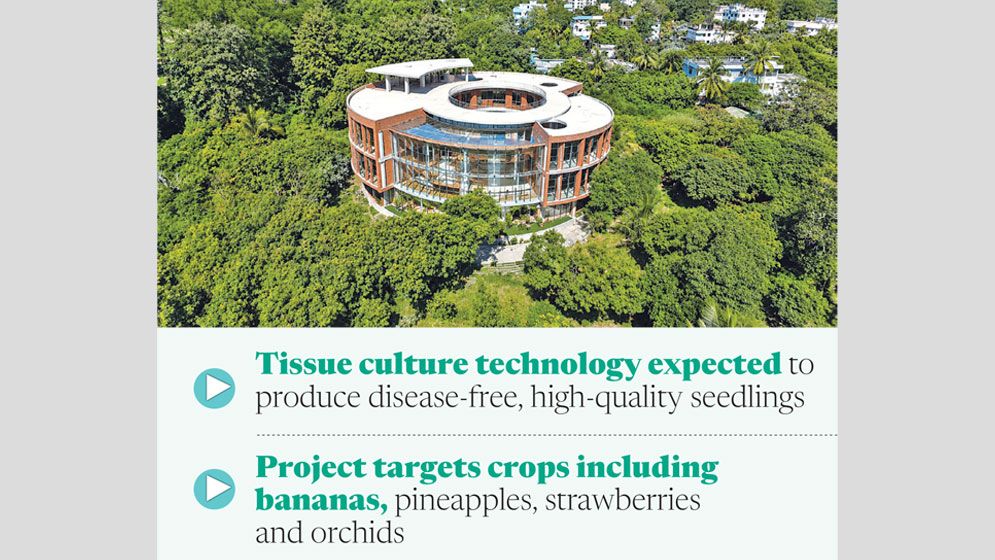
A state-of-the-art plant tissue culture laboratory is being established in Bandarban, raising hopes among agriculturists that advanced technology could unlock new possibilities for agriculture in Bangladesh’s hilly regions.
Designed as one of the country’s most modern research facilities of its kind, the laboratory building itself reflects a strong scientific theme. The structure has been modelled after the “nucleus”, the central part of a biological cell, combining modern architectural features with environmentally conscious design principles.
Constructed using ceramic bricks and iron chips, the building has been designed to maximise natural light and ventilation, reducing dampness inside the facility and creating a healthier environment for research and laboratory work, according to officials involved in the project.
Agricultural officials say tissue culture technology allows the rapid production of large numbers of disease-free and genetically identical seedlings, which can significantly improve crop quality, reduce disease risks and lower production costs for farmers.
They believe the facility could play a major role in expanding the cultivation of high-value crops in the hills, including hill bananas, Sabri bananas, pineapples, strawberries, dragon fruit and orchids. Officials also expect the initiative to attract more young people towards modern agriculture and agribusiness in the region.
The facility is being developed under the Department of Agricultural Extension’s Tissue Culture Laboratory-cum-Horticulture Centre Establishment and Development Project.
The laboratory complex will include a modern media preparation room, inoculation and transfer rooms, culture and growth chambers, acclimatisation and hardening zones, greenhouse facilities, and specialised research and training spaces. Officials say nearly all the infrastructure required for international-standard research is being incorporated into the centre.
Abu Noman Faruq Ahmmed, professor at the Department of Plant Pathology under the Faculty of Agriculture at Sher-e-Bangla Agricultural University, said Bangladesh’s agriculture sector was entering a new phase of transformation. “It is no longer enough simply to increase production,” he said. “Quality and disease-free production must also be ensured. Tissue culture technology is creating that opportunity.”
He added that the hill regions possess enormous potential for cultivating high-value fruits, flowers, spices and export-oriented crops, and that improved seedlings and technological support could help farmers contribute more significantly to the national economy.
Officials involved in the project said the centre would not only produce tissue culture seedlings but also conduct research on crops suited to hilly environments, preserve new plant varieties, develop mother plants and support innovation in climate-resilient agricultural technologies.
Agriculturists believe the facility could create major opportunities for research into orchids, exotic flowers, hill spices and other high-value crops with export potential.
Talha Zubair Masror said the project should be seen as more than just a modern building.
“We are actually creating a knowledge-based platform for the future of agriculture,” he said. “Our main goal is to ensure disease-free and quality seedlings for farmers in the hill regions, create new entrepreneurs and make research more field-oriented.”
Liton Debnath, deputy director of the Balaghat Horticulture Center, said around 80 per cent of the construction work had already been completed.
“The work on this highly modern building is being carried out maintaining a very high standard,” he said.
He added that maintaining proper temperature, humidity, cleanliness and a germ-free environment was essential for sensitive research facilities such as tissue culture laboratories.
“Keeping these issues in mind, the construction work is being carried out with utmost care,” he said.
Read More