



 For all latest news, follow the Daily Sun's Google News channel.


Weak credit, high NPLs cloud BB’s rate hold
BB estimated real GDP growth at 4.14% in FY26, with third-quarter growth at just 2.2%. Industrial production contracted by 0.28% over the period.
Daily Sun Report, Dhaka
Published: 01 Oct 2026, 12:00 AM
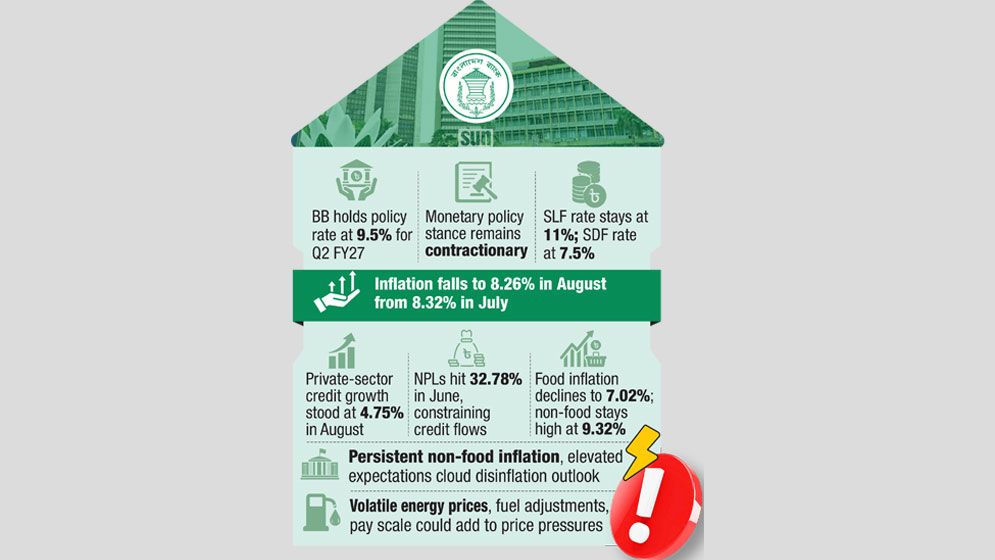
Bangladesh Bank (BB) has kept its policy rate unchanged at 9.5% for October-December, cautioning that the recent easing in inflation may not last while growth, private-sector credit and investment remain weak.
Deputy Governor Dr Md Habibur Rahman announced the decision on Wednesday while unveiling the central bank’s first-ever Quarterly Monetary Policy Statement (QMPS), covering the second quarter of ongoing 2026-27 fiscal year (FY27). Monetary policy was previously announced for six-month periods.
The central bank also retained the Standing Lending Facility (SLF) rate at 11% and the Standing Deposit Facility (SDF) rate at 7.5%, leaving its stance tight. It said the policy seeks to balance inflation control, economic recovery and financial-sector stability.
Inflation outlook
According to the Bangladesh Bureau of Statistics (BBS), headline inflation fell to 8.26% in August from 8.32% in July, a 10-month low. Food inflation eased to 7.02%, while non-food inflation stood at 9.32%.
The central bank said favourable food supplies could help inflation decline gradually, and that interest-rate and exchange-rate measures could help contain demand-pull and cost-push pressures.
But it warned that the pace of disinflation remains uncertain, citing persistent non-food inflation, elevated inflation expectations, volatile global energy prices and the pass-through from recent administered fuel-price adjustments.
A return to the inflation target, it said, would require broad-based and durable disinflation.
A Tk20-per-litre rise in fuel prices earlier this month has already pushed up transport and energy costs for manufacturers, farmers and logistics operators.
“The recent increase in administered fuel prices is likely to raise transport and production costs, while partial implementation of the national pay scale could add further inflationary and fiscal pressures,” BB said.
It also listed other risks that could weigh on growth and lift prices at the same time: the Middle East conflict, higher energy and fertiliser prices, tighter US monetary policy, domestic supply constraints, rising government borrowing and banking-sector weaknesses.
Growth subdued
BB estimated real GDP growth at 4.14% in FY26, with third-quarter growth at just 2.2%. Industrial production contracted by 0.28% over the period.
For FY27, the World Bank projects growth of 4.6%, while the International Monetary Fund recently cut its forecast to 3.5% from 4.3%. High-frequency indicators point to subdued activity in the first quarter of the fiscal year. BB said its assessment was “broadly consistent with a gradual recovery rather than a rapid return to the pre-stress growth trajectory”.
A stronger rebound, it added, will require better energy supply, business confidence, export demand and private investment, especially in manufacturing.
The statement noted that a Tk60,000 crore stimulus package, including Tk20,000 crore to reopen closed factories, is expected to support recovery. But “monetary policy alone cannot address the supply-side constraints weighing on growth”, it said.
Credit growth weak
Private-sector credit growth was 4.75% in August, reflecting weak investment and lending demand, heightened borrower risks and banking-sector weaknesses.
BB cut the policy rate by 50 basis points, from 10% to 9.5%, in early August to lower borrowing costs and encourage investment.
It said, however, that transmission to the real economy remains weak: financial conditions have eased in the interbank and government securities markets, but the extra liquidity has not led to a significant rise in business lending.
Industry stakeholders attribute the weak demand for credit to investment uncertainty, high financing costs, energy shortages and uncertain domestic and external demand.
NPLs at 32.78%
Non-performing loans rose to 32.78% of total loans in June 2026. BB linked the ratio to weak credit flows and elevated borrower risks, and said the sector urgently needs restructuring, stronger governance, capital restoration and better credit discipline to restore confidence and improve policy transmission.
It also called for measures to ease money-market pressures stemming from fiscal and capital-market developments.
External sector
Remittance inflows have supported the external sector. The balance of payments recorded a $6.6 billion surplus in FY26, but turned negative in the first two months of FY27, mainly because of a financial account deficit.
BB expects a gradual recovery in the coming fiscal year. Over the next three months, it will monitor inflation, private-sector credit demand, investment, energy supply, exports, liquidity and the external sector before deciding on any further change in stance.