


 For all latest news, follow the Daily Sun's Google News channel.


Experts stress multidisciplinary knowledge, human values in new curriculum
NCTB holds dialogue on 2028 curriculum
Daily Sun Report, Dhaka
Published: 29 Nov 2026, 11:55 PM
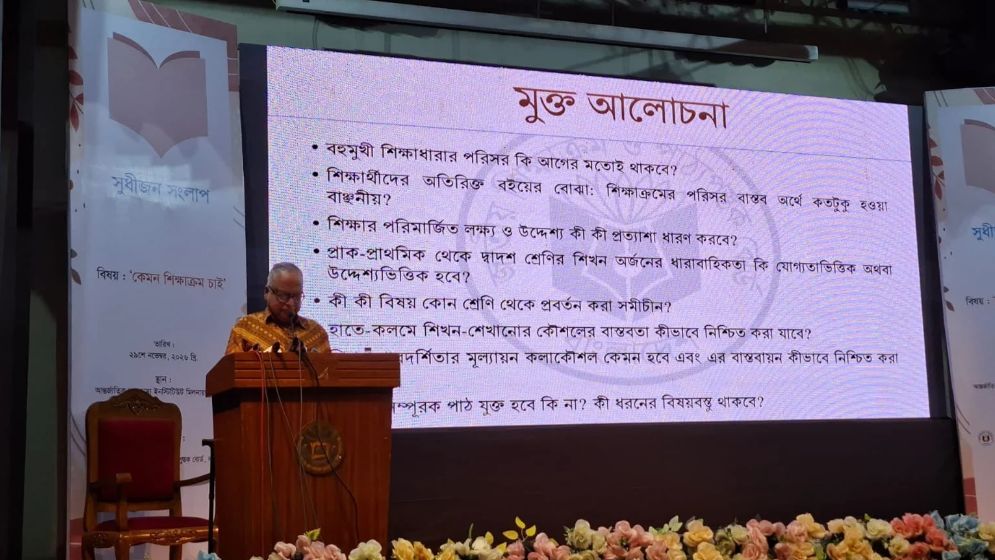
Photo: Daily Sun
Experts have stressed the need to integrate different branches of knowledge, ensure quality teachers, expand practical and technical education, and incorporate voluntary activities into the new curriculum to develop students as well-rounded individuals with multidisciplinary knowledge.
They said education should not remain confined to textbooks and examinations but should be linked to real-life experiences.
At the same time, students should be taught to ask the right questions, develop ethical and human values, and acquire skills relevant to their future careers.
The experts made the recommendations at a dialogue titled ‘Dialogue with Eminent Citizens: What Kind of Curriculum Do We Want?’ organised by the National Curriculum and Textbook Board (NCTB) at the auditorium of the International Mother Language Institute in the capital on Sunday.
The dialogue was organised to review and develop the national curriculum from pre-primary to Class XII.
National Professor Mahbub Ullah said students should have opportunities to gain knowledge in different disciplines, including linguistics, philosophy, history and mathematics, even if they specialise in a particular subject.
“Like the scholars of the Renaissance, we need to develop an education system that can produce people with multidisciplinary knowledge and bring students closer to becoming all-rounders.”
He said one of the major challenges facing the country's education system was the shortage of quality teachers. Without good teachers, even an improved curriculum and quality textbooks would not deliver the expected results.
He stressed the need to ensure teachers' professional competence, ethics and sense of responsibility while encouraging students to develop an interest in learning.
Instead of encouraging students to memorise answers, they should be taught how to ask the right questions and become good human beings, he added.
Mahdi Amin, the prime minister's adviser on education and primary and mass education and spokesperson for the Prime Minister's Office, said the government aimed to introduce a comprehensive and modern curriculum across the country by 2028, with preparations already underway.
However, it was not possible to make all necessary changes to textbooks for the 2027 academic year due to time constraints.
The government plans to undertake more extensive revisions for the next academic year while developing a comprehensive curriculum for implementation in 2028, he said.
Mahdi said the opinions of eminent educationists, experts and people directly involved in educational activities at the grassroots level were being given importance in developing and implementing the new curriculum.
“The main objective of the new curriculum is to develop students not merely as certificate holders but as skilled and productive individuals with strong moral values who can become responsible citizens,” he said.
State Minister for Primary and Mass Education Bobby Hajjaj said the curriculum must be designed with the future job market in mind.
“Those who are in Class I today will complete higher secondary education in 12 years and postgraduate studies in 16 years. We must consider what the job market will look like at that time while designing today's curriculum.”
He said the prime minister's vision placed emphasis on moral education, sports and joyful learning.
“Textbooks constitute only a small part of the curriculum. The curriculum must be designed as a complete package so that students can learn everything they need while at school,” he added.
Shaykh Ahmadullah, chairman of As-Sunnah Foundation, proposed two major changes to the curriculum.
He stressed practical, technical and skill-based education and called for at least 20% of the curriculum to be devoted to voluntary activities.
He said opportunities should be created for students to engage in voluntary work in areas such as agriculture, environmental protection and technical education. This would allow them to apply their theoretical knowledge in real-life situations.
He also called for internship opportunities at industrial establishments for students pursuing technical education.
NCTB Chairman Fakhrul Mawla said they wanted a curriculum that would strengthen students' foundational knowledge and skills while helping them become humane, creative, patriotic, responsible and competent citizens.