


 For all latest news, follow the Daily Sun's Google News channel.


15-yr HSIA 3rd terminal pact with Japanese consortium today
Daily Sun Report, Dhaka
Published: 30 Nov 2026, 12:00 AM
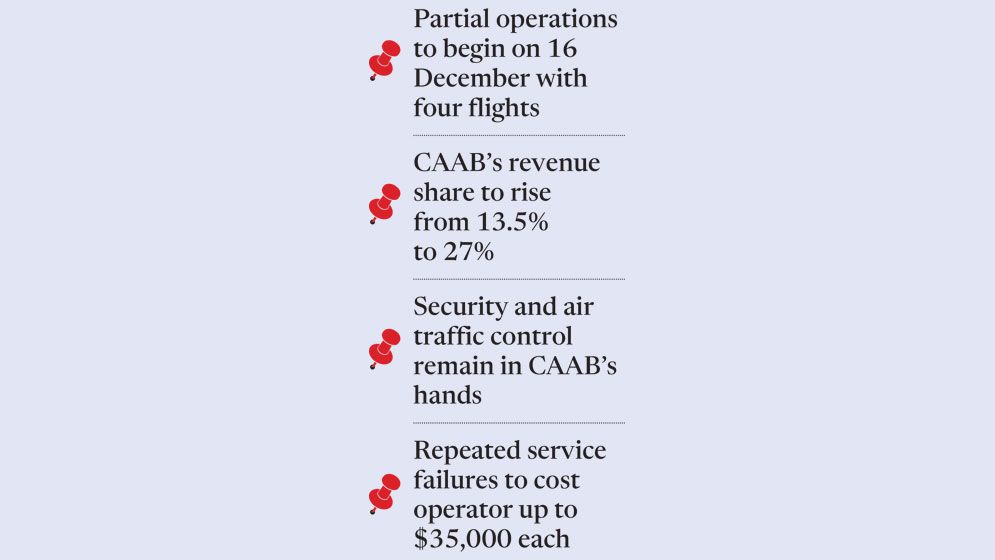
The Civil Aviation Authority of Bangladesh (CAAB) is set to sign a 15-year concession agreement with a Japanese consortium today to run Hazrat Shahjalal International Airport’s (HSIA) third terminal, clearing the way for partial operations from 16 December under a deal that fixes revenue shares, service standards and penalties.
CAAB Chairman Air Vice Marshal Md Mostafa Mahmud Siddiq told a press conference in Dhaka on Sunday that the agreement followed lengthy negotiations, technical and financial assessments and legal scrutiny. The government had prioritised national interests, airport security and international passenger service standards, he said.
The terminal will initially handle four flights, with all scheduled international passenger and cargo operations targeted for transfer within 14 months of handover. The concession area will be handed over within 15 days of signing, and the terminal is expected to handle at least 25% of regular international flights within eight months thereafter. The 15-year term will begin once all such flights have moved.
The consortium will operate and repair the terminal, multi-level car park and new cargo terminals at its own expense, installing equipment and expanding infrastructure as required. It will pay CAAB 13.5% of total passenger and cargo revenue from the start of agreed operations, rising to 27% once the terminal reaches prescribed or actual full capacity, whichever comes first.
CAAB will retain control of key airside operations and security, including air traffic control, screening and firefighting. Government agencies will continue to handle immigration, customs and health checks.
Biman Bangladesh Airlines will provide ground handling alongside an international operator. Ground handlers, including self-handlers, will pay royalties to the consortium, as will Biman for cargo handling.
Under the service standards, the first checked bag must reach the belt within 15 minutes of an aircraft stopping. The last must arrive within 42.5 minutes for narrow-body aircraft and 47.5 minutes for wide-body aircraft. Check-in waiting times will also be capped, while key systems must remain operational 95% to 98% of the time. Repeated failures will incur penalties of $5,000 to $35,000 each.
The 230,000-square-metre terminal can handle 24 million passengers annually and has 127 check-in counters and 12 boarding bridges. The new cargo terminals, with annual capacity of 820,411 tonnes, are expected to quadruple the airport’s cargo capacity.
Terminals 1 and 2 will eventually serve domestic, Hajj and other non-scheduled flights.