


 For all latest news, follow the Daily Sun's Google News channel.


Stakeholders stress long-term funding to protect Sundarbans
Daily Sun Report, Dhaka
Published: 29 Nov 2026, 09:12 PM
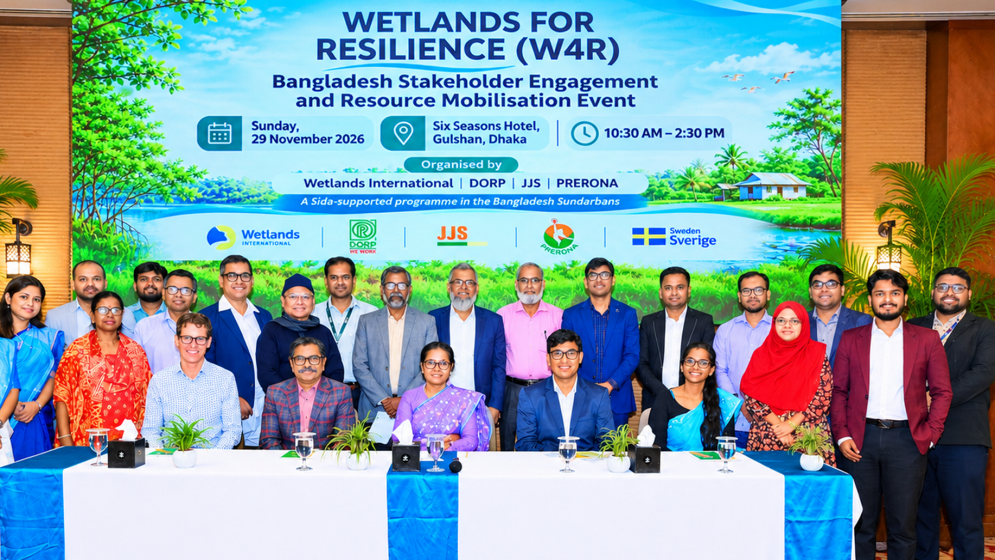
Photo: Courtesy
Stakeholders from government agencies, development partners,
research institutions and civil society have stressed the need for long-term
funding and stronger partnerships to protect the Sundarbans and coastal
wetlands while improving the livelihoods of vulnerable communities.
The views came at a stakeholder meeting titled “Stakeholder
Engagement and Resource Mobilisation,” organised by international NGO “Wetlands
International” at a hotel in Dhaka on Sunday.
The meeting focused on sharing research findings, reviewing
ongoing activities and identifying opportunities for future cooperation to
restore wetland ecosystems, strengthen climate resilience and promote
sustainable livelihoods in the Sundarbans region.
The event's concept note said the Sundarbans, the world's
largest continuous mangrove forest, plays a vital role in conserving
biodiversity, supporting local livelihoods and protecting coastal communities
from climate-related disasters.
However, rising salinity, tidal flooding, river erosion,
changes in water flow and livelihood uncertainty are threatening the ecosystem
and the people dependent on it.
To address these challenges, the Wetlands for Resilience
(W4R) programme is being implemented with support from the Swedish
International Development Cooperation Agency (SIDA).
The programme aims to strengthen coastal wetland ecosystems
and community resilience through ecosystem-based adaptation, participatory risk
assessments, sustainable livelihood initiatives and institutional cooperation.
Wetlands International South Asia (WISA) is implementing the
programme in Bangladesh, with the Development Organisation of the Rural Poor
(DORP), Jagrata Juba Shangha (JJS) and Prerona as local partners.
Activities are being carried out in Bagerhat, Khulna,
Satkhira and Barguna, focusing on research, local capacity building and
practical solutions for vulnerable communities.
The meeting also presented findings from the Ecosystem
Services and Vulnerability Assessment (ESSVA), policy and institutional
reviews, and technical assessments conducted under the programme.
Participants discussed the progress and challenges of
ongoing initiatives and explored ways to coordinate with government development
programmes and other organisations.
They also stressed the importance of securing new funding
and partners to sustain successful initiatives and expand them to other
vulnerable areas.
The meeting was attended by Siltana Jesmin Jui, MP, as the
chief guest. Mustafizur Rahman of SIDA, Sarkar Rofikul Alam, deputy director of
the Department of Fisheries, and Jeroen Jurriens of Wetlands International,
were present as special guests.
Mohammad Zobair Hasan, deputy executive director of DORP,
moderated the programme.