


 For all latest news, follow the Daily Sun's Google News channel.


5.4GW solar power can be generated on unused land of fossil-fuel-run plants: Study
Daily Sun Report, Dhaka
Published: 29 Nov 2026, 06:46 PM
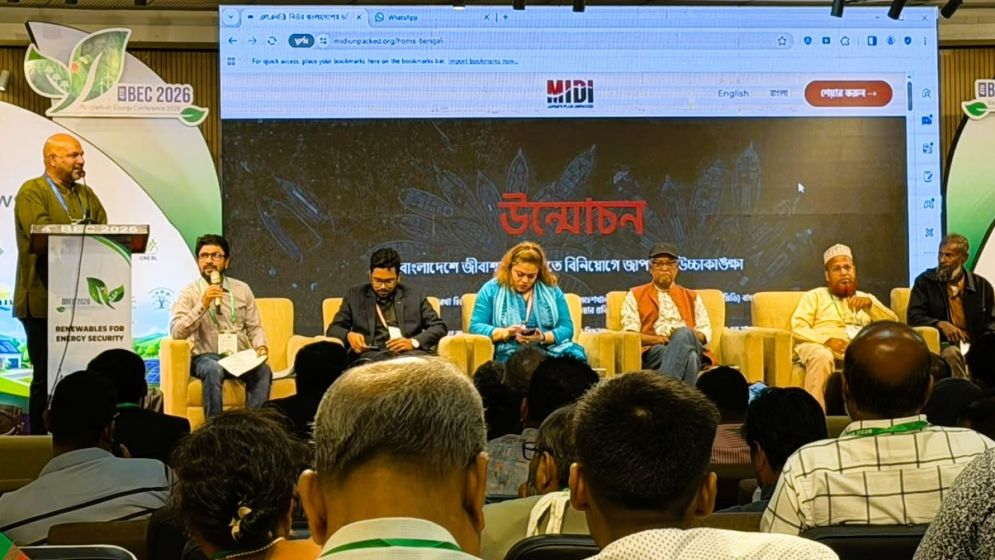
Photo: Courtesy
Bangladesh could generate more than 5,461 megawatts (MW) of
solar power by utilising unused land acquired for coal-fired power plants and
an LNG power hub, offering a major opportunity to expand renewable energy and
reduce dependence on imported fossil fuels, according to a new study.
The study found that 13 coal-fired power plants and an LNG
power hub have a combined 14,166 acres of unused land, of which 12,039 acres
are suitable for solar installations.
The Moheshkhali upazila in Cox’s Bazar alone has the
potential to accommodate 2,023MW of solar generation. The upazila hosts the 1,200MW
Matarbari coal-fired power plant, and the infrastructure needed for two nearby
offshore LNG terminals.
If developed, the proposed solar projects could save around
Tk3,15,519 crore, equivalent to $25.27 billion in LNG import costs over 20
years. They could also prevent an estimated 154.8 million tonnes of carbon
dioxide emissions compared with generating an equivalent amount of electricity
from coal.
A research officer of the Coastal Livelihood and
Environmental Action Network (CLEAN) presented the findings at the 4th
Bangladesh Energy Conference in Dhaka on Sunday.
The findings come amid growing concerns over the financial
burden of fossil fuel imports. Bangladesh spent Tk34,000 crore on LNG subsidies
between March and September this year, speakers said at the conference.
Experts urged the government to reconsider plans for new LNG
terminals and prioritise renewable energy expansion to reduce import dependence
and contain long-term costs.
A separate study presented at the conference found that the
Asian Development Bank, Asian Infrastructure Investment Bank and World Bank
Group provided a combined $15.245 billion in financing to Bangladesh's energy
sector between 2000 and 2026.
Of the total, $3.909 billion went to gas-fired power
generation projects with a combined capacity of 6,485MW. The study estimated
that these plants could emit between 190.41 million and 404.61 million tonnes
of greenhouse gases, measured in carbon dioxide equivalent (CO₂e), over their
operational lifetimes.
The associated social cost of carbon was estimated at
between $9.19 billion and $19.53 billion, highlighting the potential long-term
climate and economic costs of fossil fuel-based investments.
The conference also highlighted concerns over the Moheshkhali
Integrated Development Authority (MIDA) Act, 2026, particularly the
concentration of executive powers, environmental clearance, public consultation
and the authority of local government institutions.
A writ petition filed in August challenged nine provisions
of the Act, raising concerns over environmental safeguards, public
participation and accountability. On 25 August, the High Court Division issued
a rule in response to the petition.
Speakers stressed that development initiatives must protect
local communities' land rights, livelihoods, environment and constitutional
rights.
On the occasion, the Bangladesh Working Group on Ecology and
Development (BWGED) launched an online platform, MIDI Unpacked
(www.midiunpacked.org), featuring information, research and legal analyses on
the MIDA Act and fossil fuel-based energy projects in Moheshkhali.
Participants also called for greater involvement of local
government institutions in accelerating the renewable energy transition. They
said rooftops of public buildings, markets, hospitals and educational
institutions owned by union parishads, municipalities and city corporations
could be used to expand decentralised solar power generation.
They also highlighted the importance of net metering,
financial incentives, public-private partnerships and community-owned solar
systems through farmers' cooperatives. Such initiatives could create local jobs
and strengthen technical capacity at the grassroots level.
The three-day conference, being held at the Bangladesh
Military Museum in Dhaka from November 28 to 30, is themed “Renewables Are
Indispensable for Energy Security”. More than 350 national and international
stakeholders are taking part.
Organised by BWGED in collaboration with 14 organisations,
the conference features 13 sessions on energy policy, institutional reforms,
fossil fuel expansion, transition financing, regional cooperation, industrial
decarbonisation and the role of development banks and local governments in
renewable energy expansion.