



 For all latest news, follow the Daily Sun's Google News channel.


Bangladesh seeks faster action to end child marriage
UNICEF Representative in Bangladesh Emmanuelle Abrioux called for sustained investment in girls' education
Daily Sun Report, Dhaka
Published: 29 Nov 2026, 05:42 PM
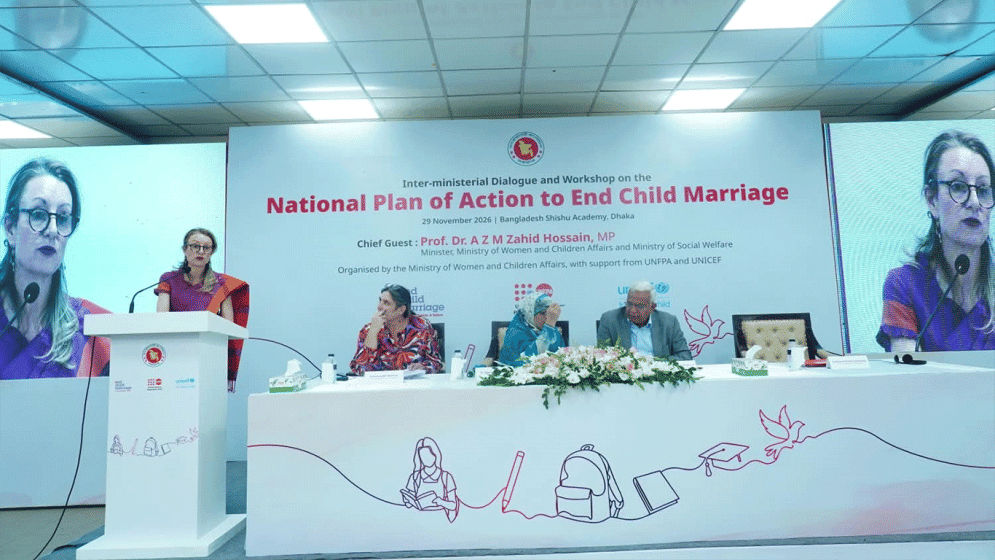
Photo: Daily Sun
Bangladesh needs to accelerate efforts to end child marriage fourfold to meet its target of reducing the rate among young women from 47.2% to 35% by 2030, as the government and UN agencies have called for stronger coordination and wider implementation of preventive measures.
The Ministry of Women and Children Affairs, in
partnership with UNFPA and UNICEF, made the call at an inter-ministerial
dialogue and workshop at the Bangladesh Shishu Academy in Dhaka on Sunday.
Representatives from 25 government ministries and
agencies attended the event to review the National Plan of Action to End Child
Marriage (NAPECM) and identify ways to turn existing commitments into
measurable results.
According to the latest national data presented by
the ministry and the Bangladesh Bureau of Statistics, 47.2% of women aged 20-24
were married before the age of 18, down from 51.4% in 2019. The data also
showed that 13.4% of young women in the age group were married before turning
15.
Participants noted that the average annual decline
of less than one percentage point was too slow to meet the 2030 targets,
leaving millions of girls at risk.
The discussions focused on five key areas of the
national action plan: responsive sector policies, legal reform, changing
harmful social norms, empowering adolescents and expanding targeted social
protection services.
Participants called for wider implementation of
proven initiatives, including school stipend programmes, community-based child
protection systems and the Social Protection Plus initiative, alongside
stronger legal safeguards.
Speaking at the event, Women and Children Affairs
and Social Welfare Minister Professor Dr Abu Zafar Md Zahid Hossain said ending
child marriage required coordinated leadership across all sectors of
government.
"Through this dialogue, the ministry is working
closely with partner ministries to turn commitment into action to ensure
integrated support for every adolescent girl in Bangladesh," he said.
UNFPA Representative in Bangladesh Catherine Breen
Kamkong said child marriage deprived girls of their fundamental rights,
disrupted their education, endangered their health through early pregnancy and
held back entire communities.
She stressed the need to expand access to quality
education and skills development, challenge harmful social norms and address
legal gaps.
UNICEF Representative in Bangladesh Emmanuelle
Abrioux called for sustained investment in girls' education, stronger child
protection systems, supportive families and empowered communities.
She said keeping girls in school and ensuring
protection services reached those most at risk were essential to accelerating
progress.
The dialogue also reviewed legal safeguards under
the Child Marriage Restraint Act 2017. Participants recommended reviewing
exemptions under Section 19, preventing the criminalisation of child victims,
ensuring the Act takes precedence over other marriage laws and making digital
birth registration-based age verification mandatory before marriage.
Participating ministries agreed to strengthen
inter-ministerial accountability and monitoring and expand successful pilot
initiatives into nationwide prevention and protection programmes through 2030.
The initiative comes after the first observance of
the International Day for the Elimination of Child, Early and Forced Marriage
on 27 November, under the global theme of keeping promises and accelerating
action to end child marriage by 2030.